 tap
The short answer
You may not need a water filter. Start with your water source, current report or test result, any home-specific plumbing concern, the outcome you want, and the exact reduction claim of the filter you are considering. Buy only when those five pieces form a clear line from problem to solution.
| If this sounds like you | Best next move | What decides it |
|---|---|---|
| Your utility report shows no issue and you only dislike the taste | Define the taste problem before buying | A modest certified taste-and-odor filter may be enough; a whole-house system is unlikely to be the first move. |
| A certified lab found a specific contaminant | Get help interpreting the result | Choose treatment only after matching the exact contaminant, concentration and treatment location. |
| You have no report or reliable test | Find the missing information first | A product quiz cannot tell you what is in your water. |
In this guide
- Begin with the water source, not a filter type
- Check 1: Is there an advisory or confirmed health concern?
- Check 2: What does the report or test actually show?
- Check 3: Could the concern be inside the home?
- Check 4: What outcome do you want?
- Check 5: Does the exact model make the needed claim?
- When skipping the filter is a reasonable decision
- Sources & editorial notes
Begin with the water source, not a filter type
A home on a public water system and a home on a private well start in different places. Public systems provide an annual Consumer Confidence Report, often called a water quality report. Private-well owners are responsible for arranging appropriate testing and keeping the results.
Write down which source serves the home before looking at products. If you do not know, check the water bill, property records or ask the local authority. This one fact determines whether your first document should be a utility report or a laboratory result.
Check 1: Is there an advisory or confirmed health concern?
If your utility or health department has issued an advisory, follow that notice rather than a general shopping guide. If a qualified laboratory has found a harmful germ or chemical in well water, contact the local health department for advice about safe water and the next step.
Do not assume that an ordinary pitcher cartridge makes an advisory or confirmed contamination safe. CDC advises choosing a system that addresses the particular germ or chemical of concern. A filter label must support that exact job.
Check 2: What does the report or test actually show?
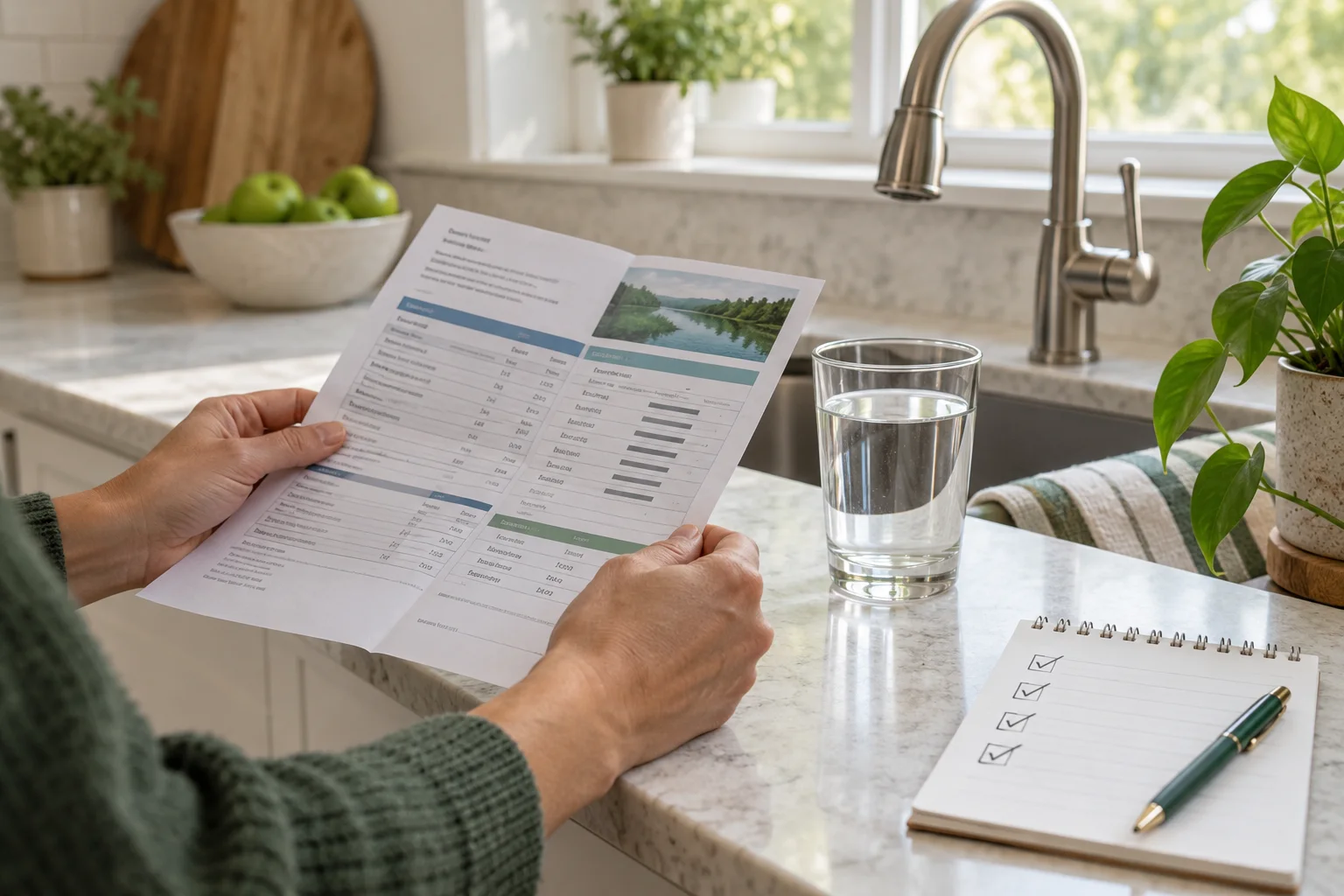
For city water, read the current report for your service area and note any violation, action-level information, disinfectant used and detected substances relevant to your question. For a private well, use an appropriate state-certified laboratory and the testing advice of your local health department.
Taste, odor and color can point to a nuisance worth investigating, but they do not prove that water is safe or unsafe. Some harmful substances have no obvious taste, smell or appearance. Start with evidence, not a before-and-after photograph in an advertisement.
Check 3: Could the concern be inside the home?
A utility report describes the public system; it is not a sample from every kitchen tap. Service lines, older plumbing, fixtures, a water heater or neglected treatment equipment can create a home-specific question. Lead is a familiar example because it commonly enters water through plumbing materials.
If the concern is tied to one home, one tap or a recent plumbing change, ask the utility, local health department or certified laboratory about property-specific testing. Buying a larger whole-house filter before locating the problem can add maintenance without answering the question.
Check 4: What outcome do you want?
Separate a safety concern from a preference. Reducing a measured contaminant, improving chlorine taste, controlling scale and removing sediment are different jobs. One product may handle more than one job, but no general “clean water” promise proves that it handles yours.
Write one sentence: “I want to reduce ___ in water used for ___.” If you cannot complete that sentence, you are not ready to compare systems. The blank may reveal that you need information, plumbing work or a water softener rather than a drinking-water filter.
| Your goal | Evidence to collect | Likely scope to compare |
|---|---|---|
| Improve taste or odor | Utility report plus a clear description of the problem | A certified taste-and-odor option at the drinking tap may be enough |
| Address a measured drinking-water concern | Exact result, units and professional interpretation | Point-of-use treatment first unless exposure elsewhere matters |
| Treat a problem at many fixtures | Result, household flow and installation constraints | Whole-house treatment only when the problem and method justify it |
| Reduce mineral scale | Hardness result and appliance symptoms | Softening or scale-management options, not a generic filter |
Check 5: Does the exact model make the needed claim?
A certification standard number by itself is not the final answer. Look up the exact brand and model in an independent certification directory and confirm the specific reduction claim that matches your concern. A model certified for chlorine taste is not automatically certified for lead, PFAS, nitrate or germs.
Also check capacity, required water conditions, replacement parts and maintenance. A suitable filter that is not replaced or serviced as required may become an expensive false reassurance. Save the performance sheet and replacement model numbers before ordering.
When skipping the filter is a reasonable decision
If the report or appropriate testing does not show a harmful substance, the household accepts the taste, and there is no property-specific concern, doing nothing can be a reasonable decision. CDC states that if tap water does not contain harmful germs or chemicals, a filter may not be needed.
You might still choose treatment for taste or convenience. Call it a preference purchase, keep the system proportionate and include replacement cost. The honest goal is not to own the most equipment; it is to solve the problem you can actually name.
Put this guide to work
Compare the full cost, not only the selling price
Use the matching tool, save the result to My Home Water Plan and return when a quote, test result or service date changes.
Open the tool →Open My Water Plan →Get the editable pack →How we checked this guide
Independent decision guide based on current CDC, EPA and NSF consumer guidance. It does not diagnose a property or replace an advisory, laboratory interpretation or qualified professional assessment.
- CDC: About choosing home water filters
- EPA: Protect your home's water
- EPA: Understanding your water quality report
- EPA: Basic information about lead in drinking water
- NSF: Home water treatment systems and solutions
- NSF: Certified drinking-water treatment unit directory
Product details can change. Confirm the exact model and current terms before ordering. How we write and update guides.