 tap
The short answer
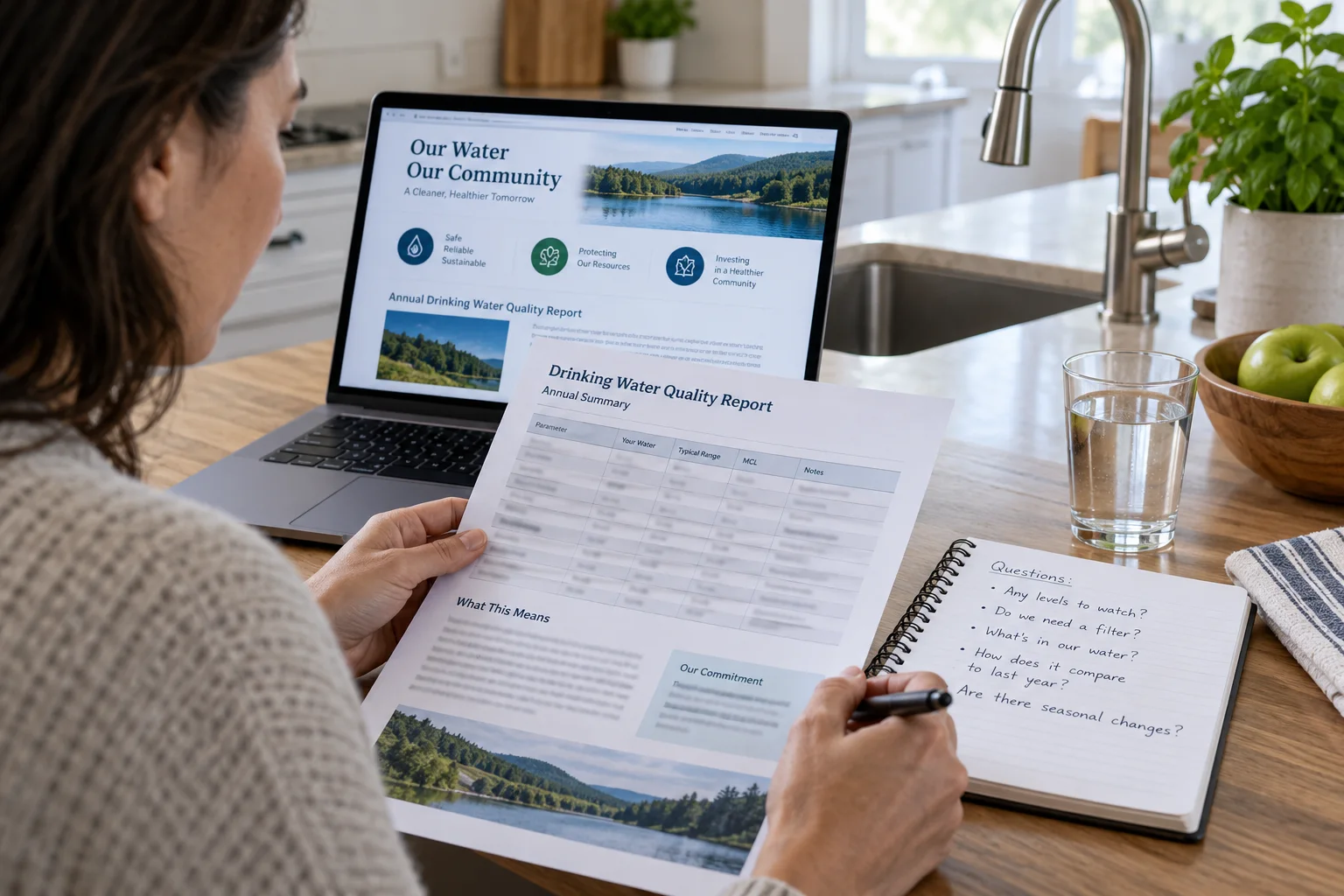
Use the report to confirm your water source, the correct service area, detected contaminants, comparison limits, violations and disinfectant. Then separate system-wide information from questions that may require a sample from your own tap. The report narrows the shopping decision; it does not automatically prove that you need a filter.
| If this sounds like you | Best next move | What decides it |
|---|---|---|
| The report shows no violation and you have no home-specific concern | Do not treat detection alone as a reason to buy | Decide whether you still have a defined taste or preference goal. |
| The report lists a violation or current notice | Follow the utility or health authority instructions | A general filter article does not replace an official notice. |
| Your concern could come from the service line or home plumbing | Ask about property-specific testing | System sampling may not describe your exact kitchen tap. |
In this guide
- Find the correct report and service area
- Start with the source and treatment summary
- Learn the five labels that make the table readable
- Read one contaminant row from left to right
- Treat violations and official notices differently from ordinary detections
- Know what the report cannot tell you about your tap
- Turn the report into a short buying brief
- Sources & editorial notes
Find the correct report and service area
Community water systems provide a Consumer Confidence Report each year. Start with the utility named on your bill and confirm the report year. If the utility operates separate service areas or sources, make sure you are reading the section that serves your address.
EPA provides a report finder, but some utilities publish reports on their own sites. Renters who do not receive a water bill can ask the property manager which system serves the building and request the current report. Private-well owners do not receive this report and need their own testing plan.
Start with the source and treatment summary
Look for the source-water description: river, reservoir, aquifer or another supply. Then find the utility’s treatment and disinfectant information. Chlorine and chloramine are not interchangeable shopping terms; if taste reduction is your goal, identify which disinfectant the utility reports.
Note any source-water assessment or vulnerability information, but do not turn a regional possibility into a claim about your tap. The detected-contaminant table and current notices carry more decision weight than a long list of substances that could theoretically reach the source.
Learn the five labels that make the table readable
The report defines its abbreviations, usually near the table. Read those definitions in the report you are using. The same row can contain a health goal, an enforceable limit, a measured value and a range; comparing the wrong columns can create unnecessary alarm or false reassurance.
| Label | What it means | How to use it |
|---|---|---|
| MCLG | A non-enforceable health goal | Context for the health goal, not the system’s measured result |
| MCL | The highest level allowed under the regulation | Compare it with the reported compliance value and violation status |
| MRDL or MRDLG | Limit or goal for a disinfectant residual | Use it when reading chlorine or chloramine information |
| TT | A required treatment technique | Check whether the report identifies a treatment-technique violation |
| AL | A level that triggers required action when the rule’s conditions are met | Do not treat it as a simple universal pass/fail number for one home |
Read one contaminant row from left to right
Name the contaminant, then note the unit. Find the value reported for the system, the detected range, the comparison value, sample date and violation column. Finally read the typical source and any health-effects language. Keep the row intact when taking notes.
Units matter. A value in parts per billion cannot be compared directly with a product claim written in parts per million unless the values are converted correctly. If the report is unclear, ask the utility to explain the row rather than relying on an online calculator with missing context.
Treat violations and official notices differently from ordinary detections
The presence of a detected substance does not automatically mean the system violated a drinking-water requirement. Check the violation column and the utility’s explanatory text. A violation, treatment-technique issue or active advisory should lead you to the utility’s instructions and local health guidance.
Do not substitute a filter selected from a generic list for those instructions. The required action may depend on the substance, duration, affected service area and household circumstances. Save the notice and note when the utility says it was resolved.
Know what the report cannot tell you about your tap
The report summarizes monitoring for the public system. It does not test every house, and some issues can arise in service lines, building plumbing, fixtures or neglected treatment equipment. Lead information is especially easy to misread: the reported 90th-percentile value comes from the system’s sampling program and is not a laboratory result for your own faucet.
If your concern is specific to the building, ask the utility or local health department about the right sampling approach and use a state-certified laboratory where appropriate. Keep the report because it provides the system context for interpreting a home sample.
Turn the report into a short buying brief
Write down only the findings related to your goal: the disinfectant for a taste complaint, the exact contaminant for a health concern, or the reason a home-specific sample is needed. Then decide whether treatment is needed at drinking taps or throughout the home.
When comparing a product, look up the exact model in a certification directory and match its reduction claim to the concern. If the report shows no relevant concern and you have no property-specific reason to test, a filter may be optional rather than necessary.
- Utility and service area
- Report year and water source
- Disinfectant used
- Relevant detected result and unit
- Violation or advisory status
- Home-specific question still unanswered
- Exact reduction claim to verify
Put this guide to work
Compare the full cost, not only the selling price
Use the matching tool, save the result to My Home Water Plan and return when a quote, test result or service date changes.
Open the tool →Open My Water Plan →Get the editable pack →How we checked this guide
Independent report-reading guide based on EPA Consumer Confidence Report requirements and EPA and CDC consumer guidance. It does not interpret a utility notice or an individual tap-water result.
- EPA: Understanding your water quality report
- EPA: Find your local Consumer Confidence Report
- EPA: Basic information about lead in drinking water
- EPA: What the lead and copper 90th percentile means
- CDC: About choosing home water filters
Product details can change. Confirm the exact model and current terms before ordering. How we write and update guides.