The short answer
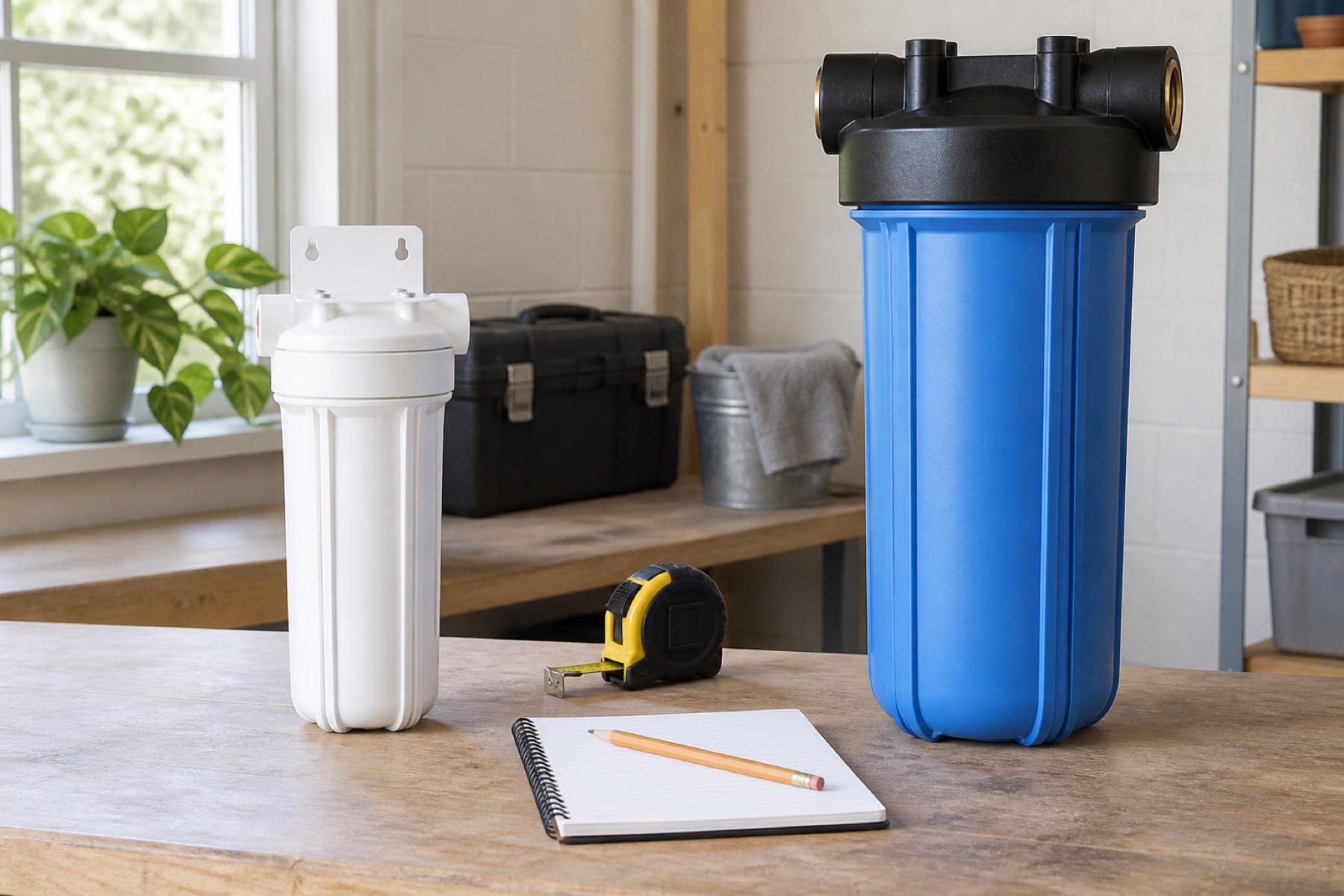
An under-sink system treats water at one location. A whole-house system treats water entering the home. Choose the location and treatment around a specific water-quality result or goal—not the size of the advertised filter.
The decision at a glance
Where the treatment happens
Whole-house
- Incoming supply→
- Entry-point treatment→
- Downstream outlets
Under-sink
- Kitchen supply→
- Treatment at one location→
- Selected outlet
| Your situation | A sensible next step | Keep in mind |
|---|---|---|
| Drinking-water concern at one tap | Investigate point-of-use treatment | Match certification to the substance of concern. |
| Problem affects water throughout the home | Assess whole-house treatment | Check flow, installation and maintenance requirements. |
| No identified problem | Clarify the goal first | You may not need a treatment system. |
In this guide
Start with the result you actually want
Before comparing brands, finish this sentence: “I want to change ___ in the water used for ___.” It might be a taste preference at the kitchen sink, or a laboratory finding that needs professional interpretation. Those are different buying decisions.
CDC advises matching treatment to what is in the water and checking the system’s label for the specific substances it removes. Clear water and a reassuring product name don’t establish that match.
Choose the location before the product
The location determines which water is treated. It does not, by itself, tell you what the equipment removes. A whole-house carbon filter, a softener and a drinking-water reverse-osmosis system do different jobs.
Our advice: write down the taps or uses that need treatment. Ask an installer to explain why the proposed equipment belongs at the supply entry or a particular outlet. If the answer is only “more protection,” ask for the specific reason.
Compare ownership costs on the same basis
Request two itemized quotes using the same time horizon. Include installation, replacement cartridges or media, routine service and any additional work. A low equipment price can be misleading if consumables or access are expensive.
Example: when comparing two suitable options over five years, add the upfront cost to five years of expected consumables and servicing. Use the manufacturer’s replacement guidance and your actual local quotes; don’t assume all cartridges last a year.
- Exact model and independently certified reduction claims
- Installation scope, including any electrical or plumbing changes
- Consumable part numbers, availability and replacement triggers
- What happens when a cartridge is exhausted or service is overdue
When neither option is the next purchase
If you don’t yet know the cause of the concern, the next step may be your water supplier, a laboratory or a qualified water-treatment professional. Buying a larger system does not compensate for choosing the wrong treatment.
A renter should also settle permission and installation constraints before shortlisting permanent equipment. A suitable solution you can maintain and remove may be more practical than a more elaborate setup.
Take this question to the seller
“Which result in my water report does this exact model address, where is that claim verified, and what will it cost me to keep it working?”
Keep the answer with your quote. If a seller won’t specify the model, the claim or the maintenance cost, you don’t yet have enough information to compare the offer.
A five-year quote comparison you can reuse
Compare only options that address the same verified water-quality goal. Use this formula: equipment + installation + replacements during the period + servicing during the period. Add electricity or water costs where relevant.
Here is a fictional budgeting example, not market pricing: Option A costs $450 installed and needs $90 of replacements in each of five years, totaling $900. Option B costs $700 installed and needs $45 a year, totaling $925. The $250 upfront difference becomes $25 over five years, before any other costs. Replace every figure with the exact model’s quote and replacement schedule.
| Ask for this | Option A | Option B |
|---|---|---|
| Exact model and certified reduction claim | Record the listing, not just a logo | Compare the same contaminant claim |
| Total installed price | Include additional plumbing or power | Identify what the quote excludes |
| Replacement schedule | Use service life and usage guidance | Do not assume a yearly replacement |
| Five-year cost | Add only replacements due in this period | Compare like-for-like water treatment |
Put this guide to work
Compare the complete ownership cost
Use the free tool, then download a record you can keep. No email required.
Open the tool →Get the editable pack →Sources & editorial notes
This guide combines published information with our suggested decision process. It does not report hands-on product testing or an assessment of your property.
- CDC: Home water treatment systems
- NSF: certification applies to specific reduction claims; standard numbers are not rankings
Product details can change. Confirm the exact model and current terms before ordering. How we write and update guides.