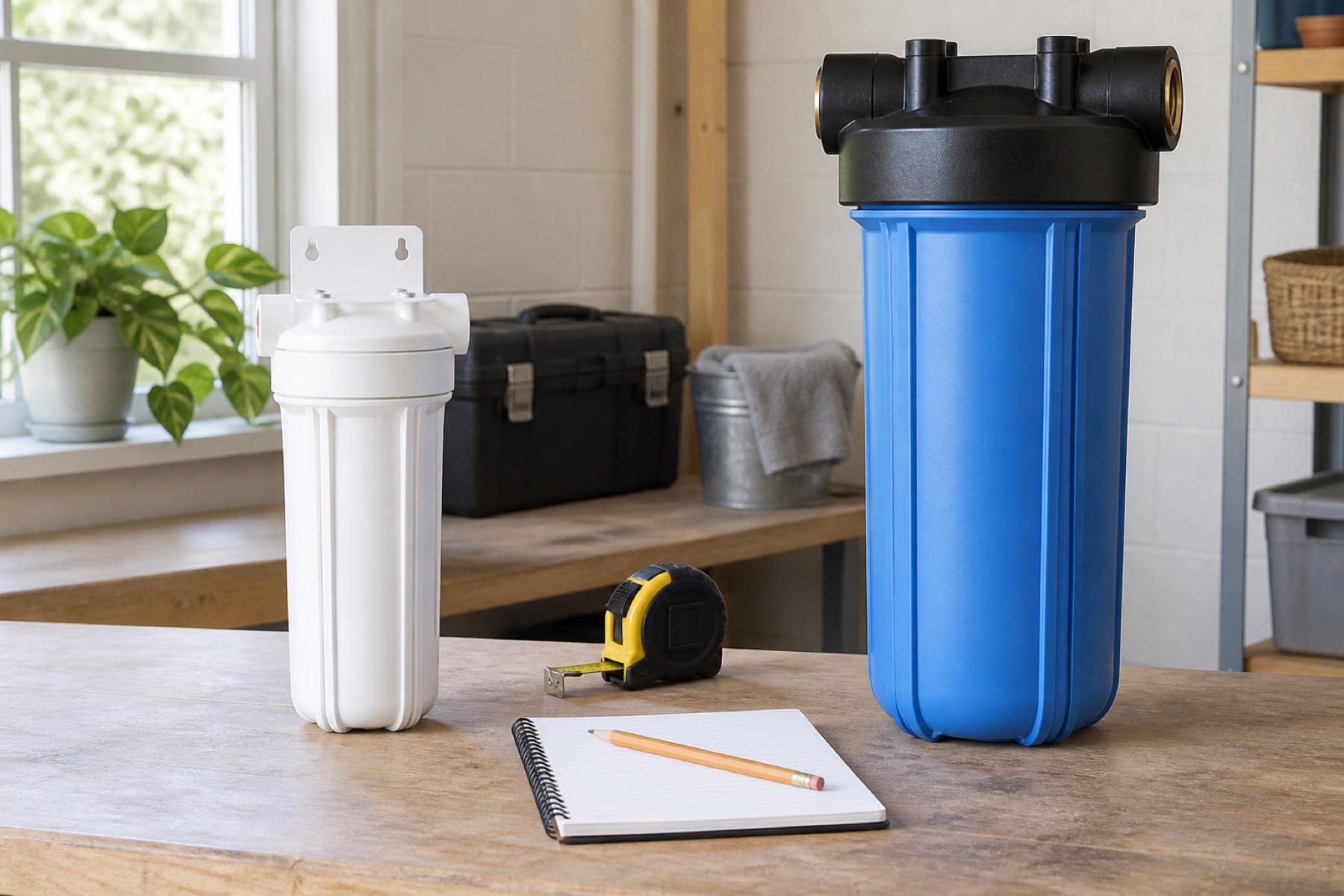
The short answer
For ordinary chlorinated municipal water, SpringWell CF1 is the stronger high-flow starting point for a one-to-three-bathroom home when its 9-gpm service rating fits. Aquasana Rhino EQ-1000 is the stronger documentation-led option when its independently tested NSF/ANSI 42 chlorine data and 7-gpm rated flow fit the household. Kind E-1000 is the compact cartridge candidate when wall mounting and visible replacement intervals matter most. Confirm that your utility uses free chlorine rather than chloramine before choosing from this list.
The decision at a glance
Three formats for free chlorine
SpringWell CF1
- Tank media→
- 9-gpm service flow→
- 6–9 month prefilter
Aquasana EQ-1000
- Model-level chlorine data→
- 7-gpm rated flow→
- Package-specific upkeep
Kind E-1000
- Wall-mounted cartridges→
- Compact floor footprint→
- 6–12 month replacements
| Your situation | A sensible next step | Keep in mind |
|---|---|---|
| Want higher published service flow | SpringWell CF1 | Verify the exact chlorine documentation and sizing. |
| Want model-level NSF/ANSI 42 chlorine data | Aquasana EQ-1000 | Make sure 7 gpm fits peak demand. |
| Want compact wall-mounted cartridges | Kind E-1000 | Budget replacements and check flow as filters load. |
In this guide
- Our shortlist and why it is situational
- First confirm the utility uses chlorine
- Best overall fit for higher flow: SpringWell CF1
- Best documentation-led alternative: Aquasana EQ-1000
- Best compact cartridge candidate: Kind E-1000
- Flow can eliminate a candidate before price does
- Capacity headlines need conditions
- Installation footprint and access
- Five-year ownership comparison
- Do you need whole-house treatment?
- Hard water is a separate decision
- What we did not rank
- Who should choose each system
- Three homes, three different winners
- How to compare chlorine evidence
- A five-year shortlist scorecard without fake ratings
- Questions readers ask before choosing
- Final buying checklist
- Sources & editorial notes
Our shortlist and why it is situational
These three systems use different formats. SpringWell CF1 is a media tank with a sediment prefilter, Aquasana EQ-1000 is a Rhino tank system with documented chlorine data, and Kind E-1000 is a wall-mounted sediment-and-carbon cartridge train. The best choice depends on the home rather than a universal ranking.
Start with disinfectant, service flow, installation space and the type of maintenance the household will perform. A tank with a long main-media interval still has shorter routine components; a compact cartridge system saves floor space but makes recurring replacements more visible.
First confirm the utility uses chlorine
Read the current consumer confidence report or ask the utility whether the residual disinfectant is free chlorine or chloramine. Do not rely only on taste or smell. Some systems change practices, and chloramine requires a different level of scrutiny.
If the utility uses chloramine, move to the chloramine-specific shortlist. A chlorine performance sheet cannot be expanded into a chloramine claim because both words appear in a category description.
Best overall fit for higher flow: SpringWell CF1
SpringWell currently lists CF1 at 9-gpm service flow for one to three bathrooms, with a one-inch connection, 25-to-80-psi operating range and sediment prefilter replacement every six to nine months. The company lists one million gallons or ten years for the main media.
Choose it only when the household’s simultaneous demand fits and the exact treatment documentation supports the chlorine goal. The larger CF4 and CF+ raise published service flow, but bigger is not automatically more appropriate.
Best documentation-led alternative: Aquasana EQ-1000
Aquasana’s EQ-1000 performance sheet lists 7-gpm rated flow and one-million-gallon capacity and reports testing according to NSF/ANSI 42 for chlorine reduction. That model-specific sheet gives a buyer a clear claim and test context to examine.
The lower rated flow can be decisive in a busy house. Also separate EQ-1000 from Aquasana’s chloramine models and from bundles that add conditioning or UV. Compare the exact equipment, not only the Rhino family name.
Best compact cartridge candidate: Kind E-1000
Kind E-1000 uses a two-stage wall-mounted format with sediment and carbon cartridges. The current page lists replacement every six to twelve months depending on water quality and emphasizes a clear wall-space requirement rather than floor-standing tanks.
The tradeoff is recurring cartridge work and the need to verify model-level reduction documents for the exact concern. “NSF-certified components” should not be rewritten as a complete system certified for every advertised contaminant.
Flow can eliminate a candidate before price does
Build a realistic peak-use scenario: perhaps two showers and a kitchen faucet, or a shower and washing-machine fill. Ask each provider to calculate expected service and pressure through the complete system at that flow.
Compare service or rated flow on like terms. A peak-flow headline and a performance-sheet rated flow may describe different conditions. Ask for definitions rather than declaring the larger number the winner.
Capacity headlines need conditions
A gallon or year capacity belongs with the tested substance, flow, water conditions and replacement rule. It does not mean the system removes every listed substance equally for that entire period.
For cartridge systems, record the interval and current replacement set. For tank systems, record both the main media limit and shorter prefilter or postfilter schedule.
Installation footprint and access
CF1 and EQ-1000 need tank space plus room for prefilters, bypass and service. E-1000 needs several feet of clear wall and clearance to lower its housings. All require a safe, maintainable main-line installation.
Send providers the same dimensioned photographs. Ask for treatment order, bypass, isolation, connection size and protection from freezing or weather.
Five-year ownership comparison
List equipment, shipping, installation, valves, cartridges, media events and planned service. Do not compare a bare product cart with a fully installed proposal.
Use quantities before future prices. A long-life tank may shift cost upfront; cartridges spread purchases over time. The best fit is the schedule the household can maintain.
Do you need whole-house treatment?
If the concern is drinking-water taste at one tap, an under-sink filter may solve the defined problem with less equipment. Whole-house treatment becomes more relevant when the benefit is wanted in showers, cooking and multiple fixtures.
Write down where treated water is needed. EPA recommends treating only where necessary and avoiding oversized systems.
Hard water is a separate decision
None of these base filtration systems is a conventional ion-exchange softener. If hardness and chlorine both matter, add a separate softening or conditioning decision instead of assuming carbon treatment changes mineral hardness.
A combo may simplify purchasing but makes footprint and upkeep larger. Verify each stage independently.
What we did not rank
We did not score taste, skin feel or “water quality” from manufacturer reviews. Those experiences are difficult to compare and can be influenced by the incoming water, expectations and installation.
We also did not rank sale prices because they change. Use current quotes after the treatment and sizing shortlist is complete.
Who should choose each system
Choose CF1 when its 9-gpm service rating, tank layout and documentation fit. Choose EQ-1000 when its 7-gpm flow is enough and its specific chlorine performance sheet is persuasive. Choose E-1000 when compact cartridges and accessible replacements suit the home.
Choose none yet if disinfectant, demand or treatment location is unclear. That pause can prevent a high-ticket mismatch.
Three homes, three different winners
Home A has two bathrooms, a modest peak flow, free chlorine and a strong preference for a model-level performance sheet. Aquasana EQ-1000 can lead that shortlist because the chlorine documentation fits and 7 gpm may be adequate. The buyer still needs an installed configuration and maintenance budget.
Home B runs more fixtures together and wants a tank system. SpringWell CF1 moves ahead if its 9-gpm service rating fits and the homeowner is satisfied with its current chlorine support. Moving to CF4 should follow the calculated demand, not anxiety about pressure.
Home C has little floor space but a clear utility wall and accepts regular cartridge changes. Kind E-1000 becomes attractive after flow and exact chlorine evidence are confirmed. The best product changes because the constraints change.
How to compare chlorine evidence
Start with the exact model and reduction claim. Record whether the complete system is certified, independently tested to a standard, or made from certified components. These statements can all be legitimate, but they communicate different evidence.
Next record rated flow, capacity, influent challenge and replacement point where provided. A high percentage at a low flow cannot be compared casually with a different claim at a higher service flow. Ask for the original sheet rather than a cropped marketing graphic.
Finally match the evidence to the buying reason. If the homeowner cares about chlorine taste and odor, a relevant Standard 42 claim is useful. If another substance drives the purchase, require its own applicable documentation rather than assuming a chlorine filter handles it.
A five-year shortlist scorecard without fake ratings
Instead of assigning stars, mark each candidate as clear, unresolved or unsuitable for seven factors: disinfectant claim, service flow, pressure, installation, replacement plan, five-year quantities and return risk. A single unresolved critical factor should stop checkout.
Use the same household inputs for all three. Do not reward a brand because it publishes more lifestyle benefits, and do not punish a cartridge system merely because its maintenance is more visible. Compare the actual amount and difficulty of work.
The scorecard ends with choose, seek clarification or remove from shortlist. It does not create a universal winner or a decimal score that suggests testing we did not perform.
Questions readers ask before choosing
Is chlorine in city water unsafe? Utilities disinfect water to protect public health and must meet applicable standards. Many purchases are driven by taste, odor or preference. Define the reason without turning a buying guide into a health claim.
Can any carbon filter remove chlorine? Carbon is commonly used, but choose from complete-system documentation, flow and capacity. Loose media names do not establish household performance.
Will a whole-house filter soften water? These shortlisted base filters do not remove hardness by ion exchange. Handle hardness separately.
How much should installation cost? It varies with pipe, location, bypass, local labor and added stages. Obtain itemized local quotes rather than relying on a national number.
Which filter is cheapest long term? Compare five-year equipment, installation and replacements. The result changes with package and maintenance frequency.
Should I choose chloramine capability just in case? Buy for the utility’s current water and a defensible future need. Extra claims do not compensate for worse flow, cost or documentation.
Final buying checklist
Require these answers for the exact model.
- Free chlorine confirmed by the utility
- Model-specific reduction document
- Service flow and pressure at peak demand
- Pipe, bypass and installation scope
- Main media and cartridge replacement triggers
- Five-year quantities and current part numbers
- Return and warranty costs after installation
Products mentioned
We add a buying link only when an approved retailer or affiliate option is available. Always confirm the exact model, current price and availability.
SpringWell CF1
Check service flow, exact treatment claims and installation space.
Aquasana Rhino EQ-1000
Check the 7-gpm rated flow and exact bundle.
Kind E-1000
Check replacement sets, service flow and housing clearance.
Put this guide to work
Compare the complete ownership cost
Use the free tool, then download a record you can keep. No email required.
Open the tool →Get the editable pack →Sources & editorial notes
This situational buying guide compares current published specifications and performance documentation. We have not installed or performance-tested these products, so the shortlist rewards treatment fit and decision clarity rather than an invented score.
- SpringWell CF-series specifications
- Aquasana EQ-1000 performance data
- Kind E-1000 product and maintenance information
- NSF explanation of Standard 42
- EPA WaterSense treatment-selection guide
Product details can change. Confirm the exact model and current terms before ordering. How we write and update guides.