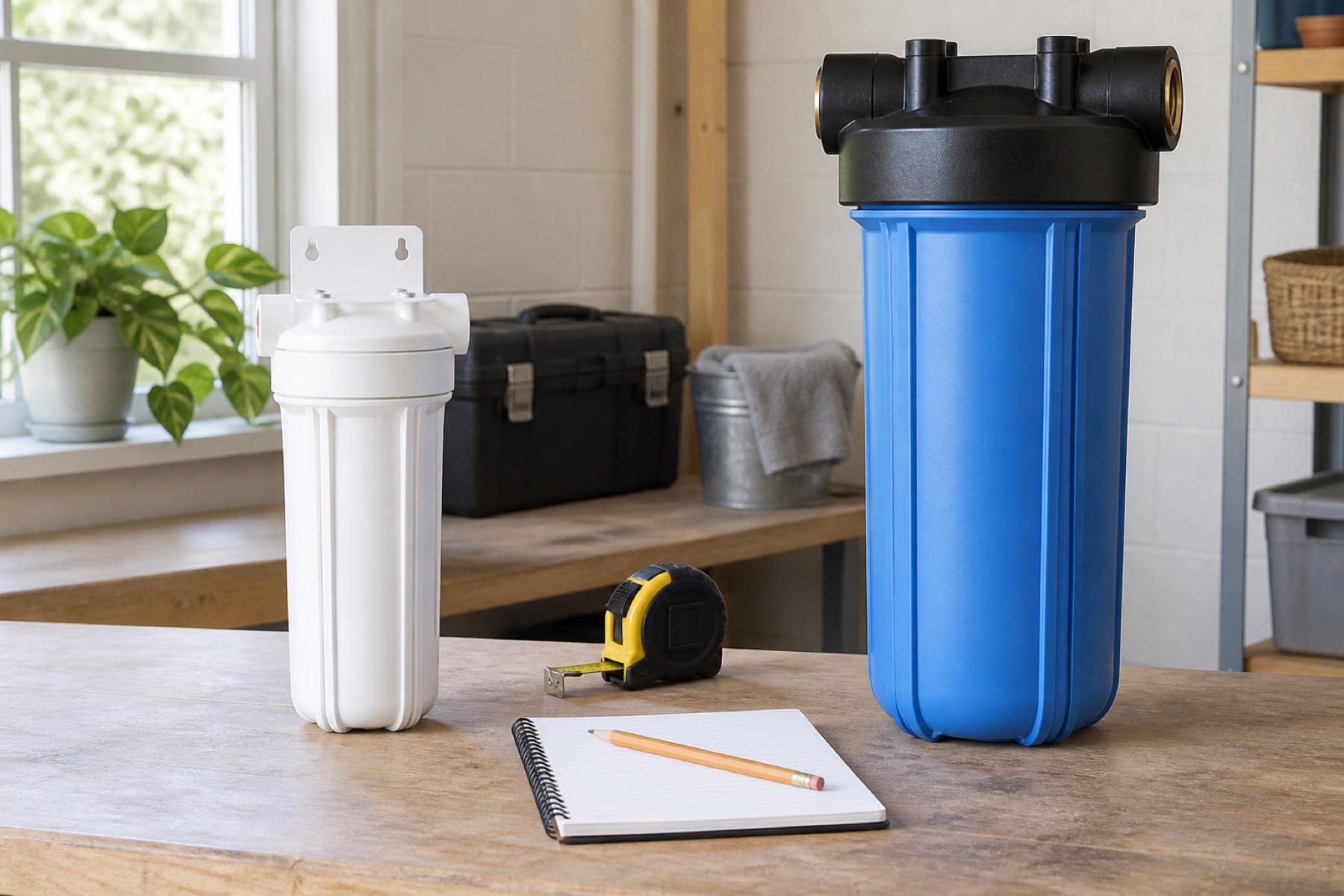
The short answer
Choose SpringWell CF1 when its 9-gpm service flow better fits your household and you are satisfied with SpringWell’s exact treatment documentation. Choose Aquasana Rhino EQ-1000 when its model-specific NSF/ANSI 42 chlorine performance sheet is the stronger decision factor and 7-gpm rated flow is sufficient. Neither base model is a conventional softener, and EQ-1000 should not be selected for chloramine from its chlorine sheet. Compare complete installed packages, not sale prices.
The decision at a glance
The core CF1 versus EQ-1000 tradeoff
SpringWell CF1
- 9-gpm service flow→
- Published city-water claims→
- Tank plus prefilter
Aquasana EQ-1000
- 7-gpm rated flow→
- Model-level chlorine sheet→
- Exact Rhino package
| Your situation | A sensible next step | Keep in mind |
|---|---|---|
| Need more published service flow | SpringWell CF1 | 9 gpm versus EQ-1000’s 7-gpm rated flow. |
| Prioritize model-level NSF/ANSI 42 chlorine data | Aquasana EQ-1000 | Verify the current sheet and package. |
| Utility uses chloramine | Neither comparison as written | Use chloramine-specific model evidence. |
In this guide
- The difference that matters first
- Chlorine versus chloramine changes the answer
- Published flow comparison
- Capacity comparison
- Treatment documentation
- Maintenance comparison
- Installation and footprint
- Five-year cost comparison
- Warranty and returns
- Hard water and optional conditioners
- Best fit for SpringWell CF1
- Best fit for Aquasana EQ-1000
- When neither is ready to buy
- A side-by-side household scenario
- Quote normalization step by step
- Questions each brand should answer
- What could change our recommendation
- More questions that can decide CF1 versus EQ-1000
- Complete decision walkthrough: CF1 or EQ-1000
- Detailed ownership comparison beyond the first five years
- Final comparison checklist
- Sources & editorial notes
The difference that matters first
CF1 and EQ-1000 are both whole-house city-water filters, but their published evidence and flow values are framed differently. CF1 lists 9-gpm service flow and broad chlorine/chloramine claims. EQ-1000 has a performance sheet listing 7-gpm rated flow and chlorine reduction under NSF/ANSI 42 testing.
The better choice depends on which model’s treatment evidence and flow fit the household. Brand reputation or tank size should not replace that match.
Chlorine versus chloramine changes the answer
EQ-1000’s reviewed data is for chlorine. Aquasana has separate chloramine models. SpringWell lists CF1 for chlorine and chloramine, but the buyer should inspect the exact support for the disinfectant present.
If chloramine is confirmed, use our chloramine shortlist rather than stretching this chlorine-focused comparison.
Published flow comparison
SpringWell lists CF1 at 9-gpm service flow; Aquasana lists EQ-1000 at 7-gpm rated flow. That two-gallon difference can matter during simultaneous use, but labels and test contexts may differ.
Give both providers the same busy-hour scenario and ask for expected pressure through the complete train. Do not declare CF1 the winner if plumbing or another stage is restrictive.
Capacity comparison
Both carry one-million-gallon headlines, and SpringWell also states ten years for its media. Aquasana’s performance sheet ties EQ-1000 capacity to the model data.
Capacity is not a substitute for flow and does not eliminate shorter-life prefilters. Record whichever gallon, time or condition limit arrives first.
Treatment documentation
EQ-1000’s performance sheet identifies chlorine, standard, flow and model. That clarity is a strong advantage for a chlorine buyer. SpringWell’s page identifies catalytic carbon, KDF and listed targets; ask for the claim documentation that matches the concern.
Do not reward the longer contaminant list automatically. One verified relevant claim is more useful than dozens of names without comparable conditions.
Maintenance comparison
SpringWell lists a sediment prefilter every six to nine months and main media at ten years or one million gallons. Aquasana ownership depends on its prefilter, postfilter and selected package.
List part numbers, quantities and access. A tank-media interval does not describe the whole maintenance experience.
Installation and footprint
Both require tank space and main-line plumbing. Aquasana bundles can add several inline components; SpringWell also offers bypass and connector add-ons.
Request dimensioned proposals showing treatment order, shutoffs, bypass and service clearance. The cheaper web cart may become the more expensive installation.
Five-year cost comparison
Use dated equipment prices, local labor, valves, cartridges, media assumptions, shipping and service. Keep optional conditioner and UV stages separate.
Do not project temporary discounts as permanent. Compare quantities and complete scope.
Warranty and returns
Read current detailed policies for installed returns, restocking, freight, replacement shipping, labor and required maintenance. A long warranty headline may cover the tank but not every expense.
Inspect freight before installation and retain model, serial, invoice and service records.
Hard water and optional conditioners
Neither base filter removes calcium and magnesium hardness. Aquasana may bundle a salt-free conditioner; SpringWell sells separate softener or conditioner combinations.
Decide hardness treatment separately. Do not compare a base CF1 with a Rhino package that includes conditioning as though scope were equal.
Best fit for SpringWell CF1
CF1 fits when 9-gpm service flow is useful, the tank and prefilter fit, and the buyer accepts SpringWell’s exact documentation and ownership plan.
Choose a larger CF size only when the peak-flow calculation supports it.
Best fit for Aquasana EQ-1000
EQ-1000 fits a chlorine-focused homeowner who values its model-level performance sheet and can live comfortably within the rated flow and package maintenance.
It is weaker when the utility uses chloramine or demand requires a different Aquasana model.
When neither is ready to buy
Wait if disinfectant, peak use, installation space or treatment location is unclear. Compare under-sink treatment if the need is limited to drinking water.
If an identified health-related substance drives the purchase, require the exact applicable claim rather than assuming these general city-water systems cover it.
A side-by-side household scenario
Take a two-bathroom chlorinated-water home where one shower, a washing machine and a kitchen faucet often overlap. If the estimated demand approaches 7 gpm, EQ-1000 may operate near its published rated flow while CF1 offers more stated service-flow headroom. That does not automatically make CF1 better; the provider must compare pressure and claim conditions on equal terms.
If the homeowner strongly values a model-specific NSF/ANSI 42 chlorine sheet and the peak scenario stays comfortably below 7 gpm, EQ-1000 may be the more reassuring choice. If the household requires chloramine reduction, this comparison should stop and move to exact chloramine models.
If only the drinking tap needs improvement, both systems can be too large. The correct answer can be neither, even when both products are credible.
Quote normalization step by step
List the base tank, prefilter, postfilter, bypass, unions, connectors, freight, labor, old-equipment removal and startup. Aquasana packages can include optional components, while SpringWell presents add-ons separately. Place equal functions on equal rows.
Then list the first five years of service. Use exact replacement quantities and part numbers. Mark the main media event even if it falls beyond five years so the future owner understands it.
Finally list the result: disinfectant treated, rated flow used, hardness unchanged unless another stage is present, and what will be checked at handover. Two equal totals can still buy different outcomes.
Questions each brand should answer
For SpringWell, ask what supports the exact chlorine or chloramine claim at the chosen flow and capacity, whether CF1 or CF4 is appropriate, and how the performance promise is handled. For Aquasana, ask whether EQ-1000 is the exact model on the sheet and how selected prefilters and postfilters affect service.
Ask both about installed returns, warranty labor, replacement shipping and maintenance records. Ask the installer—not only the merchant—about pressure, bypass and code.
Keep written answers. A confident purchase does not depend on remembering a sales call after the product is plumbed into the home.
What could change our recommendation
Independent comparable performance data at the same flow could strengthen one product. A local installer with unusually clear scope and support can also matter because whole-house ownership includes the installation.
A change in utility disinfectant, household demand or available space can reverse the choice. So can a new model revision or replacement schedule.
That is why our verdict is conditional rather than a permanent overall score. Recheck the exact pages and proposal at purchase.
More questions that can decide CF1 versus EQ-1000
Which has the better chlorine claim? EQ-1000 offers a model-specific performance sheet; SpringWell publishes its own CF-series claims and performance language. Decide which exact evidence fits the concern rather than assigning a generic winner.
Which has better flow? CF1 lists 9-gpm service flow and EQ-1000 lists 7-gpm rated flow. The terms and complete installations need comparison, and the household may fit either, one or neither.
Which is easier to maintain? That depends on the selected Aquasana package, prefilters, postfilters and the homeowner’s access. Compare exact parts and quantities rather than a brand-level impression.
Which takes less space? Both use a main tank; package components and pipe layout can dominate the difference. Require dimensioned proposals.
Which is better for hard water? Neither base model softens. Compare separate conditioning or softening stages and normalize the package.
Which is safer to order online? The safer transaction has inspected freight, clear return terms, a complete installation plan and written support. Brand alone cannot answer.
Can a plumber choose for me? A qualified installer can assess plumbing and scope, but treatment selection still needs water data and the exact product documentation.
What if both quotes seem equal? Prefer the proposal with clearer claims, flow assumptions, service parts, warranty responsibilities and local support. Clarity reduces ownership risk.
Complete decision walkthrough: CF1 or EQ-1000
Step one is the utility record. If it says free chlorine, both products can remain under consideration. If it says chloramine, EQ-1000 leaves this comparison and the buyer moves to chloramine-specific equipment. If another concern drives treatment, require its own exact claim.
Step two is demand. Write the busiest normal fixture combination and have both providers calculate it. CF1’s 9-gpm service figure provides more published headroom than EQ-1000’s 7-gpm rated figure, but those labels need context. Ask what pressure remains through the complete installed train.
Step three is evidence. Save SpringWell’s current CF documentation and Aquasana’s EQ-1000 performance sheet. Mark what each says about chlorine, flow, capacity, standards and replacement. Do not fill blank cells with assumptions from the brand’s other models.
Step four is configuration. List every prefilter, postfilter, bypass, connector, conditioner and UV stage. If one option has no defined purpose, remove it before comparing. If one quote includes an item the other needs, add it to both scopes.
Step five is ownership. Count five years of replacements and service using current part numbers and reasonable interval ranges. Include the household’s ability to perform the work. Add return freight, restocking and installation labor risk.
Step six is the verdict. Choose CF1 when the higher published service flow and SpringWell documentation best fit. Choose EQ-1000 when the specific chlorine performance sheet and lower-flow household fit are stronger. Choose neither when whole-house treatment, pressure or evidence is unresolved.
The decision should survive the sale ending. If a discount is the only reason one model wins, the comparison is not finished.
Detailed ownership comparison beyond the first five years
The main-media event deserves attention even if it falls outside an initial five-year worksheet. Ask what replacement means for CF1 and EQ-1000: media exchange, tank replacement, professional labor, disposal and current part availability. Record the stated time and gallon limits without treating either as a guarantee detached from water conditions.
Consider service continuity. Ask whether the house can use bypass water during a cartridge or tank service, how long common parts take to arrive and who is responsible for troubleshooting. A system with a lower equipment price can create more disruption if local support and parts are unclear.
Consider physical ownership. CF1 and EQ-1000 both need a tank location, but their selected prefilters, postfilters, conditioners and bypass packages can create different footprints. Measure the complete assembly, not catalog tank dimensions. Include access for a wrench, unions and future media work.
Consider household behavior. If occupants ignore filter reminders, a frequent prefilter schedule becomes a real risk. If they travel often, assign a service provider or caretaker. Maintenance suitability belongs in the comparison rather than appearing after the purchase.
Consider evidence longevity. Save the performance and specification documents with the order because product pages change. When replacement time arrives, verify the current approved part and whether any model revision affects the instructions.
Consider the property’s future. A growing household, remodel or higher-flow fixture can change peak demand. Ask whether the original size still offers reasonable margin. Do not oversize only for a hypothetical future, but avoid an installation that leaves no coherent upgrade path.
Consider resale. Label the system and leave a short treatment summary: municipal chlorine filter, exact models, replacement dates and open tasks. The next owner should not confuse it with a softener or chloramine system.
These ownership questions do not create a single universal winner. They reveal which proposal is more complete for the specific home, which is the decision this comparison is designed to support.
Final comparison checklist
Use the same rows for both quotes.
- Free chlorine confirmed
- Exact model performance document
- Service flow and pressure at peak use
- Complete package and treatment order
- Five-year cartridges and media
- Installed price and exclusions
- Return and warranty responsibilities
Products mentioned
We add a buying link only when an approved retailer or affiliate option is available. Always confirm the exact model, current price and availability.
SpringWell CF1
Confirm service flow and exact claim documentation.
Aquasana Rhino EQ-1000
Confirm rated flow, package and current performance sheet.
Put this guide to work
Compare the complete ownership cost
Use the free tool, then download a record you can keep. No email required.
Open the tool →Get the editable pack →Sources & editorial notes
A current-document comparison based on the two exact models. We have not installed or performance-tested either system and do not convert merchant ratings into our own score.
- SpringWell CF-series specifications
- Aquasana EQ-1000 manual and performance sheet
- EPA chloramine guidance
- NSF treatment-standard explanation
Product details can change. Confirm the exact model and current terms before ordering. How we write and update guides.