The short answer
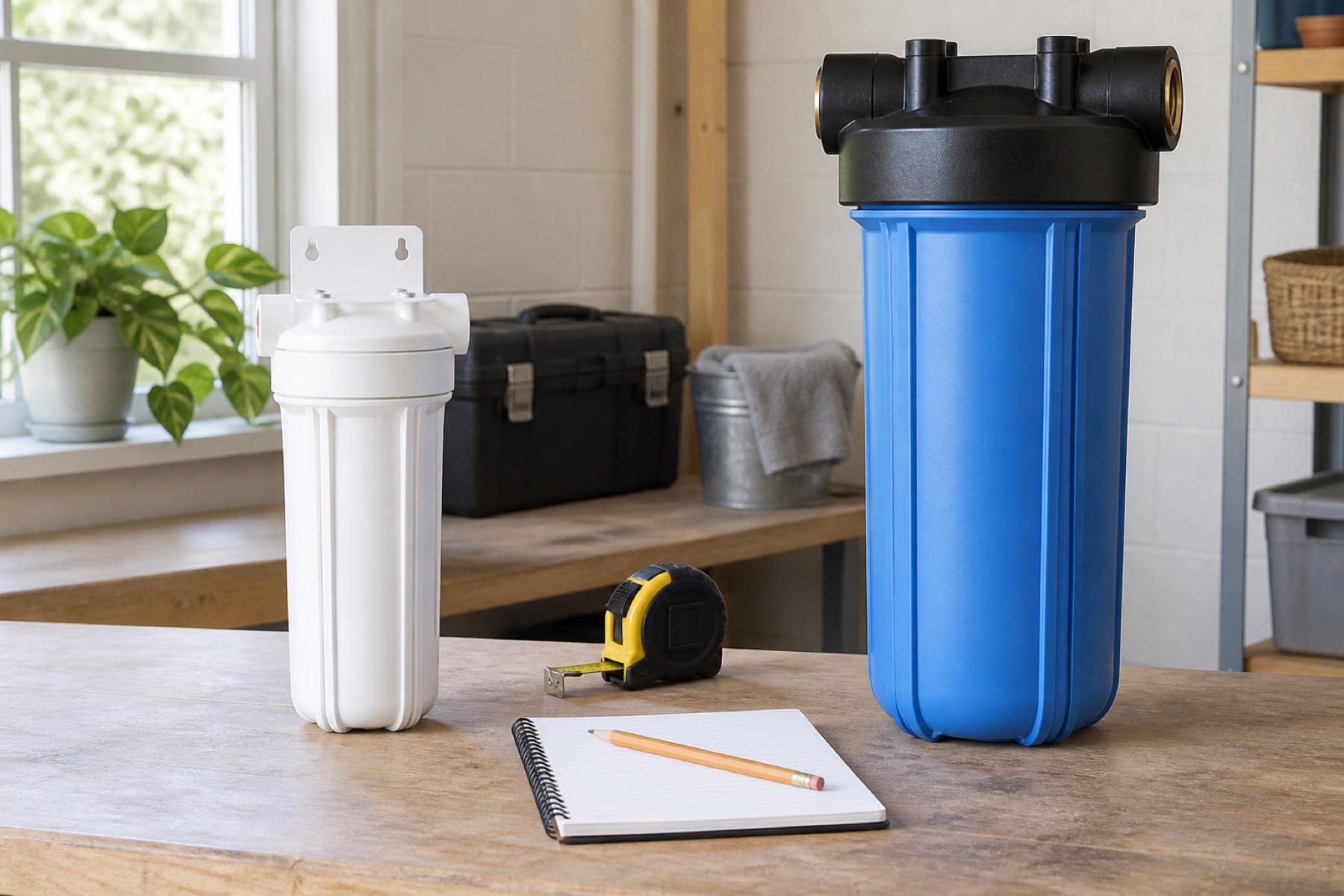
Size a whole-house filter by the busiest realistic combination of fixtures, the service-flow rating of every treatment stage, incoming pressure, pipe size and the contaminants being treated. Bathroom count is a convenient first filter, not a complete calculation. Capacity tells you how much water or time a system may treat under stated conditions; it does not tell you whether morning showers will keep acceptable pressure.
The decision at a glance
Size the complete treatment train
Household demand
- Busiest normal fixture mix→
- Incoming pipe and pressure→
- Needed service flow
Treatment limits
- Smallest rated stage→
- Clean and loaded pressure→
- Capacity and service point
| Your situation | A sensible next step | Keep in mind |
|---|---|---|
| Choosing between model sizes | Estimate peak simultaneous demand | Do not count bathrooms alone. |
| Adding several treatment stages | Find the restrictive component | Complete-train flow matters. |
| Pressure is already weak | Diagnose before adding equipment | A larger tank may not fix the cause. |
In this guide
- Four numbers that answer different questions
- Start with the busiest normal moment
- Bathroom counts are shortcuts
- Find the smallest flow rating in the train
- Incoming pressure and pressure loss
- Pipe size and fittings
- Capacity is treatment-specific
- Hardness changes softener sizing
- Chloramine can change the carbon shortlist
- Cartridges near the end of service
- Tank systems still need prefilters
- Do not oversize automatically
- A quote-ready sizing brief
- Red flags in a sizing answer
- A worked peak-flow example
- How treatment goals affect sizing
- Questions for the installer, not the product page
- Common whole-house sizing questions
- Final sizing worksheet
- Sources & editorial notes
Four numbers that answer different questions
Service flow describes the rate a system is intended to deliver during treatment. Peak flow or a similarly named headline may describe a different condition. Capacity describes total treatment before a service or replacement point. Pressure describes the force available to move water through the home.
Do not combine them into one “power” score. A million-gallon tank can still have a modest rated flow, and high incoming pressure can still fall across restrictive plumbing. Put each number in its own row.
Start with the busiest normal moment
Picture a realistic morning or evening, not every fixture running at once. List showers, faucets, toilets, laundry and appliances likely to overlap. A plumber can translate fixture use into a design-flow estimate appropriate to the property and local rules.
This scenario is more useful than “three bathrooms” because two three-bath homes may behave very differently. One household has a single occupant; another runs two showers and laundry together.
Bathroom counts are shortcuts
Manufacturers often map models to bathroom ranges because they are easy for shoppers to understand. SpringWell, for example, currently places CF1 at one to three bathrooms and 9-gpm service flow. The flow number and actual use are the more transferable facts.
Use the bathroom band to build a shortlist, then verify the household scenario. Do not jump to the largest unit because “more flow” sounds safer; larger equipment costs more and may not improve a limitation elsewhere.
Find the smallest flow rating in the train
A whole-house setup can include sediment, carbon, softening or conditioning, UV, postfiltration and a shutoff device. The practical train cannot be understood by quoting only the largest component.
List each stage in order with its service flow and pressure information. Ask the installer which stage becomes restrictive when clean and when service is due.
Incoming pressure and pressure loss
Measure or professionally assess incoming pressure under useful conditions. A static reading with no fixtures open answers a different question from pressure during flow. Avoid adjusting regulators or well controls from an online guide.
Ask each provider for expected pressure loss through the proposed clean system at the design flow and how that changes as replaceable filters load. If the current home already has low pressure, investigate the cause before adding treatment.
Pipe size and fittings
A one-inch equipment port does not guarantee the home has one-inch supply plumbing, and adapters do not create missing pipe capacity. Long runs, restrictive valves, old pipe and numerous fittings can affect performance.
Photograph and measure the main line with professional confirmation. Include bypass valves and any connector kits in the drawing.
Capacity is treatment-specific
Carbon capacity, softener grain capacity, cartridge gallons and UV lamp life describe different service limits. A capacity claim is meaningful only with the substance, test conditions, flow and replacement rule attached.
Do not convert a million-gallon claim into years without a water-use assumption, time limit and maintenance plan. Use whichever limit arrives first under the documentation.
Hardness changes softener sizing
Softener capacity depends on hardness load and household water use. Iron and other conditions can also affect a design, especially on wells. For city water, record hardness in the correct unit and ask how it is programmed.
EPA recommends demand-initiated regeneration and efficiency-focused selection. Oversizing is not a substitute for correct settings.
Chloramine can change the carbon shortlist
Chloramine is more difficult to remove than free chlorine. A tank sized for a chlorine claim should not be assumed to provide the same chloramine result at the same flow and capacity.
Identify the utility disinfectant first. Then use the exact model’s chloramine documentation where that is the goal.
Cartridges near the end of service
Cartridge systems may accumulate pressure loss as sediment loads. Ask for the initial pressure information, replacement trigger and what the household should notice. A system that is comfortable on day one but restrictive before each change may be poorly matched.
Water conditions can shorten an interval. Keep replacement access and cost in the sizing decision because choosing a larger or staged prefilter may alter ownership.
Tank systems still need prefilters
Long-life media tanks often include a shorter-life sediment prefilter. Include its housing, flow, pressure and service clearance in the complete design.
A large central tank does not make a small loaded prefilter irrelevant. Ask which component determines maintenance and whether a pressure gauge is useful in the professional design.
Do not oversize automatically
EPA advises avoiding unnecessarily large treatment systems because they tend to cost more to purchase, operate and maintain. The best size meets the documented treatment and peak-flow need with a reasonable service plan.
Ask the seller what changes when moving up one size: service flow, media, footprint, backwash, connection, price and maintenance. Pay for the improvement only if the household needs it.
A quote-ready sizing brief
Provide the water source, utility disinfectant, treatment goals, hardness, pipe information, incoming pressure, busiest-use scenario, proposed location and existing equipment. Give the same brief to each provider.
Require the response to name every model and identify the most restrictive stage. This turns a recommendation into something another installer can review.
Red flags in a sizing answer
“Any size home,” “zero pressure drop” and a model chosen only from bedrooms or square footage need clarification. Ask for the conditions, definition and number behind the claim.
Another warning is a quote that ignores existing treatment or plumbing. New equipment operates as part of the house, not as an isolated catalog item.
A worked peak-flow example
Suppose the busiest normal period includes two showers estimated at 2 gallons per minute each, a kitchen faucet around 1.5 gpm and a washing-machine fill that may overlap. Adding nameplate or estimated fixture flows gives a screening scenario, not a final plumbing calculation. A qualified provider should account for actual fixtures, pressure, diversity and local design practice.
If the screen suggests more than a 7-gpm rated filter, Aquasana EQ-1000 deserves closer scrutiny even if the house has only two bathrooms. A 9-gpm CF1 may fit better, or it may still be inadequate after adding other stages and pressure loss. The calculation narrows questions; it does not approve a model.
Repeat the scenario with the household’s actual habits. If two showers never overlap, the design may differ. Do not invent peak demand simply to justify a larger system.
How treatment goals affect sizing
A carbon system can have different performance conditions for chlorine and chloramine. Chloramine removal may demand more contact time, so a system’s general hydraulic capacity is not automatically its supported chloramine treatment flow. Use the flow associated with the exact claim.
A softener has a service-flow question and a capacity-between-regenerations question. A sediment cartridge has clean and loaded pressure behavior. UV has a maximum supported flow for the required dose. Place these different limits in one treatment-order worksheet.
When one stage lacks comparable data, flag the uncertainty rather than averaging it away. Ask the supplier to answer or choose equipment with clearer documentation.
Questions for the installer, not the product page
Ask what pressure exists while the peak scenario is flowing, which component creates the largest clean pressure loss and what happens as cartridges approach replacement. Ask whether pipe transitions, elevation or existing regulators are included in the assessment.
Request a commissioning plan: pressure or flow observations, bypass demonstration, leak check and model records. The plan should state how the household recognizes overdue service and what performance is expected during busy use.
Finally, ask how the system can be expanded. If a future conditioner, softener or UV stage is likely, the initial layout and sizing should not create an avoidable bottleneck. Do not oversize every component now; make the design serviceable and explainable.
Common whole-house sizing questions
How many gallons per minute does a three-bathroom home need? There is no single correct number. Occupancy, fixtures and simultaneous habits matter more than the room count.
Should I buy the largest model? Not automatically. Larger equipment costs and dimensions increase, while a bottleneck elsewhere can remain. Size for a supported treatment and demand range.
Is peak flow the same as service flow? Not necessarily. Manufacturers may define them differently. Use the flow associated with the relevant treatment claim and normal service.
Does a one-inch connection guarantee high flow? No. Incoming pipe, pressure, valves and other stages affect the system. A port size is one installation fact.
How do I size for chloramine? Use chloramine-specific performance data at the required flow. Do not size from a chlorine claim or carbon quantity alone.
What if pressure is already low? Investigate the existing problem before adding treatment. Record where and when it occurs and seek a diagnosis rather than compensating blindly with larger equipment.
Final sizing worksheet
Take these fields into every quote.
- Water source and disinfectant
- Measured hardness and specific treatment goals
- Peak simultaneous fixture scenario
- Incoming dynamic and static pressure if professionally measured
- Pipe size and proposed treatment order
- Service flow and pressure loss for every stage
- Capacity limit and replacement trigger
- Service clearance, bypass and future maintenance access
Put this guide to work
Compare the complete ownership cost
Use the free tool, then download a record you can keep. No email required.
Open the tool →Get the editable pack →Sources & editorial notes
This guide translates published equipment specifications and EPA selection guidance into a homeowner quote brief. It is not a plumbing design or installation approval.
- SpringWell CF and CSS published specifications
- EPA guide to efficient water softener selection
- EPA WaterSense guide to treatment selection
Product details can change. Confirm the exact model and current terms before ordering. How we write and update guides.