The short answer
For low-pressure homes, the best first purchase is often a pressure assessment. A powered tankless system such as G3P800 may manage delivery differently from a conventional ROES-50, but neither should be selected without checking its operating range. If a booster is required, it should be specified for the exact system and supply—not added by guesswork.
| Your situation | A sensible next step | Keep in mind |
|---|---|---|
| Pressure is unknown | Measure and diagnose first | Do not select from a “low pressure” search alone. |
| Pressure is within the powered model’s stated range | Assess G3P800 | Confirm outlet and outage behavior. |
| A professional specifies a compatible booster | Compare total boosted system cost | Include noise, power and service. |
In this guide
Why pressure changes RO performance
Reverse osmosis depends on pressure across its membrane. Low or unstable feed pressure can reduce production and affect the user experience. A storage tank may mask slow production for a short draw but does not correct the underlying input.
Record static and working conditions through an appropriate professional rather than changing plumbing settings yourself.
Best powered tankless candidate: Waterdrop G3P800
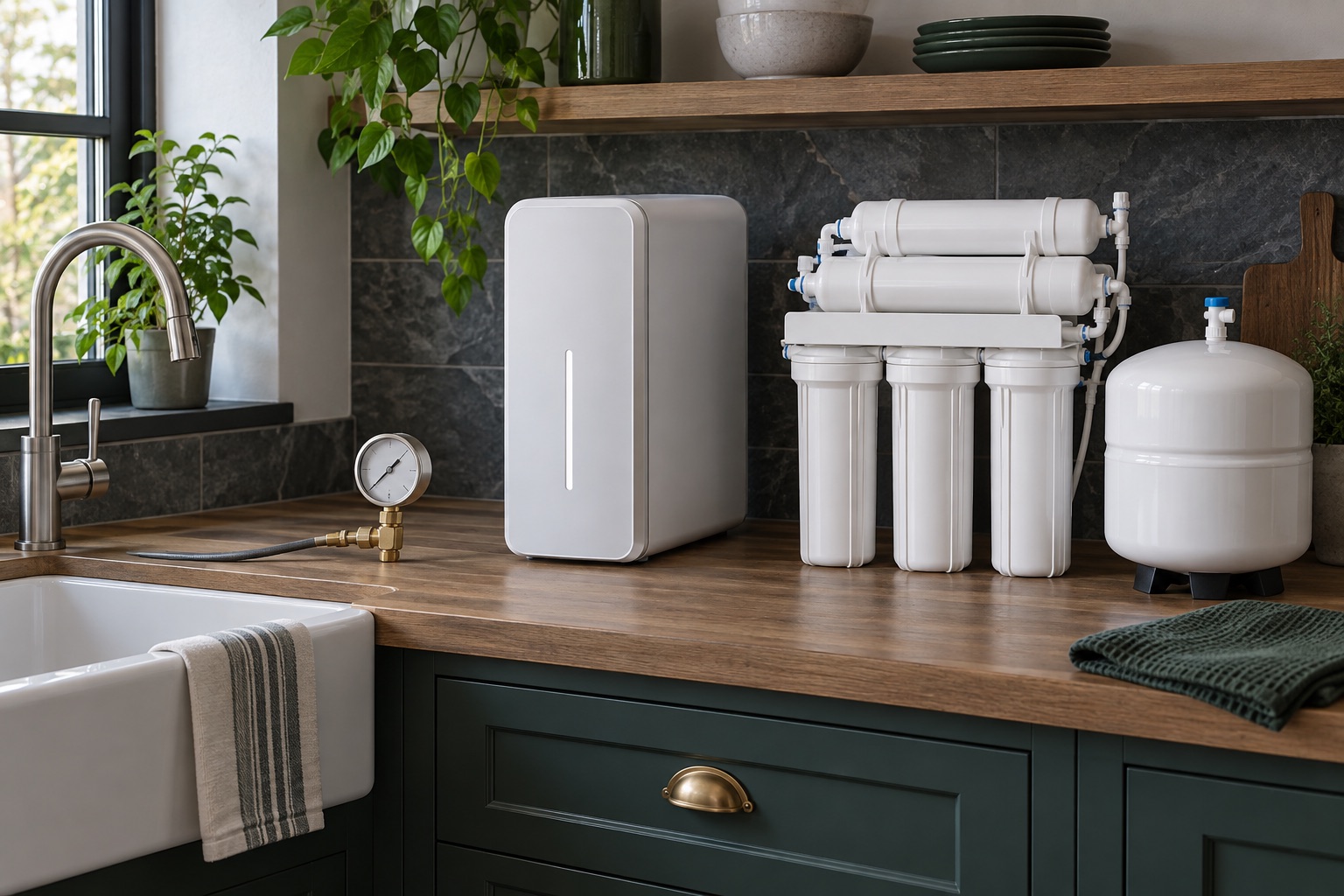
G3P800’s powered design and high-output positioning make it a candidate when its published inlet requirements are met. It still cannot be assumed to solve pressure below those requirements.
Ask for expected faucet delivery at your measured conditions and what happens if pressure drops during simultaneous household use.
Best conventional tank candidate: APEC ROES-50
ROES-50 can store treated water for later use, which may suit intermittent kitchen demand. Confirm the stated operating pressure and whether the proposed configuration needs a manufacturer-compatible booster.
Do not add a generic pump merely because production feels slow. Diagnose filters, pressure, temperature and system condition first.
The booster-pump decision
A booster adds power, noise, fittings, controls and another service component. Ask the system manufacturer or qualified installer for written compatibility and the target operating range.
Include leak protection and shutoff behavior in the installation plan. More pressure without correct controls can create a different problem.
Compare water efficiency too
Low pressure and tank backpressure can affect real-world efficiency. EPA’s WaterSense specification creates independently verified minimum criteria for labeled point-of-use RO systems, including efficiency and performance.
Check the current labeled-product list rather than assuming a product is labeled because it uses an efficient ratio in advertising.
Complete-system comparison
Ask for delivery, reject-water behavior, parts and installed cost under the same measured conditions.
| Route | Potential advantage | Cost or risk to include |
|---|---|---|
| Powered tankless | Higher on-demand delivery | Power, electronics and exact inlet range |
| Tank RO | Stored reserve | Cabinet space, refill and tank backpressure |
| RO plus booster | Raises feed pressure when correctly designed | Pump, noise, controls and service |
| No RO | Simpler if carbon meets the goal | Must still have the right certified claim |
Our recommendation
Measure first. Choose G3P800 if it operates comfortably within the verified conditions and its delivery advantage is useful. Choose ROES-50 if the storage format and a supported pressure plan produce the better complete cost.
If carbon filtration can address the concern, it may avoid the pressure sensitivity and reject water of RO.
Products mentioned
We add a buying link only when an approved retailer or affiliate option is available. Always confirm the exact model, current price and availability.
APEC ROES-50
Tank candidate; verify operating pressure and booster compatibility.
View buying options on Amazon ↗Put this guide to work
Compare the complete ownership cost
Use the free tool, then download a record you can keep. No email required.
Open the tool →Get the editable pack →Sources & editorial notes
This guide combines published information with our suggested decision process. It does not report hands-on product testing or an assessment of your property.
- EPA WaterSense: point-of-use reverse osmosis systems
- Waterdrop: G3P800 product specifications and replacement filters
- APEC Water Systems: ROES-50 reverse osmosis system
Product details can change. Confirm the exact model and current terms before ordering. How we write and update guides.