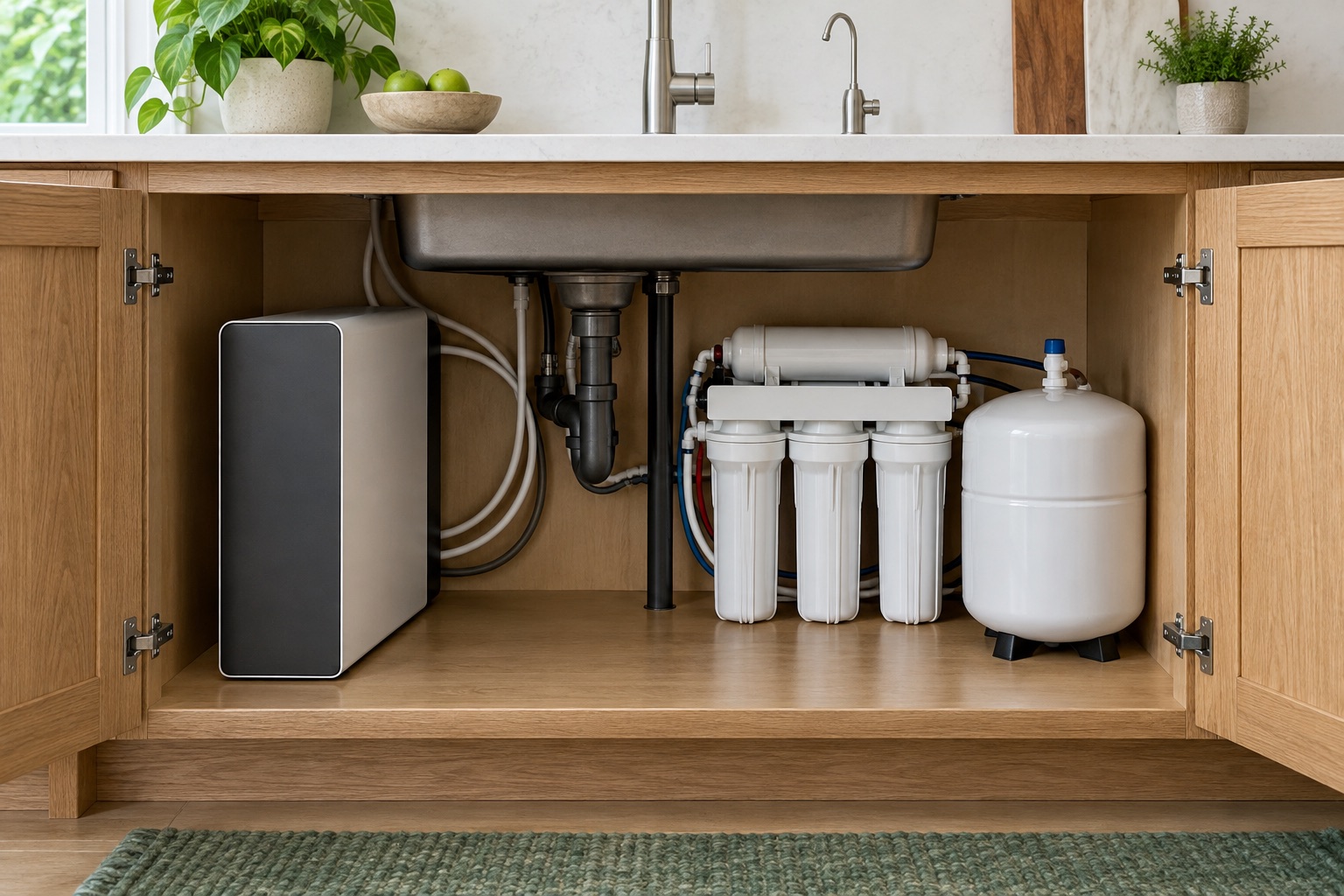
The short answer
Choose G3P800 when cabinet width is limited, fast on-demand delivery matters and power is readily available. Choose ROES-50 when you prefer a conventional tank system, have the space and value a simpler non-smart architecture. Treatment documentation and supply pressure must work before either wins.
| Your situation | A sensible next step | Keep in mind |
|---|---|---|
| Tight cabinet with a suitable outlet | Favor G3P800 | Reserve room for filter changes. |
| Enough room and preference for a tank reserve | Favor ROES-50 | Confirm refill and usable tank delivery. |
| Low or uncertain feed pressure | Pause both choices | Have pressure assessed before buying. |
In this guide
The meaningful difference
G3P800 uses power to deliver treated water without a storage tank. ROES-50 makes water more slowly and stores it in a pressurized tank. That changes cabinet layout, delivery behavior, outage behavior and maintenance—not necessarily which removes your specific concern.
Start with the exact performance documentation, then compare format.
Cabinet fit: draw both layouts
For G3P800, reserve a suitable rectangle plus connection and cartridge clearance. For ROES-50, place both the filter assembly and pressure tank, allowing tubing bends and housing service.
Measure around the disposal, drain and shutoffs. Product dimensions floating in empty space are not an installation plan.
Everyday delivery
G3P800 is intended to provide high on-demand flow under suitable conditions. ROES-50 draws from its stored reserve and then recovers. Ask how each experience changes during repeated large fills.
Do not translate GPD directly into a guaranteed glass-filling time. Supply pressure, temperature and water chemistry affect RO production.
Power and outage tradeoff
The powered tankless system depends on electricity for normal operation. A conventional tank can retain some treated water already stored, although production and pressure behavior must be confirmed for its installation.
If outages matter, ask the seller to describe supported behavior in writing rather than relying on assumptions about “tankless” or “tank.”
Maintenance and cost
G3P800 uses three proprietary core filters on separate schedules. ROES-50 uses a multi-stage replacement set and membrane. Calculate exact parts over five years and add labor if you will not service them.
| Decision | G3P800 | ROES-50 |
|---|---|---|
| Water delivery | Powered on-demand | Stored reserve plus refill |
| Cabinet layout | No pressure tank | Separate tank and filter assembly |
| Power | Required for normal use | Confirm accessories; conventional design |
| Cost comparison | Three core filter schedules | Stage kits plus membrane schedule |
Who should skip both
Skip both when a suitable carbon filter can meet the only treatment goal with less water and complexity. Pause when drilling is prohibited, the drain cannot be modified, pressure is unsuitable or the water issue has not been identified.
EPA’s WaterSense guidance makes water efficiency part of a serious RO comparison. Look for independently verified efficiency information where available.
Our recommendation
Choose G3P800 for a measured space and delivery advantage. Choose ROES-50 for a measured cost, serviceability or reserve advantage. If the choice is being made mainly on appearance or stage count, return to the water goal and installed quote.
Products mentioned
We add a buying link only when an approved retailer or affiliate option is available. Always confirm the exact model, current price and availability.
Put this guide to work
Compare the complete ownership cost
Use the free tool, then download a record you can keep. No email required.
Open the tool →Get the editable pack →Sources & editorial notes
This guide combines published information with our suggested decision process. It does not report hands-on product testing or an assessment of your property.
- Waterdrop: G3P800 product specifications and replacement filters
- APEC Water Systems: ROES-50 reverse osmosis system
- EPA WaterSense: point-of-use reverse osmosis systems
Product details can change. Confirm the exact model and current terms before ordering. How we write and update guides.