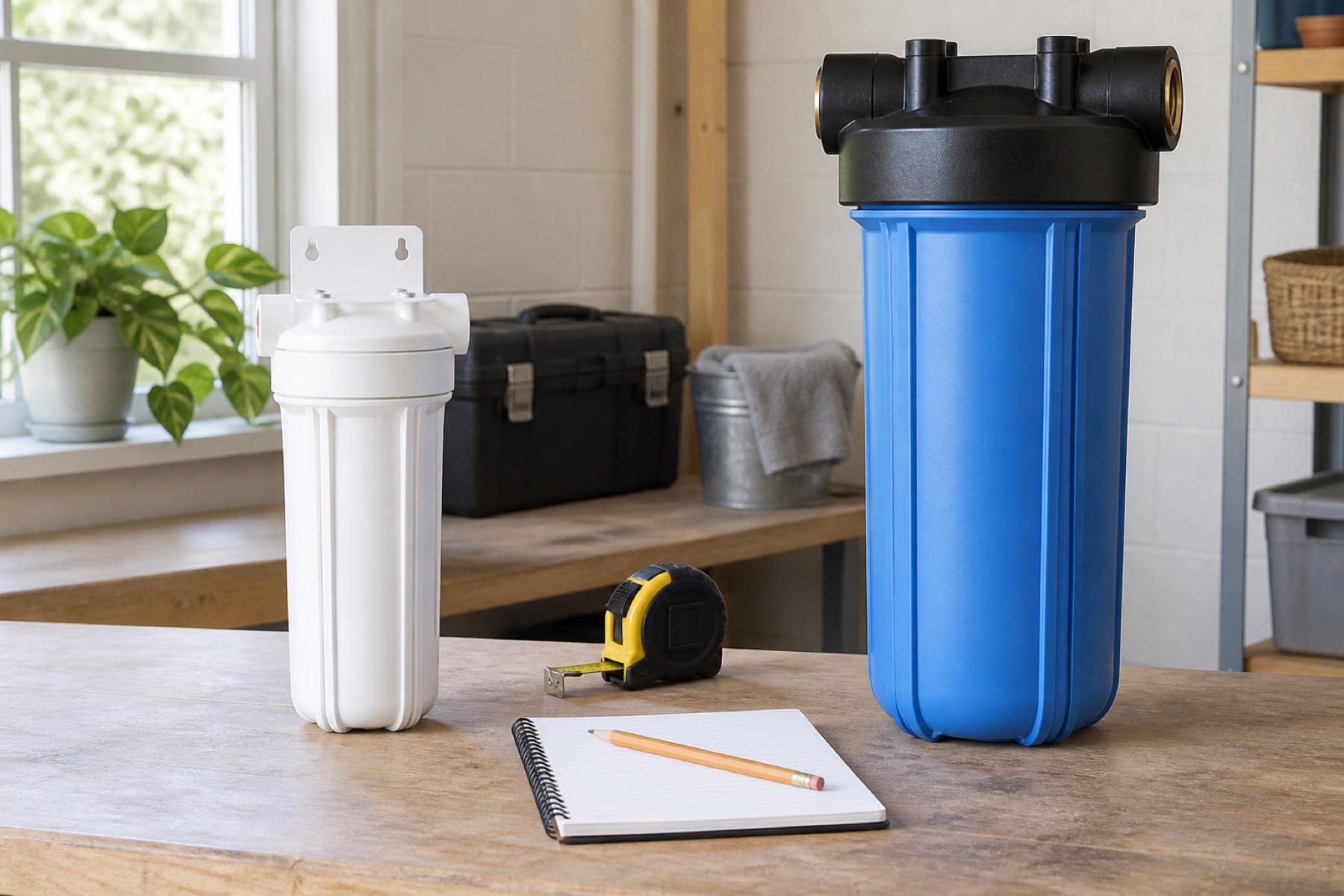
The short answer
SpringWell CSS1 is worth shortlisting when a one-to-three-bathroom home has confirmed hard municipal water, wants true ion-exchange softening and also needs whole-house city-water filtration. Its strongest advantage is a clear treatment combination: CF1 filtration followed by SS1 hardness removal. Its disadvantages are the large footprint, salt, regeneration drain, installation work and the need to verify that the CF1 claims match your utility water. It is a poor fit when you only need drinking-water treatment or refuse salt-based ownership.
The decision at a glance
CSS1 is two systems to assess
Filtration
- Confirm city disinfectant→
- Check CF1 flow and claim→
- Plan prefilter service
Softening
- Measure hardness→
- Confirm SS1 capacity→
- Plan salt and regeneration
| Your situation | A sensible next step | Keep in mind |
|---|---|---|
| Confirmed hardness and you want soft water | Strong shortlist | Plan for salt, drain, tanks and commissioning. |
| You want scale control without brine | Look at a conditioner instead | CSS1 is built around ion exchange. |
| Only one drinking tap needs treatment | Usually too much system | Compare point-of-use filtration first. |
In this guide
- What CSS1 actually is
- Our verdict before the details
- The water problem it is designed to solve
- Flow and pressure in a real household
- The physical footprint buyers underestimate
- Installation is part of the product decision
- Salt and regeneration are ongoing inputs
- Filter maintenance is separate from softener maintenance
- Five-year cost without inventing a total
- What the warranty and return policy mean in practice
- What CSS1 will not solve
- Who should buy CSS1
- Who should skip CSS1
- The alternatives worth comparing
- A realistic three-bathroom buying scenario
- How to audit the final CSS1 proposal
- First year of ownership: what good handover looks like
- Common CSS1 buying questions
- Our final CSS1 decision walkthrough
- Questions to ask before checkout
- Sources & editorial notes
What CSS1 actually is
CSS1 is SpringWell’s core filter-and-softener combination for homes the company groups at one to three bathrooms. It pairs the CF1 whole-house filter with the SS1 salt-based softener. That means the filtration and hardness stages are separate pieces of equipment with different purposes, specifications and maintenance needs.
The current CF1 specification lists 9 gallons per minute of service flow, a one-inch connection and a prefilter change every six to nine months. SS1 is listed at 11 gallons per minute and 32,000 grains. In the combined train, compare the complete installation around the more restrictive stage rather than quoting only the larger number.
Our verdict before the details
CSS1 makes sense for a homeowner who can name two needs: a city-water filtration goal that CF1 documents and actual hardness removal. It is easier to justify than a vague “premium water” bundle because each main stage has a distinct job. The household must still decide whether every indoor tap needs both treatments.
We would not recommend buying it from a bathroom count alone. Confirm current hardness, utility disinfectant, simultaneous demand, incoming pressure, pipe size, drain location and service clearance. If those facts fit, CSS1 becomes a coherent premium option. If one fails, a smaller point-of-use filter or a different hardness strategy may be more sensible.
The water problem it is designed to solve
SpringWell markets the filter side for municipal water and lists chlorine, chloramine and PFAS among its targets. Treat those as manufacturer claims that must be connected to the exact documentation and your water. A utility report can identify the disinfectant and reported substances; additional testing may be appropriate when a specific concern drives the purchase.
The SS1 side uses cation exchange to remove calcium and magnesium hardness. EPA describes this as a different result from salt-free conditioning, which aims to reduce scale behavior without removing hardness ions. Choose CSS1 when the lower-hardness result matters, not simply because white scale is annoying.
Flow and pressure in a real household
A 9-gpm service rating can be reasonable for many smaller homes, but bathroom count is only a shortcut. Picture the busiest period: two showers, a washing machine fill and a kitchen faucet. Ask an installer to estimate that simultaneous demand and explain the expected pressure change through a clean and service-due system.
Incoming pressure and plumbing restrictions also matter. SpringWell lists an operating range of 25 to 80 psi for CF1 and SS1, but being inside a broad range does not guarantee a particular fixture experience. The proposal should address the home’s pipe size, pressure, bypass and any other installed stage.
The physical footprint buyers underestimate
CSS1 is not one compact cabinet. The published dimensions describe a CF1 tank, an SS1 tank and an 18-by-33-inch round brine tank, plus control heads, plumbing and service space. Add clearance for the prefilter, valves and a safe salt-loading path. A system that technically fits can still be unpleasant to maintain.
Draw the installation area and mark the main shutoff, pipe direction, drain, outlet, floor slope, door swing and anything that blocks tank access. Ask whether the location is protected from freezing, direct weather and impact. Do this before ordering freight, because changing the location later can change the labor and materials substantially.
Installation is part of the product decision
The quote should include treatment order, bypass valves, connectors, drain work, startup, testing and disposal of old equipment where applicable. EPA generally places a whole-house filter before a softener so sediment or chemicals are treated before softening, but the exact design must follow the equipment instructions and local installation.
A DIY claim does not settle whether DIY is appropriate for your home. Main-line plumbing can create costly water damage if done poorly. If you hire a professional, ask for the labor warranty, commissioning record and exclusions. If you self-install, confirm code, warranty and skill requirements before treating the saved labor as guaranteed savings.
Salt and regeneration are ongoing inputs
The softener must periodically regenerate its resin with brine. The amount of salt and water depends on hardness, capacity, programming and household use. Ask what incoming hardness value will be entered, whether regeneration is demand initiated and what reserve capacity the installer plans. Fixed guesses can waste inputs or allow hard water before the next cycle.
EPA recommends considering both salt efficiency and water efficiency. It also notes that local jurisdictions may restrict salt-based softeners. Check local rules and the discharge route before buying. This is not a minor installation footnote; it can determine whether the system is allowed and practical.
Filter maintenance is separate from softener maintenance
SpringWell lists CF1 prefilter replacement every six to nine months and media replacement at ten years or one million gallons. Treat both as published limits, not promises that ignore unusual sediment, flow or water conditions. Record the exact replacement part, access requirement and current price.
On the softener side, the owner needs salt checks, awareness of salt bridging, brine-tank access and periodic professional attention where appropriate. Put both schedules on one calendar. Buyers sometimes focus on salt and forget the filter, or focus on long-life media and forget that the softener still has operating tasks.
Five-year cost without inventing a total
A responsible cost estimate begins with a dated equipment price and a local installed quote. Add freight if it applies, plumbing materials, drain work, prefilters, salt, regeneration water and planned service. Keep optional UV, leak shutoff and connector upgrades in separate rows so they do not silently inflate the base comparison.
Future prices are unknown, but quantities can still be useful. Ask how many prefilters and how much salt the design assumes over five years. State the water-use assumption behind regeneration cost. Our quote-comparison tool is better than publishing one national total that would be wrong for many homes.
What the warranty and return policy mean in practice
SpringWell currently advertises a lifetime warranty and a six-month performance promise, but the detailed policy matters. The page says ordinary returns require original, unused and uninstalled condition, with customer-paid return shipping and possible restocking. Installed systems are not generally returnable unless SpringWell determines they are defective.
Before plumbing begins, inspect the shipment under the carrier and seller instructions. Save photographs, serial numbers and packaging information. Ask who pays labor, freight and removal during a claim. A replacement tank can be valuable while still leaving the homeowner responsible for expenses outside the covered part.
What CSS1 will not solve
CSS1 is not a private-well iron or sulfur system, a repair for low municipal pressure, or a universal microbiological treatment. Do not add optional UV merely because it is available at checkout. Establish the need and verify the complete configuration before adding another stage.
It is also excessive when the problem exists only at the kitchen drinking tap. Treating showers, toilets and outdoor uses can cost more and increase maintenance without improving the goal. Compare whole-house and under-sink treatment location before treating a larger system as automatically better.
Who should buy CSS1
Shortlist CSS1 if hardness is confirmed, true soft water is the goal, the CF1 filtration claims fit the municipal supply, and the property can support the tanks, drain and salt routine. It is particularly coherent for a smaller household that wants one integrated purchase but understands it is maintaining two treatment systems.
Choose the larger CSS4 or CSS+ only after a peak-flow and capacity discussion, not because the larger model sounds safer. Oversizing increases cost and can complicate efficient operation. Ask the installer to show the sizing logic in writing.
Who should skip CSS1
Skip it when salt-free ownership is non-negotiable, local discharge rules prevent the installation, the required service flow exceeds the appropriate model, or no acceptable location exists. Also skip it when the household wants scale management but does not care whether hardness is removed; a conditioner may fit that narrower goal with different compromises.
Wait when hardness or disinfectant is unknown. A promotion does not expire the need to understand the water. Spending first and testing later can lock the homeowner into equipment that is expensive to return or reconfigure.
The alternatives worth comparing
Kind E-3000 is the relevant compact salt-free comparison, while an Aquasana Rhino-plus-conditioner configuration offers another modular route. Neither should be described as delivering the same ion-exchange result. Compare those when avoiding brine is more important than lowering measured hardness.
If true softening remains the requirement, compare CSS1 with another properly sized ion-exchange filter-and-softener proposal using the same water data and installation scope. A fair alternative is defined by treatment result, not by a similar-looking tank.
A realistic three-bathroom buying scenario
Consider a family of four in a three-bathroom house with 11 grains per gallon hardness, free chlorine reported by the utility and two showers that sometimes run together. The family wants less scale, different soap behavior and filtered water at showers as well as the kitchen. There is a floor drain and enough space for two tanks plus a brine tank. In that scenario, CSS1 has a logical treatment fit, subject to confirming the 9-gpm filter stage against the busiest use.
Change only the flow pattern and the answer can change. If two high-flow showers, a tub fill and laundry regularly overlap, CF1 may become the restrictive stage even though the bathroom badge says one to three. A provider should either show why the core size remains adequate or recommend a larger combination with the related dimensions and cost. The scenario, not the label, controls the decision.
Now change the water goal. If the family only dislikes chlorine taste in drinking water and is not bothered by hardness, CSS1 becomes excessive. An under-sink filter or a standalone whole-house filter may answer the actual need with less equipment. The value of CSS1 comes from needing both major stages, not from receiving more hardware for one problem.
How to audit the final CSS1 proposal
Place the quote beside the current SpringWell specification page and check the model names. A core CSS1 proposal should identify CF1 and SS1, not merely “SpringWell combo.” Record the tank sizes, connections, brine tank, prefilter housing, bypass components and installation add-ons. If the installer substitutes a connector or valve, ask whether that changes warranty, flow or service access.
Next compare the promised outcome with the equipment. The filter claim should match the disinfectant or substance motivating treatment. The softener should be sized from hardness and demand, with commissioned settings listed. If the quote promises “zero scale forever,” ask for a more precise explanation of what is being changed and what maintenance remains.
Finally check every cost boundary. Confirm whether freight delivery, inside placement, old-system removal, drain routing, permit, electrical outlet, floor protection and post-installation testing are included. Ask what would create a change order. A complete proposal can look more expensive than an equipment-only cart while being the lower-risk purchase.
First year of ownership: what good handover looks like
On installation day, the household should receive exact models, serial numbers, manuals, warranty steps, settings, replacement part numbers and a drawing of the bypass. Ask the installer to show the main shutoff, isolation valves and safe response to an observed leak. Keep the incoming hardness and commissioned output result with the settings.
During the first month, watch normal simultaneous use and check for leaks around new connections. Note any pressure difference under the same fixture pattern used before installation. Do not judge every treatment claim from a one-day taste impression; use observations and checks that match the stated purpose.
By the first prefilter interval, the household should know how service is arranged and whether the observed condition suggests the published six-to-nine-month window is appropriate. Review salt use against the installer’s estimate, look for unexplained regeneration and ask for help if hard-water symptoms return. Good ownership is a feedback loop, not a set-and-forget promise.
Common CSS1 buying questions
Does CSS1 remove hardness? Yes: its SS1 stage is a salt-based ion-exchange softener. That result depends on correct sizing, installation, salt and programming. The CF1 filter is a separate stage and should not be credited with hardness removal.
Does CSS1 need a drain? The softener needs a suitable regeneration discharge arrangement. Confirm the route, local requirements and installation cost before ordering. A nearby floor drain is not automatically an approved connection.
Will it reduce pressure? Every treatment train has hydraulic conditions. SpringWell publishes service-flow ratings, but the household result depends on incoming pressure, pipe, simultaneous demand, fittings and every stage. Ask for a design-flow explanation rather than a guarantee of “no pressure drop.”
Can it go outside? The current specifications include operating temperatures, but location suitability also involves freezing, sun, rain, impact and code. Get written confirmation for the proposed protected location.
Is the one-million-gallon filter life guaranteed for every contaminant? Treat the figure as a published capacity limit under the product conditions, not a universal promise that every listed reduction remains identical in every home. Read the claim and replacement guidance together.
Is CSS1 better than buying a filter and softener separately? It already consists of separate CF and SS systems sold as a combination. The advantage is coordinated purchasing and sizing; the homeowner still maintains and evaluates each stage separately.
Our final CSS1 decision walkthrough
Begin with the water: confirmed hardness, current municipal disinfectant and any specific filtration concern. Continue with the house: peak simultaneous demand, incoming pressure, one-inch connection context, floor space, brine access and an acceptable drain. Finish with ownership: prefilters, salt, regeneration, service and the real installed cost. CSS1 should remain on the shortlist only if all three groups align.
Do not let one attractive fact carry the other groups. A long main-media interval cannot compensate for an unsuitable drain. True hardness removal cannot compensate for inadequate flow. A promotion cannot compensate for an undocumented contaminant claim.
If CSS1 remains suitable, compare it with one other ion-exchange combination on identical scope. Then compare it with a salt-free route only if the household is genuinely willing to accept conditioning instead of hardness removal. That sequence keeps the decision honest.
Questions to ask before checkout
A good answer identifies the exact model, condition and responsibility. Keep the responses with the order and installation record.
- What hardness and disinfectant data were used?
- What should the hardness reading be after commissioning?
- What simultaneous flow was used for sizing?
- Which valves, connectors, drain work and labor are included?
- How many prefilters and how much salt are assumed over five years?
- Which return, warranty, freight and labor costs remain mine?
Products mentioned
We add a buying link only when an approved retailer or affiliate option is available. Always confirm the exact model, current price and availability.
SpringWell CSS1
Confirm the correct size, complete installation scope and five-year ownership inputs.
Put this guide to work
Compare the complete ownership cost
Use the free tool, then download a record you can keep. No email required.
Open the tool →Get the editable pack →Sources & editorial notes
This is a researched buying assessment based on current SpringWell specifications and EPA treatment guidance. We have not installed or laboratory-tested CSS1, so we do not give it a fabricated performance score.
- SpringWell CSS1 specifications, shipping, return and warranty information
- EPA guide to efficient water softener selection and maintenance
- EPA WaterSense guide to selecting home water treatment
Product details can change. Confirm the exact model and current terms before ordering. How we write and update guides.