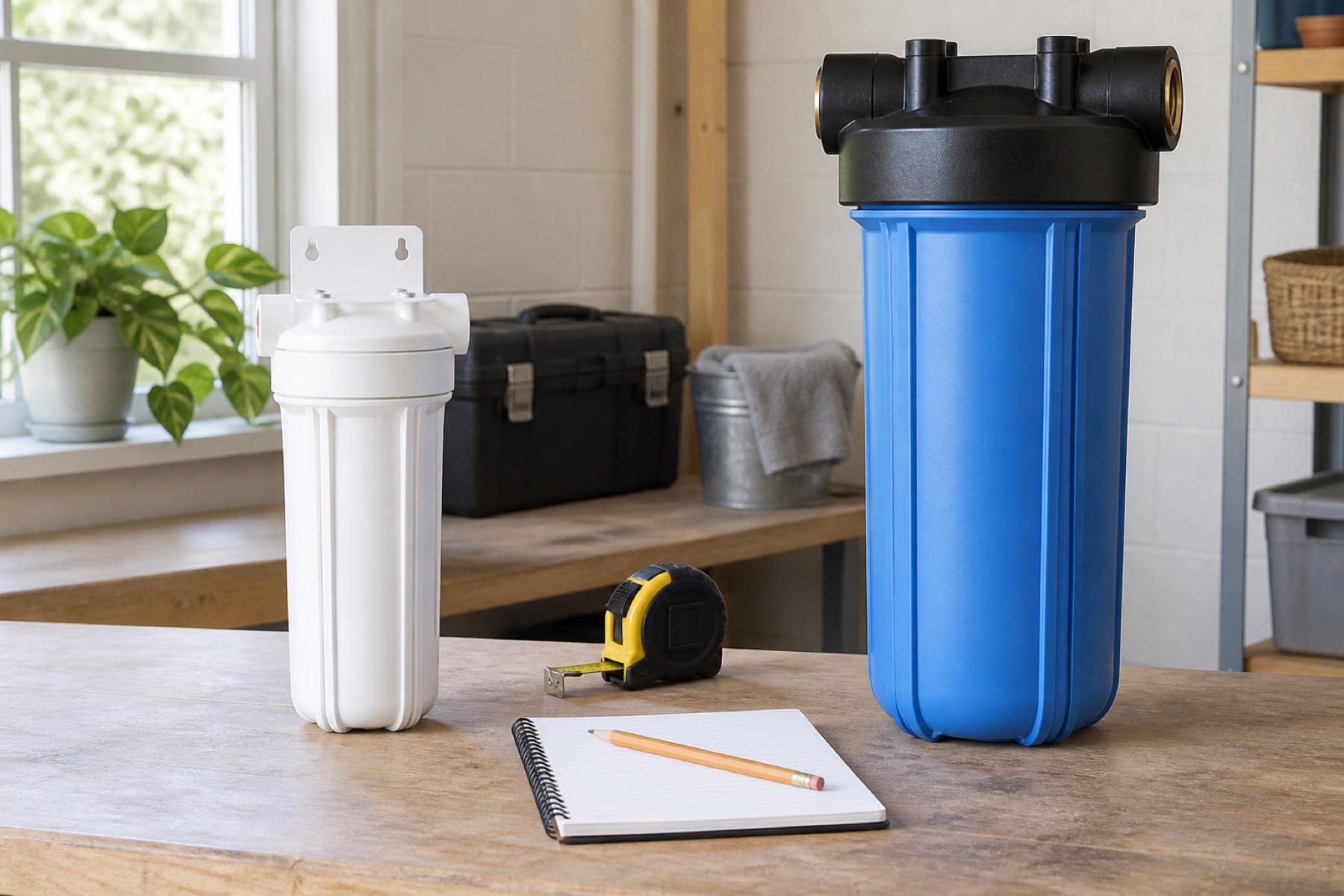
The short answer
Choose SpringWell CSS1 if you want hardness minerals removed and accept salt, regeneration, a drain and more floor space. Choose Kind E-3000 if your priority is a compact, salt-free system and you accept scale conditioning instead of true soft water. The decision is not which brand has more stages; it is which treatment outcome you actually want.
The decision at a glance
Two different hard-water outcomes
SpringWell CSS1
- Carbon filtration→
- Ion-exchange softening→
- Salt and regeneration
Kind E-3000
- Sediment and carbon→
- Salt-free conditioning→
- Cartridge replacements
| Your situation | A sensible next step | Keep in mind |
|---|---|---|
| Hardness removal is essential | SpringWell CSS1 | Ion exchange is designed to remove calcium and magnesium. |
| Avoiding salt and a drain is essential | Kind E-3000 | It conditions scale; it does not deliver the same result as ion exchange. |
| You have not measured hardness | Neither yet | Confirm the problem before buying either system. |
In this guide
- The decision in one sentence
- How the treatment trains differ
- Filtration claims need an exact-document comparison
- Flow: use the slowest relevant stage
- Space and installation: compact does not mean connection-free
- Maintenance: two different kinds of commitment
- Five-year cost: compare the same boundaries
- Water feel, fixtures and expectations
- What the E-3000 cartridge model changes
- What CSS1 regeneration changes
- A worked household scenario
- Price promotions and checkout discipline
- Who should choose SpringWell CSS1
- Who should choose Kind E-3000
- Which system fits a family with genuinely hard water?
- Which system fits a no-drain or no-salt home?
- Questions that reveal an incomplete sales answer
- How to compare ownership without guessing future prices
- Installation details that can change the winner
- What happens when maintenance is delayed
- Returns, freight and warranty costs
- Commissioning: what to check on installation day
- The questions we would send both companies
- Verdict: choose the method before the brand
- Take this checklist into the final quote
- Sources & editorial notes
The decision in one sentence
CSS1 filters city water and then softens it through ion exchange. E-3000 filters city water and uses a salt-free medium intended to reduce scale behavior. Both are sold as whole-house combinations, but the second stage is doing a different job.
If you want lower measured hardness, less soap scum and the familiar feel of soft water, investigate CSS1 first. If you want to avoid brine and mainly care about scale management, E-3000 is the more natural shortlist candidate. Do not let the shared word “softener” hide that distinction.
How the treatment trains differ
SpringWell’s core CSS1 combines CF1 filtration with the SS1 salt-based softener. The current page lists separate tank specifications and a brine tank. Kind’s E-3000 uses three wall-mounted housings for sediment, carbon and its salt-free conditioning stage.
That architecture changes installation, maintenance and the result at the tap. CSS1 needs regeneration infrastructure and salt access. E-3000 needs regular cartridge access and enough wall clearance to service its housings. A photograph of two tidy installations cannot tell you which outcome fits your water.
| Decision | SpringWell CSS1 | Kind E-3000 |
|---|---|---|
| Hardness approach | Ion exchange removes hardness ions | Salt-free conditioning targets scale behavior |
| Routine input | Salt plus prefilter/media schedule | Replacement cartridges |
| Drain | Required for regeneration | No softener regeneration drain |
| Footprint | Treatment tanks plus brine tank | Wall-mounted housings |
| Best-fit priority | True softened-water result | No-salt, compact ownership |
Filtration claims need an exact-document comparison
SpringWell markets CF1 for chlorine, chloramine and other listed city-water concerns. Kind markets E-3000 as sediment and carbon filtration for a wide list of substances. Those summaries are not enough to declare a filtration winner.
Ask for the current performance document for the exact configuration. Check the standard, reduction claim, capacity, flow and test conditions. “NSF-certified parts” is different from an entire system certified for every advertised reduction. Our comparison does not convert component language into a system-wide certification.
Flow: use the slowest relevant stage
SpringWell lists CF1 at 9 gpm service flow and SS1 at 11 gpm. In a series installation, the practical design discussion should account for every stage and the expected pressure loss. Kind’s published materials should likewise be checked for the exact rated flow and pressure conditions of the E-3000 being ordered.
Do not choose from bathroom count alone. List the fixtures likely to operate together, the incoming pressure and the pipe size. Ask the installer to document expected performance when those fixtures run at once. If either proposal cannot answer that question, it is not ready for checkout.
Space and installation: compact does not mean connection-free
E-3000 can be attractive where floor space is limited, but three housings still need a secure mounting surface, plumbing connections and clearance below for cartridge changes. CSS1 needs a level location for its tanks, brine-tank access, a drain route and the required connections.
Price the bypass, valves, connectors, drain work, disposal of old equipment and any electrical work consistently. A DIY-friendly label does not mean every home, code or owner is suited to DIY plumbing. If a leak at the main line would create serious damage, professional installation may be the lower-friction choice.
Maintenance: two different kinds of commitment
CSS1 ownership means checking salt, preventing salt bridges, keeping the brine tank serviceable and confirming efficient regeneration settings. EPA recommends programming around incoming hardness or flow and favoring demand-initiated regeneration. The filter side has its own prefilter and media schedule.
E-3000 removes the salt task but creates a cartridge schedule. Record the exact replacement set, current price, replacement trigger and space needed to complete the job. “No maintenance” is not an accurate description of a system with consumable filters.
Five-year cost: compare the same boundaries
For CSS1, include equipment, freight if applicable, professional installation, bypass and drain work, prefilters, salt, regeneration water and any planned service. For E-3000, include equipment, installation, complete replacement-filter sets, shipping and any service you will not perform yourself.
Do not use today’s sale price as a five-year guarantee. Show it as the checked purchase input, then keep recurring costs in their own rows. The comparison becomes useful when a homeowner can replace any assumption with a local quote or actual household usage.
Water feel, fixtures and expectations
A homeowner who dislikes slippery-feeling softened water may prefer conditioning even when ion exchange is technically effective. Another homeowner may consider the soft-water result the entire reason for buying. Neither preference should be disguised as a performance fact.
Write down the observable result you expect: lower hardness, less scale accumulation, fewer spots, different soap behavior or better disinfectant taste. Then ask which outcomes the proposal can support and how you will judge them after installation.
What the E-3000 cartridge model changes
A cartridge train makes recurring work visible. Ask whether the quoted replacement set includes sediment, carbon and the conditioning stage; whether each stage has the same replacement trigger; and whether capacity is based on time, gallons, water conditions or pressure change. Save the exact part numbers rather than a generic “annual filter set.”
Also ask what happens as filters load. A system can fit the opening-day flow calculation yet feel restrictive later if maintenance is delayed. The useful ownership plan states how the household recognizes a due replacement and what clearance and tools the job requires.
What CSS1 regeneration changes
A demand-initiated softener should regenerate according to capacity and actual use rather than an unexplained fixed calendar. Ask which hardness value is programmed, what reserve capacity is used, how much salt is expected and where the discharge goes. These settings affect both efficiency and the chance of hard water returning between cycles.
Do not copy settings from another household. The same model can serve different hardness and demand. Keep the installer’s commissioned settings and the incoming hardness in the home record so a later service visit begins with facts.
A worked household scenario
Consider a three-bathroom municipal-water home with confirmed hardness, a chlorine taste complaint and no convenient wall for three large housings. If the household wants truly softened water and has a suitable drain, CSS1 naturally moves ahead despite the salt task. The decision follows the desired result and site constraints.
Change two facts: there is no suitable softener drain and the household mainly wants less scale while refusing salt. E-3000 becomes the more coherent candidate, provided its filtration documentation, flow and cartridge plan fit. A universal score would hide why the answer changed.
Price promotions and checkout discipline
Both merchants may use sale prices, bundles or subscription discounts. Record the date, base system, included accessories and shipping separately. Never add an optional UV unit merely because it appears in the cart; disinfection should follow an identified need and appropriate guidance.
Before payment, compare the final cart to the accepted quote. Confirm size, model, bypass, connectors and replacement set. Screenshot or save the order details because product pages and bundles change. The goal is not to defeat a promotion; it is to know exactly what the promotion contains.
Who should choose SpringWell CSS1
CSS1 is the clearer fit when measured hardness is high enough to justify treatment, the household wants hardness removed and the property can support a brine tank and regeneration drain. It is also the better conceptual fit when the buyer would be dissatisfied if a post-installation hardness test remained unchanged.
Skip or reconsider it when local rules restrict discharge, household maintenance will be neglected, space is inadequate or salt-free ownership is a firm requirement. Ask about efficient programming rather than accepting a default schedule.
Who should choose Kind E-3000
E-3000 is the more natural fit when a compact wall-mounted layout, no salt handling and no regeneration drain are central constraints. It may also suit a homeowner whose goal is scale reduction rather than the full experience of softened water.
Skip it if the purchasing requirement is removal of calcium and magnesium hardness or if the buyer expects a conventional softener result. Also pause if the exact filtration claims, rated flow or replacement budget have not been documented for the current model.
Which system fits a family with genuinely hard water?
Suppose a household has confirmed hardness above 10 grains per gallon, is frustrated by scale and soap performance, and wants a lower hardness reading throughout the home. If there is room for the equipment and a compliant drain, CSS1 is the more logical starting point. The salt and regeneration are not incidental disadvantages; they are part of the method that produces the requested outcome.
The homeowner should still verify the CF1 filtration claims against the city report, size for simultaneous use and obtain an installed quote. Choosing the correct treatment type does not excuse weak sizing or an incomplete installation plan. It simply prevents a salt-free conditioner from being purchased for a result it was not designed to produce.
Which system fits a no-drain or no-salt home?
Now consider a household with moderate hardness, no practical drain location and a firm refusal to handle salt. If the goal is to manage scale rather than measure low hardness after treatment, E-3000 becomes easier to justify. Its wall-mounted format can also be useful where floor space is scarce, provided the wall and service clearances work.
The buyer should price complete replacement sets and confirm how flow changes as cartridges load. Avoid treating the absence of salt as the absence of maintenance. This household is exchanging brine-tank work and regeneration for cartridge purchases and replacement work. That can be a good trade, but it should be made deliberately.
Questions that reveal an incomplete sales answer
Ask the CSS1 seller what hardness value will be programmed, how regeneration responds to use and where discharge will go. Ask the E-3000 seller what the conditioning stage changes, what a hardness test should show afterward and which cartridges are included in the annual estimate. For both, ask for rated service flow, connection size, pressure expectations and exact warranty conditions.
A useful answer contains a model, a number, a document or a clearly stated limitation. “Maintenance free,” “soft water without salt” and “handles any size home” are not complete answers by themselves. Request the underlying conditions. If they cannot be supplied before purchase, do not assume they will become clearer after installation.
How to compare ownership without guessing future prices
Use quantities first and prices second. Record how many prefilters, replacement sets, bags of salt and professional visits the plan expects over five years. Add local water and sewer cost for regeneration only if you can support the usage assumption. Keep current prices dated so a future reader can update them instead of treating them as permanent.
Also value the household work involved. Carrying salt, checking a brine tank and responding to a bridge may matter more to one owner; changing large housings and keeping spare cartridges may matter more to another. The lowest spreadsheet total is not automatically the best ownership fit if the maintenance is likely to be postponed.
Installation details that can change the winner
CSS1 may be ruled out by a difficult drain route, inadequate floor space or local discharge restrictions. E-3000 may be ruled out by weak wall support, insufficient housing clearance or a cartridge-flow concern. Incoming pressure, pipe diameter, outdoor exposure and the ability to bypass the system matter to both.
Ask for a drawing that shows treatment order, shutoffs, bypass, drain, support and service envelope. Confirm what happens during maintenance: can the home still receive water, and is untreated bypass water acceptable for that period? A system is not truly compact if the filter housings cannot be opened without removing adjacent equipment.
What happens when maintenance is delayed
Delayed maintenance does not affect these systems in the same way. With CSS1, an empty or bridged brine tank can allow hardness to return, while an overdue prefilter can restrict flow. Poorly chosen regeneration settings can waste salt and water or exhaust capacity before the next cycle. The homeowner needs a simple routine that covers both the filter and softener sides.
With E-3000, loaded cartridges can increase pressure loss and an exhausted stage may no longer provide the intended treatment. Ask for practical replacement triggers instead of relying only on a calendar. Time and gallon estimates assume particular water conditions and use, so record any change in pressure, taste or household demand that could justify an earlier check.
Returns, freight and warranty costs
Before ordering either system, identify how it ships and what must happen if a tank or housing arrives damaged. Record the inspection window, return authorization process, return-freight responsibility and whether installed products can be returned. Plumbing labor is often separate from the product transaction, so a product refund may not recover installation or removal cost.
Break each warranty into covered equipment, labor, shipping and consumables. Confirm whether professional installation, registration or approved replacement parts are conditions. Keep photographs of the installation, model and serial numbers, invoices and maintenance receipts. These records are useful even when no claim occurs because they give a future technician an accurate starting point.
Commissioning: what to check on installation day
Ask the installer to demonstrate the main shutoff, system bypass, leak check, drain path where applicable and the correct way to isolate each system for service. For CSS1, record hardness, capacity and regeneration settings. For E-3000, record the cartridge part numbers, installation date and replacement basis. Do not let the paperwork disappear with the packaging.
Run several fixtures and check for unexpected pressure changes, leaks or unusual noise. Confirm that the treatment train matches the drawing and that water flows in the correct direction. The purpose of commissioning is not to prove every long-term claim in one afternoon. It is to confirm correct installation, establish baseline information and make ownership tasks understandable.
The questions we would send both companies
Ask both sellers to respond to the same short brief: incoming hardness, disinfectant, household size, simultaneous-use estimate, pipe size and installation photographs. Request the correct model, rated service flow, expected clean-system pressure loss, treatment result, included parts and five-year replacement quantities. For CSS1, add salt and regeneration estimates; for E-3000, add complete cartridge-set details.
A written response makes the comparison easier to revisit after a sales call. It also reveals whether a recommendation was designed for the house or copied from a generic bathroom-count chart. If an important answer depends on a local plumber, move it into the installation quote rather than leaving it as an assumption.
Verdict: choose the method before the brand
SpringWell CSS1 wins for the buyer who has decided on true softening. Kind E-3000 wins for the buyer who has decided on salt-free scale conditioning and compact upkeep. Naming one universal winner would erase the most important difference.
Our preferred next step is two written quotes based on the same water report, peak-flow estimate and installation photographs. Ask each provider to state what the hardness reading should do after treatment. That single answer often exposes whether the proposals are being compared honestly.
Take this checklist into the final quote
Do not order until every row has an answer tied to the exact model.
- Incoming hardness and city disinfectant
- Desired result: removal or scale conditioning
- Rated service flow and expected pressure loss
- Complete equipment and bypass list
- Drain, power, wall and floor requirements
- Five-year consumables and salt assumptions
- Warranty conditions affected by water quality or installation
- Who will commission and maintain the system
Products mentioned
We add a buying link only when an approved retailer or affiliate option is available. Always confirm the exact model, current price and availability.
SpringWell CSS1
Confirm the size, drain, brine-tank and peak-flow requirements.
Kind E-3000
Confirm the rated flow, exact replacement set and scale-conditioning expectation.
Put this guide to work
Compare the complete ownership cost
Use the free tool, then download a record you can keep. No email required.
Open the tool →Get the editable pack →Sources & editorial notes
A current-document comparison, not hands-on testing. We reviewed manufacturer product information, manuals and EPA treatment guidance. We do not award performance scores that cannot be supported by comparable independent testing.
- SpringWell CSS1 current specifications
- Kind E-3000 current product information
- Aquasana product information
- EPA WaterSense treatment-selection guide
- EPA explanation of ion-exchange softening
Product details can change. Confirm the exact model and current terms before ordering. How we write and update guides.