 tap
tap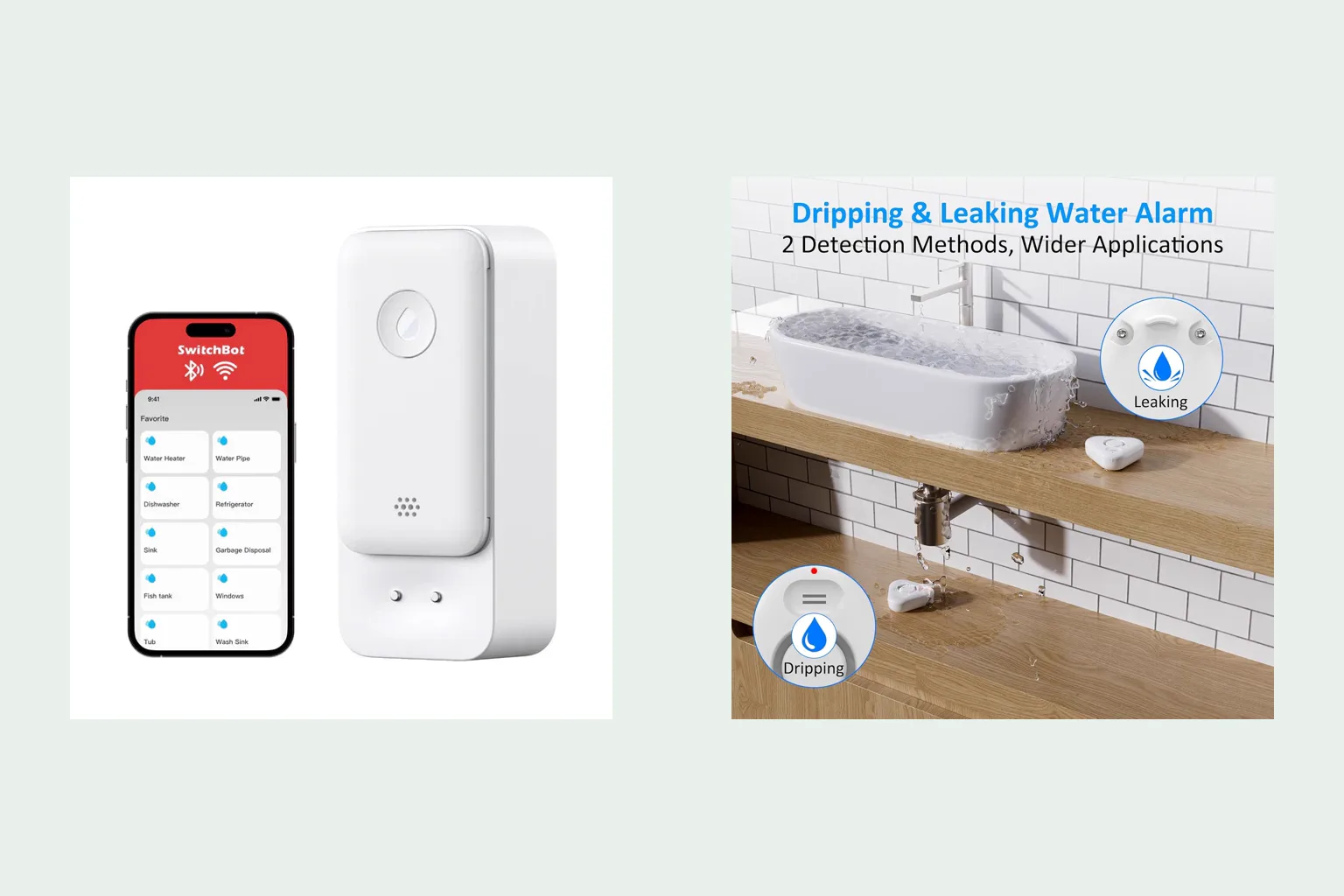
Our recommendation
Choose the $99.95 smart detector when phone notifications let you respond to an empty property. Choose the $29.95 local alarm when someone is usually close enough to hear it or when you want several low-cost sensors. Neither product automatically shuts off the water, and both need correct placement and testing.
The decision at a glance
Remote notice or local sound?
Smart detector
- $99.95→
- Phone alert→
- Confirm app and Wi-Fi
Local alarm
- $29.95→
- Adjustable sound→
- Must be heard nearby
| If this sounds like you | Best next move | What decides it |
|---|---|---|
| Property is often empty | Smart detector | Remote notification can change the response. |
| Someone is usually nearby | Basic alarm | A loud local alert may be enough. |
| Several risk points need coverage | Compare a mixed layout | Use smart alerts strategically and local alarms elsewhere. |
In this guide
- The practical difference
- Pay for remote alerts only when they change the outcome
- Coverage can cost more than the device suggests
- What each product still leaves open
- Who should buy which
- Setup checklist
- A mixed system can be the sensible answer
- Local sound is still useful in a smart product
- Neither device replaces automatic action
- Price coverage by room, not by box
- Frequently asked questions
- Sources & editorial notes
The practical difference
The smart detector connects directly to Wi-Fi and is marketed with smartphone alerts. The basic alarm is a local device with four adjustable volume levels. The current price difference is $70 per sensor.
The smart version lists IP67 water resistance and up to two years of battery life. The basic alarm lists IP66 and up to three years, with batteries included. These are vendor claims that should be checked against the current manuals.
| Feature | Smart detector | Water leak alarm |
|---|---|---|
| Price | $99.95 | $29.95 |
| Alert | Phone notification; confirm local sound | Adjustable local alarm |
| Connection | Direct Wi-Fi; no hub | No network |
| Water resistance | IP67 claim | IP66 claim |
| Battery claim | Up to 2 years | Up to 3 years |
See current HyLine Water Systems options ↗ · See current HyLine Water Systems options ↗
Pay for remote alerts only when they change the outcome
A phone alert has value when the property is empty and a responder can act. If no one can reach the building, the notification describes a problem without stopping it. A basic alarm can be equally useful in an occupied home.
Write the response plan before buying the sensor. That makes the $70 premium a practical decision rather than a feature-count decision.
Coverage can cost more than the device suggests
Water must reach the sensor. A laundry room, water heater, dishwasher and basement low point may each need their own device. Multiply the unit price by the actual placement map.
A mixed layout can make sense: one smart sensor at the highest-consequence remote location and several local alarms where household members are usually nearby. Test whether alarms can be heard through closed doors and on another floor.
What each product still leaves open
Neither page describes a motorized shutoff valve. Neither protects against water entering from rain, groundwater or every drain backup. The smart product page also leaves app and network details unclear; the basic page does not publish a decibel figure.
Ask for current manuals before treating any missing detail as a feature.
Who should buy which
Choose smart for a vacation property, basement or equipment room where remote alerts and reliable Wi-Fi matter. Choose basic for occupied rooms, budget coverage and locations where network setup is undesirable. Choose automatic shutoff when the response plan requires action without waiting for a person.
Setup checklist
Install and test according to the exact manual. Record the battery type and next test date. A sensor hidden and forgotten is not maintained protection.
- Map likely water paths
- Confirm Wi-Fi at smart-sensor locations
- Choose alert recipients and responders
- Test local sound from occupied rooms
- Retest after battery or network changes
A mixed system can be the sensible answer
The comparison does not require choosing one model for the entire property. Put remote notification where absence creates the largest consequence, then use lower-cost local alarms in occupied or lower-risk areas. This can improve coverage without paying $99.95 at every point.
The mixed approach adds two maintenance routines. Keep a simple inventory with location, model, battery type, app assignment and last test date.
Local sound is still useful in a smart product
A phone may be muted, charging elsewhere or outside coverage. Ask whether the smart detector also sounds locally and how loud it is. If it does not, consider a local alarm beside it only when that duplication serves a real response need.
For the $29.95 alarm, test audibility with normal appliances running and doors closed. “Loud” without a published decibel figure is not enough for a distant bedroom.
Neither device replaces automatic action
Both products depend on a person. An automatic shutoff can close a supported valve under configured conditions, but it costs more, requires plumbing compatibility and still has limits.
For an often-empty property, compare the complete response times: detection, notification, human confirmation, travel and shutoff. If that delay is unacceptable, shop the shutoff category rather than adding more alert-only sensors.
Price coverage by room, not by box
Four smart detectors cost $399.80 at current prices. Four local alarms cost $119.80. A mixed plan of one smart detector and three alarms costs $189.80. These arithmetic examples exclude tax and show why placement matters more than the price of one device.
Do not maximize sensor count blindly. Follow actual water paths, appliance connections and the ability to respond.
Frequently asked questions
Which should I choose in the HyLine Smart Leak Detector vs Water Leak Alarm comparison?
Choose the $99.95 smart detector when phone notifications let you respond to an empty property. Choose the $29.95 local alarm when someone is usually close enough to hear it or when you want several low-cost sensors. Neither product automatically shuts off the water, and both need correct placement and testing.
What should decide the comparison?
Property is often empty: smart detector. Remote notification can change the response.
What should I do before ordering?
Draw a placement and response map, then price the number of smart and local sensors the home actually needs.
Put this guide to work
Make a leak-protection purchasing brief
Use the free tool, then download a record you can keep. No email required.
Open the tool →Get the editable pack →Sources & editorial notes
Research-only comparison of current official HyLine product information. We did not test detection speed, sound level, connectivity or battery life.
- HyLine: smart water leak detector specifications
- HyLine: water leak alarm specifications
- HyLine: limited warranty terms
- HyLine: returns and refunds policy
Product details can change. Confirm the exact model and current terms before ordering. How we write and update guides.