 tap
Our recommendation
Choose the standalone metal-removal system when iron, manganese or sulfur is the documented problem and hardness is acceptable. Add the softener only when a hardness test and ownership goals justify ion exchange. The softener does not make the iron media stronger; it adds a separate tank, brine system, salt use and maintenance job.
| If this sounds like you | Best next move | What decides it |
|---|---|---|
| Metals problem without hard water | Standalone | Do not add salt-based treatment without a hardness need. |
| Metals plus confirmed hard water | With softener | Treat two measured problems with separate stages. |
| Need broader chemical filtration | Consider SMART option separately | Do not confuse it with softening. |
| Unknown brown stains | Test first | Iron, manganese and tannins need different treatment. |
In this guide
- Crystal Quest Iron Filter With Softener vs Standalone: our verdict
- What the metal-removal tank does
- What the softener adds
- Use two test results to decide
- Space and installation difference
- Five-year cost difference
- Choose standalone if
- Choose the softener configuration if
- Should you choose Crystal Quest Iron Filter With Softener vs Standalone?
- Frequently asked questions
- Sources & editorial notes
Crystal Quest Iron Filter With Softener vs Standalone: our verdict
Standalone is the cleaner default. Add the softener when measured hardness causes scale or other problems and the household accepts salt regeneration. This keeps the recommendation tied to two water results instead of assuming every well with iron is hard.
Crystal Quest allows standalone, SMART, softener, and SMART-plus-softener configurations in 1.5 or 2.0 cubic feet. That flexibility is valuable only when each stage has a defined job. We have not installed either configuration.
What the metal-removal tank does
The main tank is intended to treat iron, manganese and hydrogen sulfide. A sediment filter sits before it and a carbon filter after it. Crystal Quest states a normal household flow of 9–11 GPM for the 1.5-cubic-foot size and 10–13 GPM for the 2.0-cubic-foot size.
Confirm the maximum iron and manganese levels, pH range, type of iron, risk of iron bacteria and the flow needed for the tank’s cleaning cycle. One iron-filter category cannot solve every iron problem.
What the softener adds
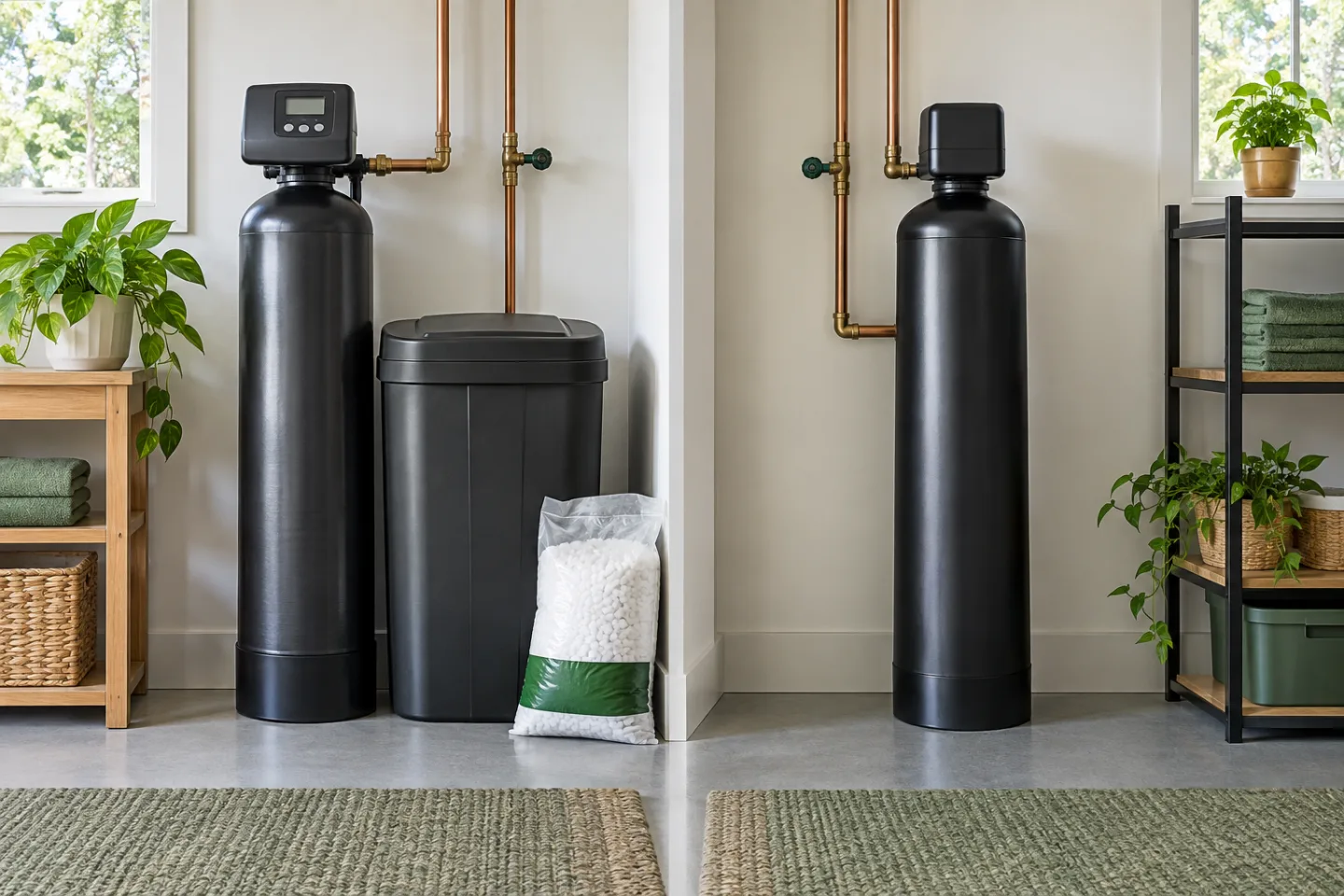
The optional softener has its own treatment tank and salt tank. Crystal Quest lists 48,000- or 60,000-grain sizes. It treats calcium and magnesium hardness and needs salt or potassium, water for its cleaning cycle and regular service.
It does not replace the metal-removal tank. Ask Crystal Quest to show which tank the water enters first and how the two controls are set so they do not clean themselves during heavy household water use.
Use two test results to decide
Record iron, manganese, hydrogen sulfide where available, pH, hardness and peak household flow. Choose standalone when the metals treatment is needed but hardness does not justify softening.
Choose the combined system when hardness treatment independently passes the same cost-and-maintenance test. A hard-water symptom without a numerical result is not enough.
Space and installation difference
The standalone system needs the metal-removal tank, cartridge housings before and after it, a bypass valve, power and a drain. The softener version adds another treatment tank and an approximately 18-by-33-inch salt tank, with room to refill it.
Measure the space needed to service the equipment and route the drain, not just the tank diameter. Confirm the well can supply both cleaning cycles without a large pressure drop.
Five-year cost difference
Standalone costs include installation, cartridges, water used during cleaning, valve service and eventual replacement of the metal-treatment material. The softener adds salt, service for another tank and more cleaning water. SMART filtration adds another treatment bed that will eventually need replacement.
Ask for each tank and filter as a separate quote line. You can then remove an option that the water test does not justify.
Choose standalone if
Choose standalone when hardness is acceptable, the metal-removal method fits the water and the stated flow meets the home’s needs. With one less tank, it is easier to start up, maintain and troubleshoot.
An existing softener may also make the combined package unnecessary. Confirm which tank the water should enter first and whether the equipment can work together.
Choose the softener configuration if
Choose it when measured hardness creates a separate whole-house problem and a professional confirms the combined treatment sequence. Size the softener from hardness and demand, not merely to match the metal tank size.
Plan salt storage and discuss sodium in softened water where relevant. Point-of-use RO can address drinking-water preferences but is another separate decision.
Should you choose Crystal Quest Iron Filter With Softener vs Standalone?
Ask for the standalone iron filter first, then add the softener only if the hardness result shows a separate need. Apply the same rule to SMART filtration.
The best system is not the one with the most tanks. It is the simplest setup that solves every confirmed water problem while still supplying enough water when several fixtures run.
Water terms used in this guide
- Regeneration
- A cleaning or reset cycle. A conventional softener normally uses salty water from its brine tank.
- Point of use
- Treatment for one outlet or appliance, such as the kitchen drinking-water faucet.
Frequently asked questions
Which should I choose in the Crystal Quest Iron Filter With Softener vs Standalone comparison?
Choose the standalone metal-removal system when iron, manganese or sulfur is the documented problem and hardness is acceptable. Add the softener only when a hardness test and ownership goals justify ion exchange. The softener does not make the iron media stronger; it adds a separate tank, brine system, salt use and maintenance job.
What should decide the comparison?
Metals problem without hard water: standalone. Do not add salt-based treatment without a hardness need.
What should I do before ordering?
Put metals and hardness results on separate lines, then require every proposed tank to answer one of them.
Put this guide to work
Estimate softener demand and salt use
Use the matching tool, save the result to My Home Water Plan and return when a quote, test result or service date changes.
Open the tool →Open My Water Plan →Get the editable pack →How we checked this guide
We prepared this configuration comparison using current official product specifications. We did not install or test either configuration.
- Crystal Quest: Metal Removal Whole House Water Filter
- CDC: About home water treatment systems
Product details can change. Confirm the exact model and current terms before ordering. How we write and update guides.