 tap
Our recommendation
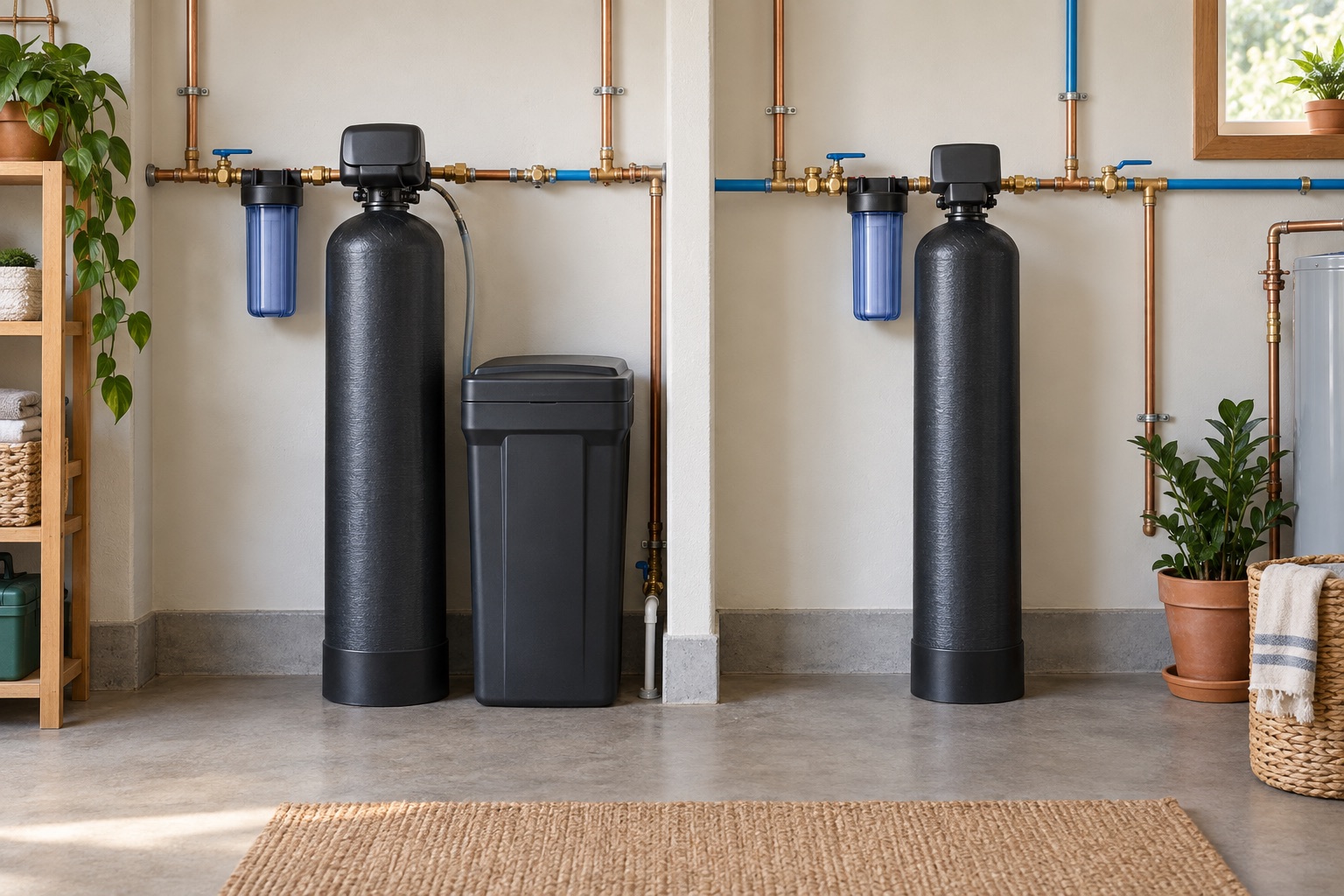
Shortlist iSpring WCFM500K when the laboratory report fits iSpring’s published 3–12 ppm iron use range and you want a defined single-model system. Shortlist Crystal Quest when you need a configurable 1.5- or 2.0-cubic-foot system and can have the media, flow and backwash settings matched to the complete water analysis. Neither should be ordered from odor or staining alone.
| If this sounds like you | Best next move | What decides it |
|---|---|---|
| Published high-iron screening range | iSpring WCFM500K | iSpring directs roughly 3–12 ppm iron to this model. |
| More configuration choices | Crystal Quest | Two media volumes, tank materials and optional companion stages. |
| Published service-flow choices | Crystal Quest | 9–11 or 10–13 GPM depending on size. |
| Simpler exact-model shortlist | iSpring WCFM500K | Fewer configuration branches to price and verify. |
In this guide
- iSpring WCFM500K vs Crystal Quest Metal Removal Filter: the short answer
- Do not buy from color or odor alone
- System design side by side
- Flow and peak household demand
- Backwash supply and drain are purchase gates
- Media life and the misleading gallon headline
- Installation and complete price
- Who should choose iSpring WCFM500K?
- Who should choose Crystal Quest?
- Ask how each system handles different iron forms
- pH, hardness and competing chemistry
- Compare control valves and service support
- Well-pump compatibility worksheet
- startup checks and treated-water verification
- Questions every quote should answer
- Should you choose iSpring WCFM500K vs Crystal Quest Metal Removal Filter?
- Frequently asked questions
- Sources & editorial notes
iSpring WCFM500K vs Crystal Quest Metal Removal Filter: the short answer
Both are automatic backwashing whole-house systems intended for iron, manganese and hydrogen sulfide problems. The meaningful difference is not brand reputation; it is whether the media, tank size, service flow and regeneration conditions fit the laboratory result and the home’s plumbing.
WCFM500K is the more bounded choice for a report that fits iSpring’s stated range. Crystal Quest is the more configurable platform, but every added configuration creates another item to specify in writing. We have not sampled water before or after either system.
Do not buy from color or odor alone
Orange staining suggests iron and rotten-egg odor can involve hydrogen sulfide, but those observations do not identify concentration, iron form, bacteria, pH or competing water chemistry. Order a complete laboratory test appropriate to a private well before selecting treatment.
Record iron, manganese, hydrogen sulfide where available, pH, hardness, turbidity, alkalinity and other parameters recommended by the laboratory or qualified professional. The result determines whether oxidation, sediment treatment, softening, disinfection or another step belongs before or after the filter.
System design side by side
iSpring lists WCFM500K as a 12-by-56-inch, roughly 140-pound backwashing system. Crystal Quest offers 1.5-cubic-foot and 2.0-cubic-foot media configurations, with fiberglass or stainless-steel tank choices and optional SMART, softener, UV and leak-valve additions.
The configurable system is not automatically better. Ask Crystal Quest to identify the exact media, tank, valve, service flow and backwash requirements in the quote. Ask iSpring to confirm the report is inside WCFM500K limits and whether pretreatment is required.
Flow and peak household demand
Crystal Quest publishes service flow of 9–11 GPM for 1.5 cubic feet and 10–13 GPM for 2.0 cubic feet. For iSpring, obtain the current manual’s service and backwash values for the exact valve and installation rather than using a generic whole-house flow headline.
List fixtures that can operate together and have the plumber estimate realistic peak demand. A system can reduce iron effectively at a laboratory flow yet create unacceptable pressure loss when showers, laundry and irrigation overlap. Oversizing also has costs, so match rather than maximize.
Backwash supply and drain are purchase gates
Both systems need adequate supply during automatic backwash and a legal, suitable drain route. A well that serves the house comfortably may still fail to sustain the filter’s backwash requirement. The pressure tank, pump recovery and drain capacity must be assessed together.
Put minimum pressure, backwash flow, duration, frequency and drain size in the quote. Ask what happens during a power outage and whether the valve retains its schedule. Do not route wastewater based on an online article; follow the manual and local requirements.
Media life and the misleading gallon headline
Crystal Quest lists one million and 1.5 million gallons for its two media volumes. Treat those as manufacturer capacity claims tied to stated conditions, not guaranteed household life. WCFM500K is marketed for long service, but actual life depends on contaminant load, water use, backwashing and maintenance.
Request the exhaustion or replacement trigger, media part number, service procedure and disposal expectations. A large gallon number is not a substitute for a water-quality verification plan.
Installation and complete price
Price the equipment, shipping, bypass, connectors, electrical outlet, drain, floor protection, startup and follow-up testing. For Crystal Quest, capture every selected option and tank material. For iSpring, confirm whether the advertised package includes everything shown in the installation plan.
A lower equipment price can lose its advantage if the site needs a longer drain, pump or pressure-tank work. Compare two itemized installed scopes rather than two cart totals.
Who should choose iSpring WCFM500K?
Choose it when iron is in the published high-iron range, sulfur and manganese conditions fit the manual, and the well can support the required backwash. It suits buyers who want a defined model with an approved direct affiliate route and US support.
Skip it when the report is outside its limits, bacterial iron or another chemistry requires a different process, or the drain and pump cannot support backwash. The name “set and forget” should not be interpreted as “test once and never verify.”
Who should choose Crystal Quest?
Choose it when the water professional can use the broader configuration choices to solve a documented treatment setup and Crystal Quest supplies the exact design in writing. The 2.0-cubic-foot option may better fit higher household flow when its backwash demand also fits.
Skip it when the quote leaves media, valve, tank size or companion stages vague. Optional softening or SMART filtration should solve separate measured needs, not be added because the configurator permits it.
Ask how each system handles different iron forms
Iron may be dissolved, already oxidized, organically bound or associated with bacteria. A total-iron number alone does not confirm that the selected media and pretreatment will work. Ask each seller how the laboratory result and visible conditions affect its recommendation.
Do not add disinfectants or attempt well shock treatment from an affiliate comparison. If bacterial iron or a health-related well issue is suspected, use qualified water-well and treatment professionals and follow applicable public-health guidance.
pH, hardness and competing chemistry
Media performance can depend on pH and other dissolved constituents. Send the full report rather than only iron and sulfur. Ask for the acceptable pH, manganese, sulfur and hardness ranges and whether tannins, turbidity or another parameter changes the design.
A separate softener may be appropriate for hardness, but it should not be added automatically to an iron-filter quote. Have the seller explain the order of every stage and what measured problem it solves. This prevents a package configurator from becoming the treatment plan.
Compare control valves and service support
The automatic valve determines when and how the media backwashes. Record its model, programming, power requirements, battery or memory behavior and access to parts. Ask who can service it locally and whether the owner can obtain seals, injectors or a replacement controller.
A long media-life claim is less useful when valve service is difficult. Include the expected service call, travel charge and downtime in the ownership comparison. Keep the startup settings with the water report so another technician can understand the original design.
Well-pump compatibility worksheet
Record static pressure, pressure-switch range, pump recovery, pressure-tank drawdown and the backwash flow and duration requested by the filter. A qualified well or treatment professional can decide whether the system can backwash without starving the house or cycling the pump improperly.
Ask what happens when backwash overlaps with ordinary demand and whether the schedule can be placed at a low-use time. Do not solve inadequate backwash by changing pump or pressure settings without professional assessment.
startup checks and treated-water verification
After installation, confirm the programmed time, hardness or contaminant setting where applicable, backwash sequence, drain behavior and bypass position. Inspect for leaks and unusual pressure loss. Record a pre-treatment sample point and a post-treatment sample point.
Arrange follow-up testing after the system has been flushed and placed into normal operation. The timing should follow laboratory or professional advice. A clear sample and reduced odor are useful observations, but the treatment decision should be verified against the contaminant result it was purchased to address.
Questions every quote should answer
Require exact tank size, media and amount, valve, service flow, pressure loss, backwash flow, drain size, installation scope, warranty, startup and follow-up testing. Ask what condition triggers media replacement and what the expected service costs are.
If one quote provides a complete design and the other only a product name, they are not ready for price comparison. Return the incomplete quote for clarification. The goal is not to make every system identical; it is to expose what each seller is actually proposing.
Should you choose iSpring WCFM500K vs Crystal Quest Metal Removal Filter?
WCFM500K is the clearer first quote for a report inside iSpring’s stated 3–12 ppm iron range. Crystal Quest is the stronger custom-configuration candidate when the household needs a documented size or treatment-train choice.
Choose neither until a laboratory report, peak-flow estimate and backwash assessment are complete. Retest after startup and keep the result with the model and valve settings.
Water terms used in this guide
- Service flow
- The amount of water a system is designed to treat during normal household use, usually shown in gallons per minute.
- Backwash
- A cleaning cycle that sends water backward through a treatment tank and then to a drain.
- Regeneration
- A cleaning or reset cycle. A conventional softener normally uses salty water from its brine tank.
Frequently asked questions
Which should I choose in the iSpring WCFM500K vs Crystal Quest Metal Removal Filter comparison?
Shortlist iSpring WCFM500K when the laboratory report fits iSpring’s published 3–12 ppm iron use range and you want a defined single-model system. Shortlist Crystal Quest when you need a configurable 1.5- or 2.0-cubic-foot system and can have the media, flow and backwash settings matched to the complete water analysis. Neither should be ordered from odor or staining alone.
What should decide the comparison?
Published high-iron screening range: ispring wcfm500k. iSpring directs roughly 3–12 ppm iron to this model.
What should I do before ordering?
Send the same laboratory report and peak-flow estimate to both sellers and compare written, itemized treatment designs.
Put this guide to work
Compare two quotes on the same scope
Use the matching tool, save the result to My Home Water Plan and return when a quote, test result or service date changes.
Open the tool →Open My Water Plan →Get the editable pack →How we checked this guide
We prepared this comparison using current official product pages and manuals. We did not install either system or test treated water.
- iSpring: WCFM500K product information and manual
- Crystal Quest: Metal Removal Whole House Water Filter
- CDC: About home water treatment systems
Product details can change. Confirm the exact model and current terms before ordering. How we write and update guides.