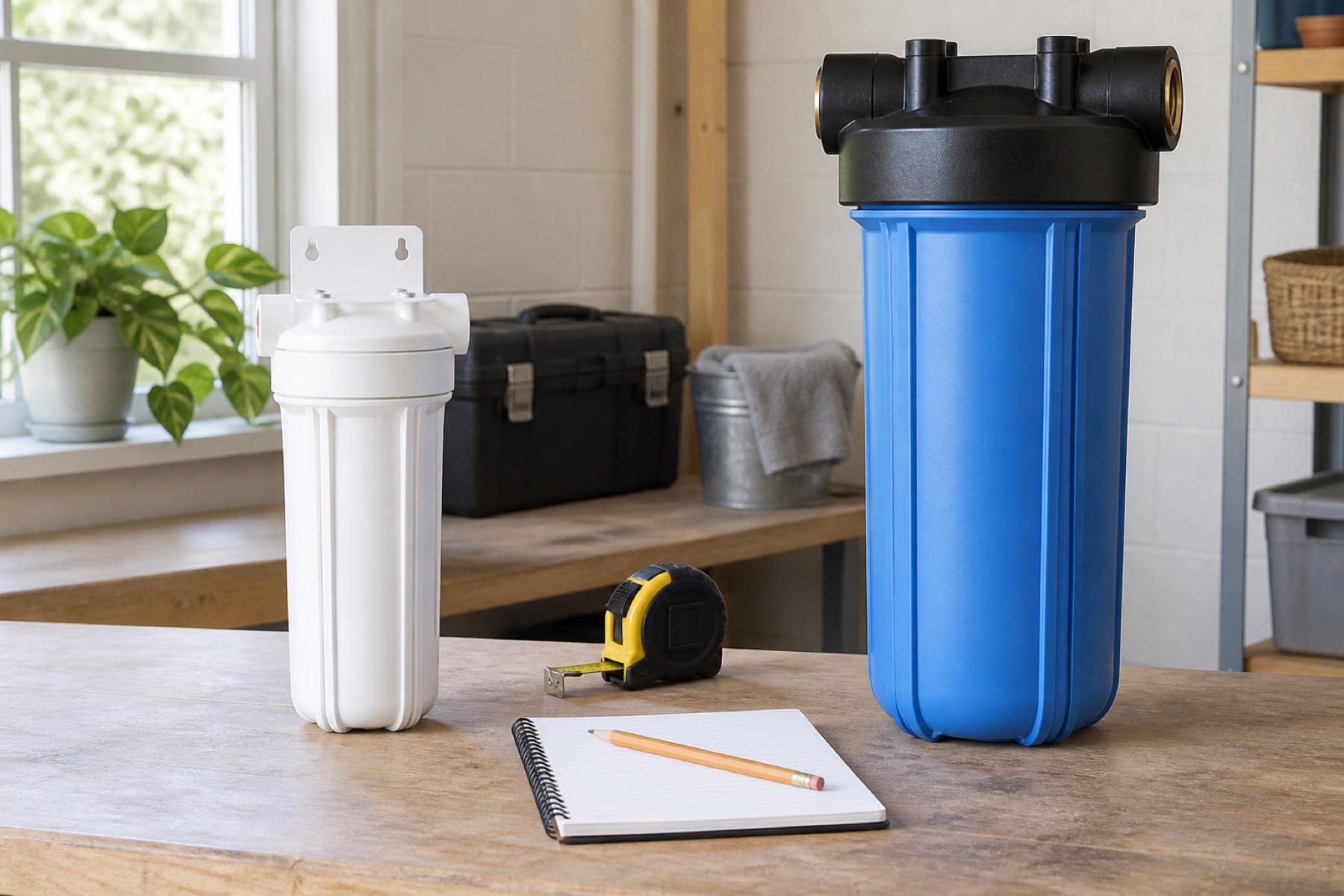
The short answer
Catalytic carbon is generally the more relevant carbon type to investigate for chloramine, but the media label alone does not prove a whole-house result. Choose a complete system with chloramine-specific performance documentation at a flow and capacity suitable for the home. Standard activated carbon can be effective for free chlorine and many adsorption applications, but chloramine is more difficult to remove. Contact time, bed design, incoming concentration and media condition can matter as much as the marketing name.
The decision at a glance
Media name is only the first clue
Activated carbon
- Common chlorine treatment→
- Exact system claim required→
- Flow and capacity matter
Catalytic carbon
- Relevant chloramine candidate→
- Complete-system evidence required→
- Contact time and service matter
| Your situation | A sensible next step | Keep in mind |
|---|---|---|
| Utility uses free chlorine | Activated carbon may fit | Use an exact chlorine claim. |
| Utility uses chloramine | Investigate catalytic carbon systems | Require chloramine-specific data. |
| Media is named but system data is absent | Do not buy from the label alone | Ask for flow, capacity and performance evidence. |
In this guide
- Start with the disinfectant
- What activated carbon does
- What catalytic carbon changes
- Why contact time matters
- Media bed versus cartridge
- NSF/ANSI 42 language
- A useful chloramine performance sheet
- SpringWell’s catalytic-carbon example
- Pressure and peak flow
- Capacity and breakthrough
- Prefilters protect but add upkeep
- Do not confuse carbon with softening
- When point-of-use treatment is enough
- A practical document-reading example
- Cold water, concentration and real conditions
- How maintenance changes carbon performance
- Questions before buying a chloramine system
- What this comparison cannot tell you
- Common carbon-media questions
- Buying questions for any carbon system
- Sources & editorial notes
Start with the disinfectant
Free chlorine and chloramine are both used by utilities, but chloramine is more persistent and more difficult to remove. Confirm the current disinfectant before comparing carbon.
A product chosen for the wrong disinfectant can look impressive and still be a poor match.
What activated carbon does
Activated carbon provides a large surface for adsorption and can reduce chlorine taste and odor when a complete filter is designed and maintained for that purpose. NSF/ANSI 42 covers aesthetic claims such as chlorine.
The phrase activated carbon does not state capacity, flow or every contaminant claim. Those belong to the exact system.
What catalytic carbon changes
Catalytic carbon is modified or selected to improve catalytic reactions, including chloramine reduction. It is widely used in systems marketed for chloraminated water.
That does not make all catalytic carbon products equal. Quantity, contact time, flow pattern, incoming water and replacement condition influence the complete result.
Why contact time matters
Water must interact with media long enough for the intended process. Higher flow can shorten contact time unless the system is designed with adequate media and hydraulics.
This is why a high-flow chloramine claim needs its own evidence. Do not assume a larger plumbing port proves better chloramine treatment.
Media bed versus cartridge
Tank systems can hold substantial media and may offer longer central-media intervals, while carbon-block cartridges can provide a compact, replaceable format. Both can be appropriate when documented for the job.
Compare pressure, service flow, replacement work and claim conditions. The format alone does not decide performance.
NSF/ANSI 42 language
NSF explains that Standard 42 addresses aesthetic effects including chlorine, taste and odor, and its listings include chloramine claims. A certification applies to the listed model and claim, not every product made by the brand.
Read whether a system is certified, independently tested to a standard, or built with certified components. These phrases are not interchangeable.
A useful chloramine performance sheet
Look for exact model, influent and effluent conditions, reduction, rated flow, capacity and test standard. Check whether the model sold in the selected package matches the sheet.
Aquasana WH-1021 is an example with a published 83% chloramine claim and 10-gpm rated flow. Use it as a documentation example, not proof that every Rhino product handles chloramine.
SpringWell’s catalytic-carbon example
SpringWell CF1 lists catalytic carbon, chloramine and 9-gpm service flow. A buyer should request the exact support tying the claim to flow and capacity.
Manufacturer documentation can be useful without being mislabeled as independent certification. State what it is.
Pressure and peak flow
The best media on paper is a poor household fit if the complete system cannot support normal simultaneous use. Build a peak-use scenario and ask for pressure-loss information.
Also consider how a prefilter behaves as it loads. Sizing belongs inside the treatment decision.
Capacity and breakthrough
Carbon performance changes as media is used. A capacity claim should identify the treated substance and replacement point. A taste change is not a reliable universal safety monitor.
Follow the exact maintenance and consider appropriate testing when a specific result must be verified.
Prefilters protect but add upkeep
Sediment prefilters can protect carbon media and equipment, but they introduce pressure loss and recurring replacement. Compare the complete train.
Record part numbers, quantities and clearance.
Do not confuse carbon with softening
Carbon treatment does not remove calcium and magnesium hardness by ion exchange. A carbon tank can appear beside a conditioner or softener in a bundle, but each stage has a separate job.
If scale is also a concern, make a separate hardness decision.
When point-of-use treatment is enough
If the objective is drinking-water taste only, a certified under-sink system can be more proportionate. Whole-house treatment is justified when the desired benefit extends to multiple fixtures.
Compare complete ownership, not just the cartridge price.
A practical document-reading example
Suppose Product A says “premium catalytic carbon” but provides no chloramine percentage, rated flow or capacity. Product B publishes a chloramine performance sheet for the exact model at the household’s needed flow. Product B is easier to evaluate even if its media description sounds less sophisticated.
Now suppose Product A supplies a current third-party listing after you ask. The comparison changes. Save both documents and compare claim, flow, capacity and replacement conditions. The lesson is not that marketing language is false; it is that it is incomplete for the decision.
If neither product supports the household’s peak flow, neither wins. Treatment evidence and hydraulic fit must be satisfied together.
Cold water, concentration and real conditions
Reaction and adsorption performance can vary with water conditions, including temperature and incoming concentration. A laboratory or certification test defines its conditions so results can be understood. Household water may not be identical.
Ask whether the published range covers the utility water and installation temperature. Do not invent a correction factor from an online chart. If the application is unusual, request professional design support.
This is another reason to avoid comparing loose media by weight alone. The complete vessel, flow path and test conditions matter.
How maintenance changes carbon performance
Carbon media has a finite service life. As it is used, treatment can decline, and sediment can alter pressure or flow. Follow the exact replacement trigger and do not wait for an obvious taste change when a specific claim matters.
Prefilters can protect downstream carbon but require their own changes. Backwashing tanks, cartridges and non-backwashing media systems have different service needs.
Keep dates, parts and water-use estimates. A well-maintained modest system can be a better real purchase than a larger neglected one.
Questions before buying a chloramine system
Ask who tested the complete model, which standard or protocol was used, what chloramine reduction was achieved, at what rated flow, and for what capacity. Ask whether the claim applies to the exact size being quoted.
Ask how pressure loss was measured, how service is recognized and what replacement costs. Record any required prefiltration or water-condition limits.
Finally confirm the utility still uses chloramine. The best catalytic-carbon system is unnecessary when the household is solving the wrong disinfectant problem.
What this comparison cannot tell you
It cannot declare all catalytic carbon superior to all activated carbon systems, because complete designs and evidence differ. It cannot predict taste preferences or guarantee a result in an unmeasured installation.
It also cannot choose treatment for lead, PFAS, pathogens or hardness from the media name. Each concern needs its own claim and context.
Use this guide to screen documentation. Use the water report, product sheet and qualified installer to finish the purchase decision.
Common carbon-media questions
Is catalytic carbon a different material? It is activated carbon with enhanced catalytic properties, but exact production and performance vary. Judge the system rather than a simplified label.
Can ordinary activated carbon reduce chloramine? Under suitable conditions it may, but chloramine is more difficult and a complete chloramine-specific claim is more useful for selection.
Does more carbon guarantee better treatment? No. Quantity, flow distribution, contact time, incoming water and media condition matter.
Can I compare pounds of media? Only with caution. Different media, vessels, test conditions and hydraulics make weight an incomplete proxy.
What certification should I look for? Search the exact model and chloramine claim under the relevant Standard 42 listing or performance documentation.
Will a carbon filter remove hardness? No. Hardness removal and scale conditioning are separate technologies.
How do I know when carbon is exhausted? Follow the exact capacity and replacement instructions; taste alone is not a universal monitor.
Is a tank always better than a cartridge? No. Tanks and cartridges trade footprint, contact, flow and service. Choose the documented complete system that fits the home.
Buying questions for any carbon system
Ask for answers tied to the exact model.
- Which disinfectant is in my utility water?
- What exact chlorine or chloramine claim applies?
- At what rated flow and capacity?
- Is the complete system certified, tested, or made with certified components?
- What prefilter and carbon replacement quantities are required?
- What pressure and installation conditions apply?
Put this guide to work
Compare the complete ownership cost
Use the free tool, then download a record you can keep. No email required.
Open the tool →Get the editable pack →Sources & editorial notes
This educational buying guide uses EPA chloramine guidance, NSF standards information and current system examples. It does not provide a chemical-treatment design or rank loose media.
- EPA chloramines in drinking water
- EPA monochloramine removal questions
- NSF explanation of treatment standards
- Aquasana WH-1021 chloramine information
- SpringWell CF-series information
Product details can change. Confirm the exact model and current terms before ordering. How we write and update guides.