 tap
tap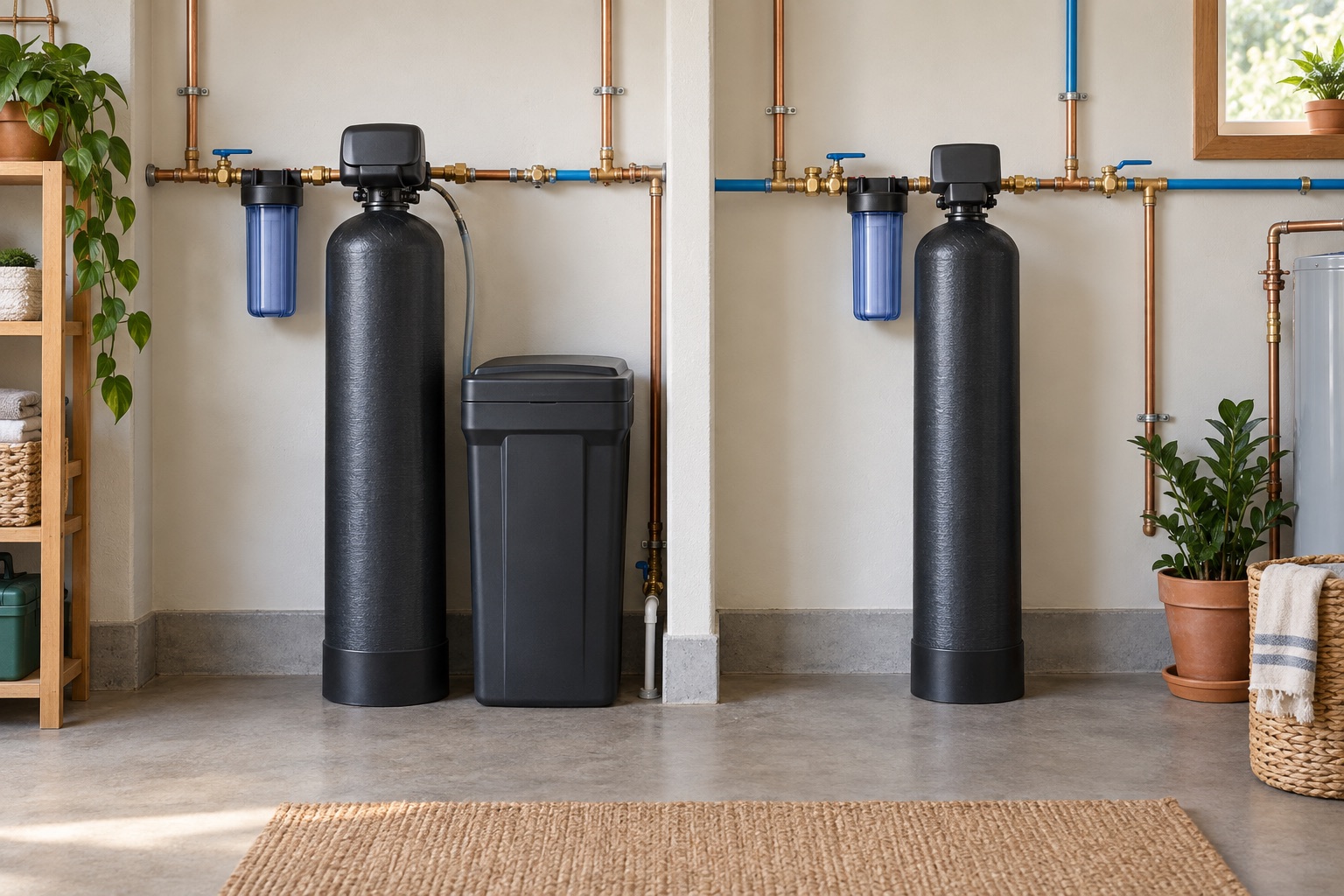
Our recommendation
Choose Shell’s combo when measured hardness and a separate filtration goal both justify treatment. Choose Radiant Life Series 4 when municipal-water filtration is the main job and the household does not need softening from the same system. These are not direct substitutes: Shell includes ion-exchange softening, while Series 4 is a mixed-media filter.
Shell displayed $2,664 for its combo and Radiant Life displayed Series 4 from $2,299 when checked September 28, 2026. Configurations and installation differ.
| If this sounds like you | Best next move | What decides it |
|---|---|---|
| Hard water plus chlorine or chloramine concern | Start with the Shell combo | Verify softener settings and carbon claims. |
| City-water filtration without softening | Start with Radiant Life Series 4 | Match exact claims and flow to the home. |
| Well-water iron, sulfur or bacteria | Use a test-led well design | Neither default package should replace diagnosis. |
In this guide
- The key difference
- Treatment comparison
- Flow and pressure
- Drain, power and floor space
- Maintenance differences
- Price the same outcome
- Evidence and sales claims
- Choose Shell when
- Choose Radiant Life when
- Choose neither when
- Shell vs Radiant Life: the bottom line
- Frequently asked questions
- Sources & editorial notes
The key difference
Shell’s featured salt-based combo uses cation-exchange resin to remove hardness and a catalytic-carbon stage for filtration. Radiant Life Series 4 is positioned as a mixed-media municipal-water filter. It does not become a softener because it is large or expensive.
Start by deciding whether calcium and magnesium hardness must be removed. If yes, compare a softener-inclusive Shell quote with a Radiant Life filter plus a separately specified softener. If no, the Shell package may include equipment you do not need.
Treatment comparison
Both vendors make broad filtration claims. For either one, request exact-model certification or test reports for the priority contaminant. Radiant Life states some Series 4 figures are based on media-manufacturer specifications. Shell’s page mixes product descriptions with a certification reference that should not be assumed to cover every stage.
A utility report tells you what was measured at the public system; a home test may still be appropriate for premise-plumbing concerns. Match the evidence to the actual decision.
| Decision area | Shell combo | Radiant Life Series 4 |
|---|---|---|
| Hardness removal | Salt-based ion exchange included | Not presented as a softener |
| Filtration stage | Catalytic carbon described | Mixed media described |
| Published service flow | 10, 15 or 20 GPM max | 8, 10 or 12 GPM |
| Current starting price | $2,664 sale shown | $2,299 |
Flow and pressure
Shell publishes higher maximum-flow headlines for its larger packages. Radiant Life publishes service-flow figures. Those terms may not be measured under the same conditions, so do not rank the products by the numbers alone.
Ask both vendors for pressure loss at the home’s target flow and the test basis. Include simultaneous fixtures, pipe size and other treatment stages.
Drain, power and floor space
The Shell softener needs regeneration, brine storage, salt access, a drain and power. Series 4’s smallest published size is non-backwashing, while the larger configurations require drain and power.
Draw the installation area with tank dimensions, brine tank, bypass, drain, outlet and service clearances. The best system on paper can be a poor fit in a tight utility closet.
Maintenance differences
Shell involves salt loading, regeneration settings and a sediment cartridge as well as long-life media. Radiant Life promotes low maintenance, but the prefilter, valve and eventual media still require an ownership plan.
Ask each vendor for a year-by-year service list and exact replacement part numbers. Compare paid-service scenarios if you do not expect to maintain the equipment yourself.
Price the same outcome
A fair comparison may require adding a softener to the Radiant Life proposal or removing the softener from the Shell scope. It may also require a drinking-water RO stage if the whole-house system lacks suitable evidence for a specific drinking-water concern.
Use an itemized ten-year view. Include installation, salt, cartridges, valve work, media and any separate drinking-water system. A sale price is not the lifetime price.
Evidence and sales claims
Do not give either brand credit for a claim that is not connected to the exact configuration. Save the certificate or test report with the quote, note the checked date and make the installer confirm what will be verified after startup.
Be especially cautious with health language, broad “all contaminants” implications or standard logos without a model listing. Water treatment is specific to the contaminant, concentration and operating conditions.
Choose Shell when
Shell is the stronger starting point when the household needs verified hardness removal and carbon filtration, values the published 10–20 GPM range and accepts salt handling and regeneration. The final configuration still needs calculations and claim documents.
A single supplier for softening and filtration can simplify support when the quote clearly separates the stages.
Choose Radiant Life when
Series 4 is the cleaner fit for municipal-water filtration without softening, particularly when the smaller non-backwashing size meets flow demand and avoids a drain constraint.
Choose it only after the target claims are documented. The large advertised gallon capacity should not replace a comparison of test conditions and ten-year cost.
Choose neither when
Choose neither default package when private-well chemistry, microbial risk, severe iron or another condition calls for a custom train. Also choose neither when one-tap treatment solves the only verified concern more efficiently.
If hardness is mild and only aesthetic, compare the operating tradeoffs before committing to salt use.
Shell vs Radiant Life: the bottom line
Shell and Radiant Life overlap in whole-house marketing but solve different core jobs. The fastest way to make a bad decision is to compare their package prices before defining hardness removal, filtration evidence and installation constraints.
Frequently asked questions
Which should I choose in the Shell vs Radiant Life comparison?
Choose Shell’s combo when measured hardness and a separate filtration goal both justify treatment. Choose Radiant Life Series 4 when municipal-water filtration is the main job and the household does not need softening from the same system. These are not direct substitutes: Shell includes ion-exchange softening, while Series 4 is a mixed-media filter.
What should decide the comparison?
Hard water plus chlorine or chloramine concern: start with the shell combo. Verify softener settings and carbon claims.
What should I do before ordering?
Write whether hardness removal is required, then request two itemized proposals that deliver the same treatment outcome and include ten-year ownership costs.
Put this guide to work
Compare the complete ownership cost
Use the free tool, then download a record you can keep. No email required.
Open the tool →Get the editable pack →Sources & editorial notes
Research-only comparison of current official product information and independent treatment guidance. We did not install or test either system.
Not Licensed to Radiant Life. This independent editorial article may not be reused by Radiant Life without separate written permission.
- Shell Water Systems: softener and whole-house filtration combo
- Radiant Life: Series 4 specifications
- NSF: verify standards and product claims
- CDC: match treatment to the water problem
Product details can change. Confirm the exact model and current terms before ordering. How we write and update guides.