 tap
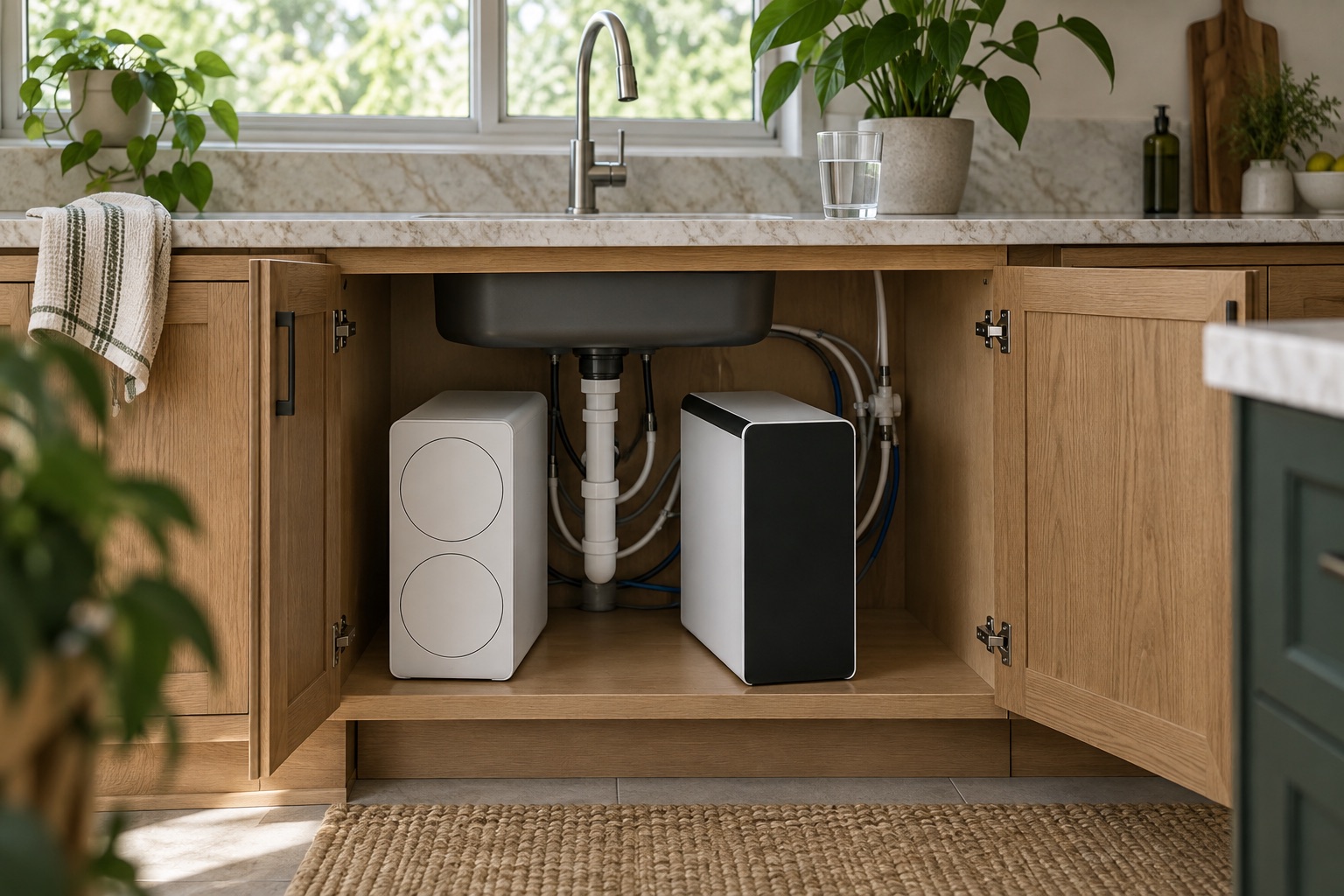
Our recommendation
PD800-TAM4 is the better value when 0.56 GPM is fast enough. Pay more for PD1000-TAM4 only if repeated large fills make its 0.70 GPM delivery useful. Both use a 2:1 ratio and TAM4 remineralization, and both were marked unavailable when checked, so supply may decide the purchase before performance does.
| If this sounds like you | Best next move | What decides it |
|---|---|---|
| Most households | PD800-TAM4 | The lower flow is still fast for glasses and bottles. |
| Frequent large-container fills | PD1000-TAM4 | 0.70 GPM saves time on repeated gallon-scale tasks. |
| Lower planned filter cost | PD800-TAM4 | Its first and RO stages list for less. |
| Better drain ratio | Tie | Both publish 2:1. |
In this guide
- Frizzlife PD800 vs PD1000: the short answer
- Side-by-side specifications
- How much faster is PD1000?
- Treatment and taste are essentially the same decision
- Cabinet fit can reverse the choice
- Replacement cost comparison
- Water efficiency is a tie
- A purchase-price difference is only half the comparison
- Warranty and model-continuity risk
- Use this three-question upgrade test
- Choose PD800-TAM4 if
- Choose PD1000-TAM4 if
- When to choose neither
- Should you choose Frizzlife PD800 vs PD1000?
- Frequently asked questions
- Sources & editorial notes
Frizzlife PD800 vs PD1000: the short answer
The models solve the same job in nearly the same way: tankless RO, a smart outlet-TDS display, a 2:1 pure-to-drain ratio and separate TAM4 remineralization. The purchase question is whether 0.14 GPM of extra stated flow justifies the higher system and cartridge cost.
PD800 is our default choice because 0.56 GPM is already quick for common kitchen use. PD1000 earns its premium only for a household that repeatedly fills large containers. Neither can be recommended without resolving current product and filter availability.
Side-by-side specifications
Compare the practical figures rather than the stage count. Both pages use broad nine-stage language, but the meaningful differences are the membrane class, faucet flow, cabinet length and cartridge set.
| Decision factor | PD800-TAM4 | PD1000-TAM4 |
|---|---|---|
| Published faucet flow | 0.56 GPM | 0.70 GPM |
| Production class | 800 GPD | 1,000 GPD |
| Pure-to-drain | 2:1 | 2:1 |
| Main cabinet | 5.3 × 14.7 × 15.5 in | 17.4 × 5.28 × 15.51 in |
| First stage | ASR211 | ASR411 |
| RO stage | ASR212-800G | ASR412-1000G |
How much faster is PD1000?
Ideal arithmetic puts a one-gallon fill near 107 seconds for PD800 and 86 seconds for PD1000. The difference is about 21 seconds. For an eight-ounce glass, Frizzlife’s examples are roughly seven seconds and five seconds.
Actual flow can fall with cold water, lower pressure, high feed TDS or aging filters. If a 20-second saving on a one-gallon task is not meaningful, do not pay for the larger number.
Treatment and taste are essentially the same decision
Both use RO followed by TAM4 remineralization. Both can show a higher TDS after the mineral stage, and both are marketed for alkaline finished water. There is no reason to choose PD1000 because its water is inherently “more mineralized.”
For either model, confirm the exact reduction claim that matches the water result. The linked testing language should be reviewed model by model; do not transfer a claim from PD800 to PD1000 or vice versa.
Cabinet fit can reverse the choice
PD800’s main unit is shorter in length, while PD1000 is about 17.4 inches long. Both also need the TAM4 housing. A cabinet with a disposer on one side may accept one orientation and reject the other even when total volume looks similar.
Make a scaled paper rectangle for the footprint and include bend radius, outlet, shutoff, drain saddle and cartridge-change access. The “better” flow upgrade is worthless if servicing requires removing the disposer or crushing tubing.
Replacement cost comparison
At the prices checked, PD800’s ASR211 and ASR212-800G were about $33.99 and $89.99. PD1000’s ASR411 and ASR412-1000G were about $43.99 and $109.99. Both can use FZ-4 at about $29.99 or the TAM4-HF kit at about $39.99.
A simple five-year schedule puts PD800 near $500 and PD1000 near $590 before tax and shipping. That roughly $90 difference is smaller than the system-price difference but still belongs in the decision. Availability matters more: several listings were unavailable when checked.
Water efficiency is a tie
Both publish a 2:1 pure-to-drain ratio. PD1000 does not become more efficient simply because it produces water faster. Under stated conditions, making 600 gallons of product water would send about 300 gallons to the drain with either model.
If a better ratio matters, compare a verified 3:1 model. Keep in mind that published ratios are test results and actual recovery varies with conditions.
A purchase-price difference is only half the comparison
Record the normal product price on the same date, not two unrelated sale prices. Add the cartridge schedule, shipping, tax and any installer charge. Then add accessories that differ: a refrigerator kit, mini tank, pressure regulator or extra faucet work. Five years is long enough to expose a cheap system with expensive maintenance.
Do not treat a coupon as permanent value. Frizzlife says codes cannot be combined and may be product-specific. Compare the final checkout totals after the same required accessories are included, and keep screenshots because promotions change.
Warranty and model-continuity risk
The pages state one-year warranty coverage with registration language that may extend it and a 30-day return policy. Confirm the exact terms for both models. A longer return window is not useful if drilling, cutting tubing or running water changes return eligibility.
Model continuity matters because PD800 and PD1000 use different first-stage and membrane cartridges. If one model is being replaced, ask whether its consumables will remain available and whether the successor is backward-compatible. Do not assume a PD-series cartridge fits from the name alone.
Use this three-question upgrade test
First, is 0.56 GPM actually too slow for a repeated task? Second, will PD1000 fit without compromising service access? Third, is its distinct cartridge set in dependable supply? A “no” to any question weakens the upgrade case.
If both models are available and the answers are yes, PD1000 is a defensible convenience upgrade. If not, PD800 or a different current product is the safer choice. This test prevents the larger GPD number from becoming the decision by default.
Choose PD800-TAM4 if
Choose PD800 when ordinary bottles, kettles and glasses dominate; 0.56 GPM is satisfactory; the smaller main cabinet fits; and the lower filter cost is preferable. It is the more rational value choice when stock and evidence are equally sound.
Confirm ASR211, ASR212-800G and FZ-4 supply before purchase. Do not substitute a similar-looking cartridge without manufacturer confirmation.
Choose PD1000-TAM4 if
Choose PD1000 when gallon containers, stockpots or shared-kitchen use occur often enough that 0.70 GPM is useful. Pay for it as a convenience improvement, not because a household is supposed to consume 1,000 gallons a day.
Confirm ASR411 and ASR412-1000G pricing and stock. The model uses different first and membrane stages from PD800, so its ownership plan must stand on its own.
When to choose neither
Choose neither while the official product and key filter listings remain unavailable, when the required contaminant claim cannot be verified, or when no dedicated faucet, drain and outlet can be provided.
A Waterdrop G3P800 or X12 Pro may offer a stronger current availability or efficiency case. A conventional tank RO may suit an outage-prone home, and a simpler carbon filter may be sufficient for taste and odor only.
Should you choose Frizzlife PD800 vs PD1000?
Buy PD800 by default and upgrade only when the fill-time calculation supports PD1000. Keep the extra money if the difference is invisible in your real kitchen routine.
At the research date, however, our immediate recommendation is to wait or confirm supply with Frizzlife. A model comparison is useful only if the chosen system and its replacement filters can actually be maintained.
Frequently asked questions
Which should I choose in the Frizzlife PD800 vs PD1000 comparison?
PD800-TAM4 is the better value when 0.56 GPM is fast enough. Pay more for PD1000-TAM4 only if repeated large fills make its 0.70 GPM delivery useful. Both use a 2:1 ratio and TAM4 remineralization, and both were marked unavailable when checked, so supply may decide the purchase before performance does.
What should decide the comparison?
Most households: pd800-tam4. The lower flow is still fast for glasses and bottles.
What should I do before ordering?
Compare a one-gallon fill at 0.56 and 0.70 GPM, then confirm current system and cartridge stock.
Put this guide to work
Compare two quotes on the same scope
Use the matching tool, save the result to My Home Water Plan and return when a quote, test result or service date changes.
Open the tool →Open My Water Plan →Get the editable pack →How we checked this guide
We prepared this comparison from current official specifications and replacement-filter listings. We did not install or laboratory-test either system.
- Frizzlife: PD800-TAM4 product, specifications and replacement filters
- Frizzlife: PD1000-TAM4 product, specifications and replacement filters
- CDC: About home water treatment systems
Product details can change. Confirm the exact model and current terms before ordering. How we write and update guides.