 tap
tap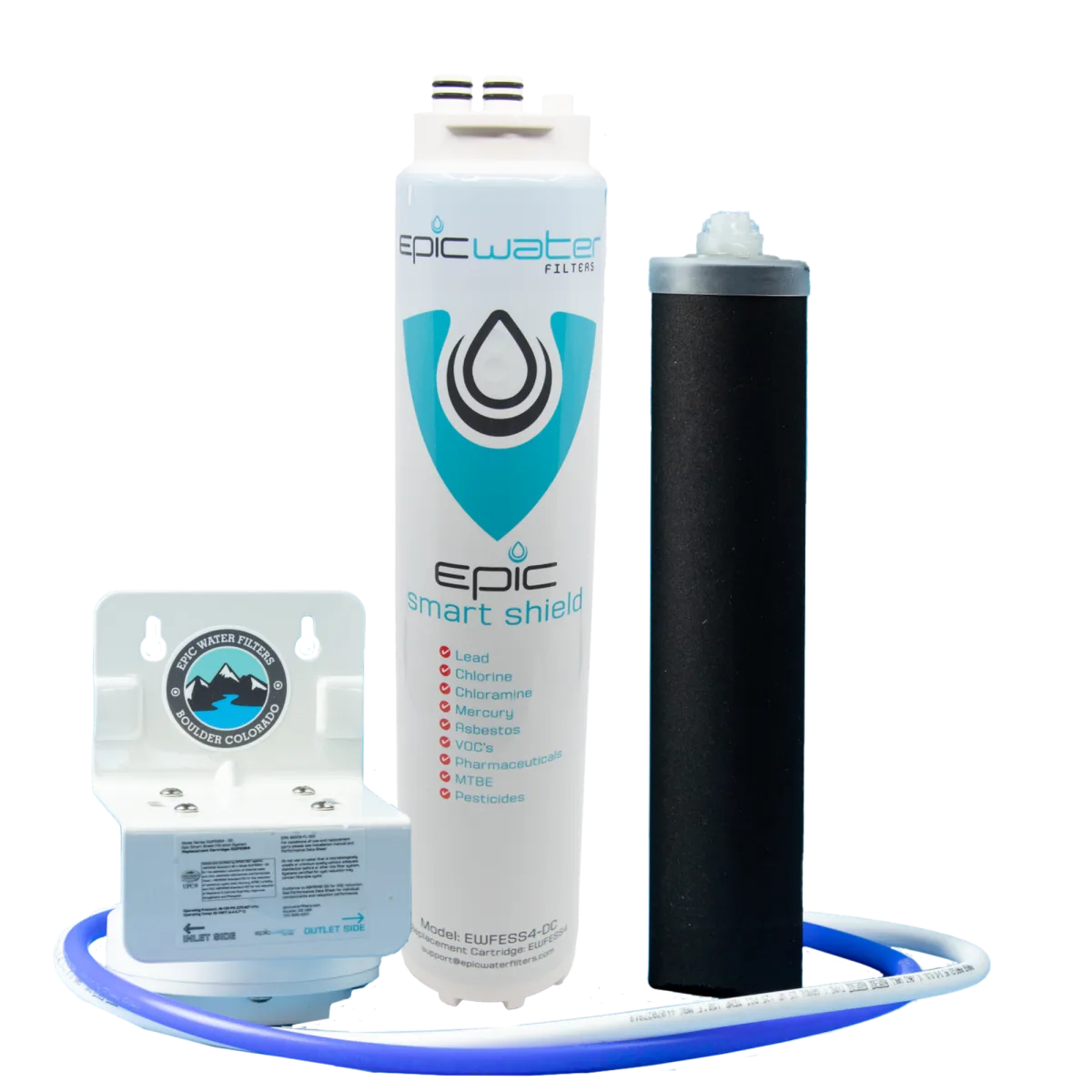
Our recommendation
Choose the original Smart Shield when a current IAPMO certification claim matters more than extra capacity. Choose Smart Shield Max when its exact test data covers your concern and you prefer its 750-gallon rating. The newer model is not automatically the better documented model.
The decision at a glance
Capacity or certification position?
Smart Shield Max
- 750 gallons→
- 0.5 GPM published flow→
- Certification in progress
Original Smart Shield
- 651 gallons→
- IAPMO certification stated→
- Check replacement availability
| If this sounds like you | Best next move | What decides it |
|---|---|---|
| Certification position | Original Smart Shield | Epic states IAPMO certification to NSF/ANSI 42, 53 and 401. |
| Higher stated capacity | Smart Shield Max | 750 gallons versus 651 gallons. |
| More cautious choice today | Original Smart Shield | Easier certification status to verify. |
| Buy neither when | The claim or flow does not fit | Use the water result and household routine first. |
In this guide
- Epic Smart Shield Max vs. Smart Shield: the short answer
- Side-by-side buying comparison
- Certification beats a longer feature list when confidence is the goal
- Capacity difference in real household use
- Flow and faucet experience
- Dimensions and cabinet fit
- Replacement cartridges decide long-term value
- Choose Max when these conditions are true
- Choose the original when these conditions are true
- When neither model is right
- How we compared the two models
- Create an evidence ledger for both models
- Worked capacity examples
- Replacement availability can decide the winner
- Compare price per useful gallon carefully
- Installation should be similar, but verify it
- Decision scenario: certification-first buyer
- Decision scenario: capacity-first buyer
- Decision scenario: renter or uncertain plumbing
- Final decision rule
- Questions the product pages do not settle for you
- Do not compare features that perform no useful job
- Plan for the next cartridge before choosing the housing
- Final comparison checklist
- Frequently asked questions
- Sources & editorial notes
Epic Smart Shield Max vs. Smart Shield: the short answer
These systems share the same general job: filter the kitchen cold-water line and deliver through the existing faucet. Their most important difference is evidence status, not appearance. Epic currently describes the original as IAPMO certified, while its Max FAQ says certification is still in progress.
The Max adds 99 gallons of stated capacity. That is about 50 days at two gallons per day, or about 25 days at four gallons per day. Extra capacity is useful, but it is not enough by itself to outweigh a certification preference or a better claim match.
See current Epic Water Filters options ↗ · See current Epic Water Filters options ↗
Side-by-side buying comparison
Use this table to decide which difference matters. Prices and availability change, so the table focuses on durable decision factors.
| Decision | Smart Shield Max | Original Smart Shield |
|---|---|---|
| Evidence status | Epic says third-party tested; certification in progress | Epic says IAPMO certified |
| Stated capacity | 750 gallons | 651 gallons |
| Installation | Existing cold-water line and faucet | Existing cold-water line and faucet |
| Best reason to choose | Specific Max test result and extra capacity | Clearer current certification position |
Certification beats a longer feature list when confidence is the goal
A long contaminant list attracts attention, but buyers need a verifiable claim for the exact model. The original’s stated IAPMO certification gives it a simpler evidence story. Confirm the current public listing and the claim you need rather than relying only on a product-page badge.
The Max may still be the right product when its independent report directly addresses your concern. The fair conclusion is not that tested products are bad; it is that tested and certified describe different assurance levels.
Capacity difference in real household use
Rated gallons become meaningful only after you estimate use. At two gallons daily, 651 gallons is about 10.7 months and 750 gallons is about 12.3 months. At four gallons daily, those estimates fall to about 5.4 and 6.2 months.
Both calculations assume volume is the limiting factor. Water quality, flow decline or the manufacturer’s time limit may require earlier replacement. Treat rated life as a ceiling, not a guaranteed schedule.
Flow and faucet experience
Epic publishes 0.5 GPM for the Max. The original listing should be checked for its current rated flow before treating the two as identical. Even when the housings connect the same way, cartridge design and test conditions can change delivery.
For either model, direct connection means all cold water from that faucet passes through the filter. That is convenient for drinking and cooking, but it also uses cartridge capacity for rinsing or other cold-water tasks. A dedicated faucet separates those uses.
Dimensions and cabinet fit
Epic lists the original at approximately 19.75 by 4.5 by 4.25 inches. Check the current Max dimensions and installation diagram directly because cabinet pipes, disposal units and shelf lips can make a small difference decisive.
Measure the mounting surface and service clearance, not only the empty rectangle beside it. You need room to route tubing, operate the shutoff and remove the cartridge without dismantling the cabinet.
Replacement cartridges decide long-term value
Record the exact replacement part and current price for each model. The Max replacement was $129 when checked. The original replacement appeared unavailable in current catalog data during our research, which is a meaningful ownership concern even if stock later returns.
Do not choose the lower system price before verifying replacement availability. A filter is an ongoing consumables commitment. If one cartridge is difficult to source, the apparent saving can disappear quickly.
Choose Max when these conditions are true
Max is the better fit when its current reduction report directly covers the water concern, the buyer accepts tested-not-yet-certified status, its 0.5 GPM flow suits the kitchen and the replacement price is sustainable.
It is also reasonable when the extra capacity prevents an additional replacement during the household’s normal year. Calculate that from actual use rather than marketing language.
Choose the original when these conditions are true
The original is the more defensible choice when a current certification claim is the priority and its 651-gallon capacity is sufficient. Verify that both the system and replacement cartridge are available before ordering.
A certified product is still not universal treatment. Confirm the precise reduction claim and rated capacity within the certification documentation.
When neither model is right
Choose another route if the household needs a dedicated faucet, reverse osmosis, higher flow, hardness removal, well-water treatment or a reduction not supported for either exact model.
The best under-sink filter is not the model with the longest claim list. It is the one whose evidence, installation, flow and recurring cost align with one defined need.
How we compared the two models
We treated Smart Shield Max and the original Smart Shield as separate products. We did not transfer a certification claim, gallon rating or flow figure from one housing to the other. The comparison uses the current pages and supporting documents available on the checked date.
The model name matters because certification and testing attach to defined products and configurations. A newer version can add useful capacity while temporarily having a less mature certification position. That is why this comparison does not use a simple “Max wins” score.
We have not installed either system. The verdict is about documented buyer fit, not a hands-on claim about taste, build quality or measured filter life.
Create an evidence ledger for both models
Make two columns and list each substance that matters. For the original, record the standard and current IAPMO listing or certificate that supports the claim. For Max, record the independent test report and its rated endpoint. Leave a blank where evidence is unavailable rather than assuming both products share the same reduction because they use similar language.
Next, add the exact system and replacement-cartridge model numbers. A complete-system certification may depend on the housing and cartridge being used together. A compatible-looking cartridge or a claim from a predecessor should not be substituted without documentation.
This ledger turns a vague brand comparison into an auditable treatment decision. It also makes future updates easier: when Max gains a public certification listing, one line can be changed without rewriting the whole conclusion.
Worked capacity examples
At 1.5 gallons per day, the original’s 651 gallons represents about 434 days and Max’s 750 gallons about 500 days before applying any time limit. At 3 gallons per day, the estimates become about 217 and 250 days. At 5 gallons per day, they fall to roughly 130 and 150 days.
The difference remains 99 gallons in every case. Its value depends on whether that extra volume crosses a meaningful replacement boundary. If both models still require one cartridge within the same year, the larger number may not save a cartridge. If one falls just short of the household’s annual volume, Max could avoid an inconvenient midyear change.
Always apply the shorter of the stated time or volume limit and consider actual water conditions. Capacity mathematics cannot predict clogging, unusual contaminant loading or household changes.
Replacement availability can decide the winner
A durable housing has little value without the correct cartridge. During this research, current catalog data showed the original replacement as unavailable while the Max replacement had a listed price. Stock can change quickly, so this is a pre-purchase check rather than a permanent criticism.
Ask Epic whether the original cartridge is temporarily unavailable, discontinued or replaced by a new part number. Request written confirmation of cross-compatibility before accepting another cartridge. A product page that fits physically is not enough.
If original cartridge supply is uncertain, the clearer certification story may be outweighed by ownership risk. If supply is stable when you buy, retain a link or part number and set a reminder well before the first replacement is due.
Compare price per useful gallon carefully
Divide cartridge price by the supported capacity for the exact claim you need—not automatically by the largest headline capacity. If Max costs $129 for a 750-gallon endpoint, the simple headline figure is about 17 cents per gallon. The original calculation requires its current replacement price and applicable 651-gallon endpoint.
This figure excludes installation, shipping, water used during flushing and early replacement. It also assigns no value to a stronger evidence position. Price per gallon is helpful only after both products have met the treatment requirement.
A cheaper unsupported gallon has no value for a contaminant decision. Conversely, paying more for claims unrelated to the household’s goal is not prudent.
Installation should be similar, but verify it
Both systems use the existing cold-water line and faucet, which should make their installation patterns similar. Do not assume brackets, tubing length, connector sizes or service clearance are identical. Compare the current manuals before choosing based on an older installation photograph.
Measure the original model’s listed 19.75-inch height against the Max diagram and the actual cabinet. Include cartridge removal and tubing bends. If a garbage disposal or shelf blocks access, the smaller-looking product photograph may still be the harder fit.
Ask whether switching between the models later requires new mounting holes or fittings. A reusable layout can add value, but only if Epic confirms the parts are compatible.
Decision scenario: certification-first buyer
A buyer concerned about a health-related substance may prefer a currently certified product whose exact claim appears in a public directory. If the original supports that precise reduction and its replacement supply is stable, it is the more straightforward choice.
That buyer should still verify rated capacity, installation and flow. Certification is evidence of performance to a defined standard; it does not mean the system treats every contaminant or suits every water source.
If Max later receives the relevant certification, compare again using the current listing rather than this snapshot.
Decision scenario: capacity-first buyer
A household with a supported taste, odor or other Max claim may prioritize the 750-gallon rating and available replacement path. The extra 99 gallons can be useful where usage places the original just below a planned service interval.
That buyer should consciously accept the current tested-not-certified distinction. Saving the independent report and monitoring certification status is better than ignoring the difference.
Capacity should not be the priority when the household routinely uses enough cold water that either cartridge would be changed very frequently. A dedicated faucet or different higher-capacity format could be the better design.
Decision scenario: renter or uncertain plumbing
Both systems alter the cold-water connection, even if the work is reversible. A renter needs written permission and a plan to restore the original connection. Neither product is ideal where the valve is old, access is poor or the owner prohibits plumbing changes.
A countertop or faucet-mounted filter may reduce installation friction, though its evidence, flow and cartridge costs must still be checked. Do not force either Smart Shield into a property simply because it is compact.
For an owner planning a kitchen renovation soon, delaying the purchase can be sensible. The new faucet and cabinet layout may create a better dedicated-filter option.
Final decision rule
Choose the original only when its current certified claim matches the concern, replacement supply is confirmed and 651 gallons is sufficient. Choose Max only when its exact test data matches the concern, its current evidence status is acceptable, replacement cost is sustainable and the added capacity is useful.
If one model wins only because of a sale price, calculate at least three years of cartridge cost. Consumables can reverse the opening-price advantage quickly.
If neither passes the evidence, flow, fit and ownership tests, move to another model. Brand familiarity is not a reason to compromise the treatment decision.
Questions the product pages do not settle for you
Neither product page can decide whether point-of-use treatment is sufficient for your home. A concern affecting showers, laundry or every tap requires a different location decision. Nor can a product page diagnose hardness, iron, sediment, sulfur odor or a private-well safety issue from appearance alone.
The pages also cannot tell you whether your valve, supply hose and cabinet are suitable. Product dimensions help, but an actual plumbing inspection resolves corrosion, nonstandard fittings and service access. Treat these as property questions rather than product weaknesses.
Finally, the pages cannot predict how often your household will exhaust a cartridge. That requires a usage estimate and attention to the applicable time limit. Write down the unresolved questions so a sales answer does not get mistaken for evidence.
Do not compare features that perform no useful job
A broader contaminant list is valuable only where the household needs one of those supported reductions. Extra capacity matters only if it changes a replacement interval. A smaller housing matters only if the cabinet is constrained. Converting each feature into a household consequence removes most marketing noise.
The same principle applies to certification. A certification claim is valuable because it independently verifies defined performance and materials—not because a logo makes water universally safe. Locate the exact scope.
When a feature cannot be connected to the water result, kitchen routine, installation or ownership cost, leave it out of the final decision.
Plan for the next cartridge before choosing the housing
Check where the replacement is sold, whether it can be shipped to the property, the normal price outside promotions and what happens if it is unavailable. Consider ordering a spare only when storage conditions and shelf life are clear; stockpiling without that information can waste money.
Set a reminder before the estimated replacement date rather than on it. This gives time to confirm the part number and stock. Keep the old order record so a renamed product cannot quietly change the specification.
If Epic later consolidates the two product lines, request written confirmation of which cartridge, certification and capacity apply to the installed housing.
Final comparison checklist
Before choosing, place five confirmed facts beside each model: the exact reduction you need, evidence status, applicable capacity, current replacement price and replacement availability. Add the measured cabinet fit and expected daily gallons.
Reject any column that still depends on a claim borrowed from the other model. If the final choice still feels close, prefer the option with easier consumable supply and clearer documentation rather than the one with a marginally larger specification.
Keep the completed sheet. It gives you a reasoned purchase record and a fast way to reassess the decision when price, certification or stock changes. Record who will handle the next cartridge order.
Frequently asked questions
Which should I choose in the Epic Smart Shield Max vs. Smart Shield comparison?
Choose the original Smart Shield when a current IAPMO certification claim matters more than extra capacity. Choose Smart Shield Max when its exact test data covers your concern and you prefer its 750-gallon rating. The newer model is not automatically the better documented model.
What should decide the comparison?
Certification position: original smart shield. Epic states IAPMO certification to NSF/ANSI 42, 53 and 401.
What should I do before ordering?
Choose from certification status, exact claim fit and replacement availability—not the word “Max.”
Put this guide to work
Compare the complete ownership cost
Use the free tool, then download a record you can keep. No email required.
Open the tool →Get the editable pack →Sources & editorial notes
Research only. We assessed current product pages, performance documents, policies and replacement requirements; we have not installed or laboratory-tested these systems.
- Epic Smart Shield Max product page
- Epic Smart Shield product page
- NSF guide to drinking-water treatment standards
- Epic returns, exchanges and warranty
Product details can change. Confirm the exact model and current terms before ordering. How we write and update guides.