 tap
tap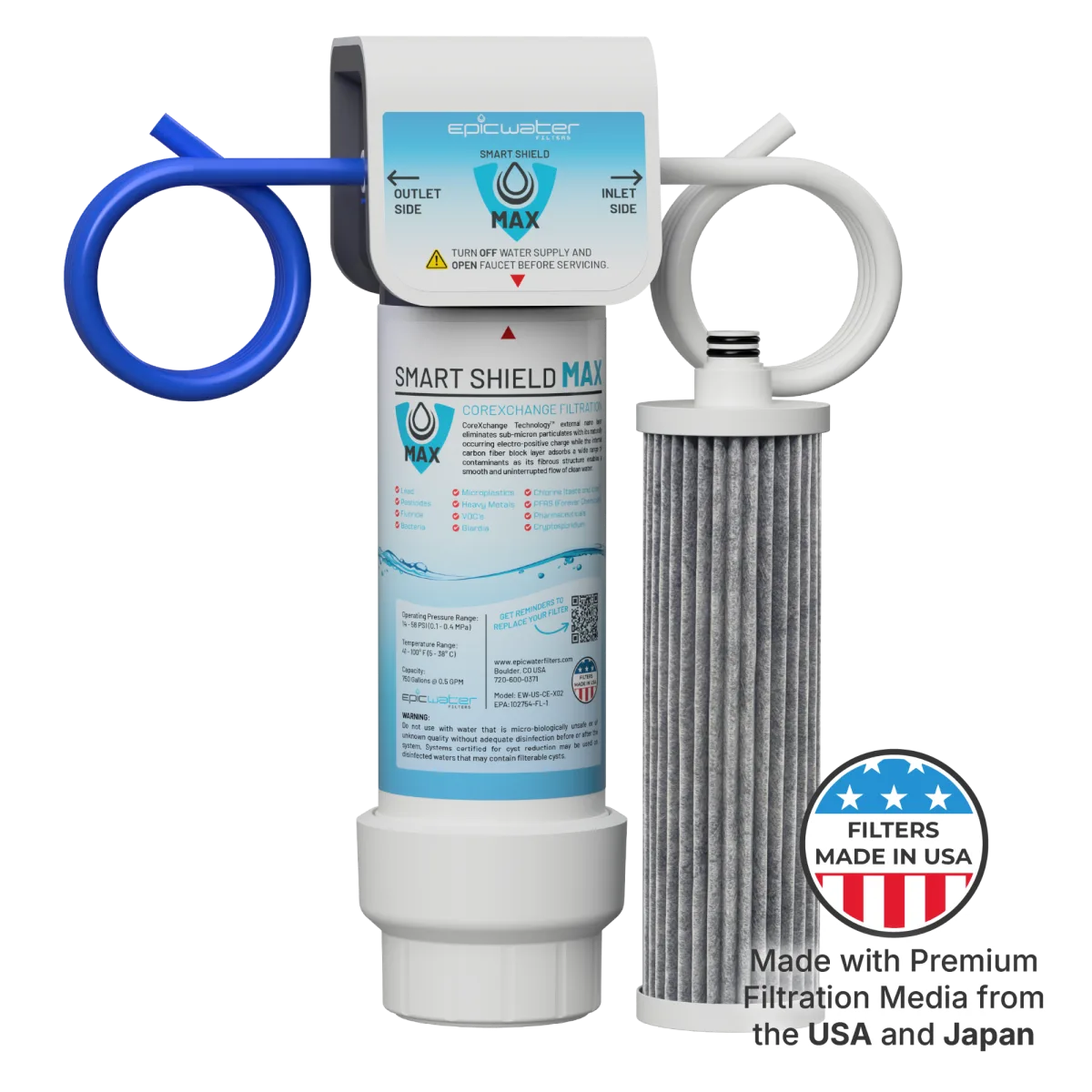
Our recommendation
The Epic Smart Shield Max is a sensible shortlist choice for a homeowner who wants one compact under-sink filter on the existing cold-water line and accepts moderate 0.5 GPM delivery. Its strongest limitation is not size or installation: Epic says the system has been independently tested to several NSF/ANSI standards, but also says complete third-party product certification is still in progress. Buy it only after the published reduction data covers your actual concern.
The decision at a glance
The Max buying gate
Verify
- Named water concern→
- Exact Max reduction result→
- Tested—not currently certified
Fit
- 0.5 GPM routine→
- Cold-line connection→
- Cartridge clearance
Own
- 750-gallon ceiling→
- $129 checked replacement price→
- Current return terms
| If this sounds like you | Best next move | What decides it |
|---|---|---|
| Best fit | One kitchen tap with a defined filtration goal | Check the exact reduction result first. |
| Main advantage | Compact direct-connect format | No separate drinking-water faucet is required. |
| Main drawback | 0.5 GPM operating flow | Expect slower delivery than an ordinary unfiltered faucet. |
| Evidence caution | Tested, not currently product-certified | Do not treat those terms as interchangeable. |
In this guide
- Epic Smart Shield Max: our verdict
- What you are buying
- The filtration evidence, in plain English
- Tested versus certified: why the wording matters
- Will 0.5 GPM feel slow?
- Installation and space checks
- Replacement cost and the real annual budget
- Returns and warranty limits to know before installation
- Who should buy it?
- Who should not buy it?
- What to check before you order
- How we assessed the Smart Shield Max
- Build a one-page claim check before checkout
- A practical flow test you can do before buying
- Three annual cartridge scenarios
- Questions to ask Epic before purchase
- Installation quote checklist
- First-week commissioning record
- Alternatives worth comparing
- Frequently asked questions
- Sources & editorial notes
Epic Smart Shield Max: our verdict
Smart Shield Max improves on the original model’s stated capacity and uses a compact direct-connect layout. At the checked price of $149, it sits above many basic carbon filters but below premium multi-stage and reverse-osmosis systems. The purchase makes sense when its documented reductions match the substances you want to address and when 0.5 GPM is acceptable at the kitchen sink.
The product is less convincing for a buyer who wants the clearest possible certification trail. Epic’s own FAQ says the Max is not yet third-party product certified, even though the company describes third-party testing to NSF/ANSI 42, 53, P231 and 401. That does not make the test data meaningless; it means buyers should read the actual report and avoid translating “tested to” into “certified.”
What you are buying
The Max is a single-cartridge under-sink filtration system that connects to the existing cold-water supply. Water continues through the normal kitchen faucet, so there is no second faucet to drill into the counter. The current package shows the housing, cartridge, tubing and connection hardware.
Epic lists a 750-gallon cartridge capacity and an operating flow of 0.5 gallons per minute. Capacity is a volume limit, not a promise that every household receives the same number of months. A home using two gallons a day would reach 750 gallons in about twelve months; a home using four gallons a day would reach it in roughly six months. Water conditions can also shorten useful life.
The filtration evidence, in plain English
NSF/ANSI 42 commonly covers aesthetic effects such as chlorine taste and odor. Standard 53 addresses specified health-related reductions. Standard 401 covers certain emerging compounds, while P231 is a microbiological purifier protocol. A standards number alone does not mean a product removes every substance associated with that standard. The exact reduction table, test conditions and rated capacity control the claim.
Epic publishes a performance document and a long list of reduction claims. Use that document as a lookup tool: find the substance from your utility report or water test, confirm that the Max appears on the report, then record the tested influent, effluent, percentage reduction and capacity. If the substance is absent, do not infer removal from the carbon media or the number of listed standards.
Tested versus certified: why the wording matters
Independent testing can provide useful product data. Certification adds an ongoing program in which a recognized certification body evaluates the product against a standard and normally maintains a public listing. These are related forms of evidence, but they are not the same status.
The original Smart Shield page states that model is IAPMO certified to NSF/ANSI 42, 53 and 401. The Max FAQ says certification is in progress. If certification status is the deciding factor, the original model may be the more comfortable choice today even though its capacity is lower. If Max becomes certified later, we would reconsider this tradeoff.
Will 0.5 GPM feel slow?
At the published operating flow, one gallon takes about two minutes in ideal conditions. Filling a 24-ounce bottle takes roughly 23 seconds. Actual delivery depends on pressure, plumbing and the condition of the cartridge. That is reasonable for glasses, kettles and bottles, but it can feel slow if the same faucet is used to fill large pots repeatedly.
Before ordering, time your current faucet while filling a measured one-gallon container. Then compare that routine with a two-minute filtered fill. This simple test tells you more about fit than the word “high flow.” If you want unrestricted cold water for washing and filtered water only for drinking, consider the dedicated-faucet bundle instead.
Installation and space checks
Direct-connect installation is simpler than a dedicated-faucet or drain-connected RO system, but it still involves the pressurized cold-water line. Confirm the connection size, shutoff condition, tubing route, mounting clearance and whether the cabinet remains usable after installation. Do not begin if the shutoff does not work reliably.
Measure for the full housing plus the clearance required to remove the cartridge. Photograph the valve and supply hose before ordering. Renters should obtain written permission because even reversible plumbing work can fall under a lease restriction. A plumber is the safer choice when fittings are corroded, unusual or difficult to access.
Replacement cost and the real annual budget
The Max replacement cartridge was listed at $129 when checked. One replacement a year would therefore cost almost as much as the initial $149 system. A household that reaches 750 gallons twice a year could spend about $258 annually at that price. Promotions can change these figures, so compare today’s system price and replacement price on the same day.
Keep a small log with the installation date, approximate daily filtered-water use and any change in flow or taste. Replace according to the manufacturer’s limit and the condition that occurs first. Do not stretch a cartridge past a stated capacity to improve the cost calculation.
Returns and warranty limits to know before installation
Epic publishes a 30-day satisfaction policy and a three-year warranty for filter hardware. Its policy also says filters and consumables are not covered by that hardware warranty, used filters cannot be returned, and the customer generally pays return shipping. Read the current policy before opening or installing the cartridge.
The practical consequence is simple: inspect all parts, confirm fit and resolve questions before water passes through the filter. Keep the order confirmation, model name and photographs of the installation. A warranty can cover defined defects, but it is not a trial program for an unsuitable treatment choice.
Who should buy it?
Shortlist the Max if you own or have permission to modify the under-sink line, want filtration through the existing kitchen faucet, have a concern covered by the product’s specific data and can accept the flow. It is especially practical where a second faucet hole is undesirable.
The strongest case is a household replacing bottled water or a simple pitcher with a plumbed-in filter while remaining willing to buy the proprietary cartridge on schedule.
Who should not buy it?
Skip it if you need water softening, a documented reduction absent from the performance sheet, whole-house treatment, unrestricted kitchen flow or a product with a current certification listing. It is also a poor match when the cabinet valve or plumbing should be repaired before equipment is added.
Do not buy it simply because the contaminant list is long. Start with the water problem, then confirm the exact claim. For private wells, a laboratory test and professional treatment plan may point to disinfection, iron treatment, softening or another system entirely.
What to check before you order
Open the current performance document and search for the exact substance that matters. Confirm the rated capacity, operating flow, installation connection, replacement cartridge price and return terms. Save copies because product pages and policies can change.
If all five checks work, the Max is a credible compact option. If certification status is the remaining concern, compare it with the original Smart Shield. If flow separation is the concern, review the dedicated-faucet bundle.
- Named water concern appears in the exact model report
- 0.5 GPM is acceptable for the household routine
- Cabinet and cold-water connection are compatible
- Replacement cartridge cost fits the annual budget
- Current return and warranty terms are acceptable
How we assessed the Smart Shield Max
We separated the buying decision into five questions: what the exact model is documented to reduce, how that evidence is described, whether the flow and installation suit an ordinary kitchen, what the replacement routine costs, and which policy limits matter after opening the package. We did not award points for the number of contaminants on a marketing page or for claims attached to another Epic model.
This is a research-only assessment. We have not installed the Max, measured flow, opened a cartridge or sent treated water to a laboratory. Vendor specifications are useful for screening, but they do not replace a result from the reader’s own water or a hands-on durability test. Where a specification could not answer a practical question, we have treated it as an item to confirm rather than filling the gap with an assumption.
Our conclusion can change. A current certification listing for the Max, a different cartridge price, a revised performance sheet or a meaningful product change would all justify a new assessment. Readers should use the checked date as a boundary around volatile facts.
Build a one-page claim check before checkout
Start with the substance you care about—not the product. Write its exact name from the utility report or laboratory result. Then find the same name in the Max performance material. Record the stated test standard, challenge concentration, treated concentration, percentage reduction and gallon endpoint. This prevents a broad phrase such as “removes chemicals” from replacing an actual product claim.
Next, ask whether the test conditions resemble the intended use. Water chemistry, pressure, temperature and flow can influence performance. A test is not a prediction for every home, but it is stronger evidence than a media ingredient or customer testimonial. If a health-related contaminant is involved, discuss the report and treatment choice with an appropriate water-quality professional.
Keep the page with the receipt. At the next cartridge purchase, check that the replacement part number and claims have not changed. A filter system is not a one-time research decision; the evidence follows the consumable that performs the treatment.
A practical flow test you can do before buying
Use a one-gallon container and time the kitchen cold tap at the flow you normally use. If it fills in 30 seconds, your present rate is roughly 2 GPM. Max’s listed 0.5 GPM would take about four times as long. The comparison is not a guarantee of installed performance, but it makes the lifestyle difference concrete before the return window becomes relevant.
Repeat the exercise with the quantities you actually fill: a 12-ounce glass, a 24-ounce bottle, a kettle and the largest cooking pot. A 24-ounce bottle at 0.5 GPM takes about 23 seconds; a two-gallon pot takes about four minutes. Many households will accept the first and dislike the second.
If the wait is uncomfortable, the solution may be a dedicated filtered faucet rather than abandoning the Max. The main faucet remains available for normal cold water, while the smaller outlet supplies drinking water. That changes installation and cost, so compare the complete bundle rather than imagining the extra faucet is free.
Three annual cartridge scenarios
A light-use scenario of 1.5 gallons per day totals about 548 gallons a year and stays below the 750-gallon ceiling. A moderate-use scenario of 2.5 gallons per day totals about 913 gallons and could reach the volume limit in roughly ten months. A heavy-use scenario of 4 gallons per day totals 1,460 gallons and approaches two cartridges per year.
At the checked $129 replacement price, those scenarios imply roughly $129, $129 to $258, and about $258 a year before shipping, promotions or early changes caused by water conditions. The first-year system purchase includes its initial cartridge, so compare a five-year period rather than simply multiplying the replacement price by five.
This is a budgeting model, not a prescribed schedule. Follow the manufacturer’s volume and time limits and respond to abnormal flow, taste or water-quality changes. The purpose is to reveal how strongly usage affects value. A household buying many filtered gallons can justify a different format even when it costs more upfront.
Questions to ask Epic before purchase
Ask for the current performance sheet and the status of product certification for the exact Max model. If certification is described as pending, ask where a future listing will appear and which complete model name should be searched. Also confirm the operating pressure range, connection size, current cartridge part number and time-based replacement limit.
For the order itself, ask whether the cartridge is returnable before installation, whether opening the package changes eligibility, and whether return shipping is deducted or paid separately. Confirm which hardware falls under the three-year warranty and which items are treated as consumables.
A useful seller answer names the model, document and policy. A general reassurance such as “our filters meet NSF standards” does not resolve the difference between testing and certification or tell you whether the claim applies at 750 gallons.
Installation quote checklist
When using a plumber, request a quote that identifies the cold-water connection, mounting location, supplied and additional fittings, leak test and cleanup. Ask whether the existing shutoff and supply hose are suitable or whether replacement is recommended. If replacement is optional, have it priced separately.
The installer should leave enough space for cartridge removal and show the homeowner how to isolate the filter. Ask where water would appear if a connection leaked and whether stored items could hide it. The system does not include automatic shutoff protection.
After installation, photograph the model label, tubing route and closed/open valve positions. Keep the manual nearby. These steps do not prove treatment performance, but they make routine service and troubleshooting safer and more efficient.
First-week commissioning record
Before using the water for drinking, follow the current flushing instructions exactly. Record how long the flush took and whether the initial water contained carbon fines or trapped air. Never substitute our summary for the product manual because flushing instructions can change.
Time a measured fill after flushing and note the starting flow. Check every connection while the faucet is running and again after it closes. Recheck later that day and after several days. A dry paper towel placed below a fitting can reveal a small leak, but it should not obstruct inspection or remain as permanent protection.
If flow is far below the published expectation, do not immediately remove or modify the cartridge. Confirm valve position, tubing and supply pressure within the instructions, then contact support or the installer. Save the answer with the commissioning record.
Alternatives worth comparing
The original Smart Shield is the closest alternative when certification status matters more than added capacity. Waterdrop WD-15UA is the value comparison for a simpler chlorine taste and odor goal. A dedicated-faucet carbon system can preserve normal faucet flow, while reverse osmosis belongs in the comparison only when its treatment method and documented claims match the concern.
A pitcher or countertop unit may be better for a renter who cannot modify plumbing. A whole-house filter may be justified only when the concern affects water throughout the home and the exact system supports the required flow and claim. A softener solves hardness rather than acting as a substitute for this carbon-based filtration decision.
Keep at least one lower-cost suitable option on the shortlist. The question is not whether Max removes more items than a cheap filter on paper; it is whether the extra supported reductions, capacity or format create value in this home.
Frequently asked questions
Is the Epic Smart Shield Max worth considering?
The Epic Smart Shield Max is a sensible shortlist choice for a homeowner who wants one compact under-sink filter on the existing cold-water line and accepts moderate 0.5 GPM delivery. Its strongest limitation is not size or installation: Epic says the system has been independently tested to several NSF/ANSI standards, but also says complete third-party product certification is still in progress. Buy it only after the published reduction data covers your actual concern.
Who is the Epic Smart Shield Max best for?
Best fit. One kitchen tap with a defined filtration goal. Check the exact reduction result first.
What should I check before buying the Epic Smart Shield Max?
Verify the exact reduction claim and test whether a two-minute gallon fill fits your kitchen routine.
Put this guide to work
Compare the complete ownership cost
Use the free tool, then download a record you can keep. No email required.
Open the tool →Get the editable pack →Sources & editorial notes
Research only. We assessed current product pages, performance documents, policies and replacement requirements; we have not installed or laboratory-tested these systems.
- Epic Smart Shield Max product page
- Epic returns, exchanges and warranty
- NSF guide to drinking-water treatment standards
- CDC guide to home water treatment systems
Product details can change. Confirm the exact model and current terms before ordering. How we write and update guides.