 tap
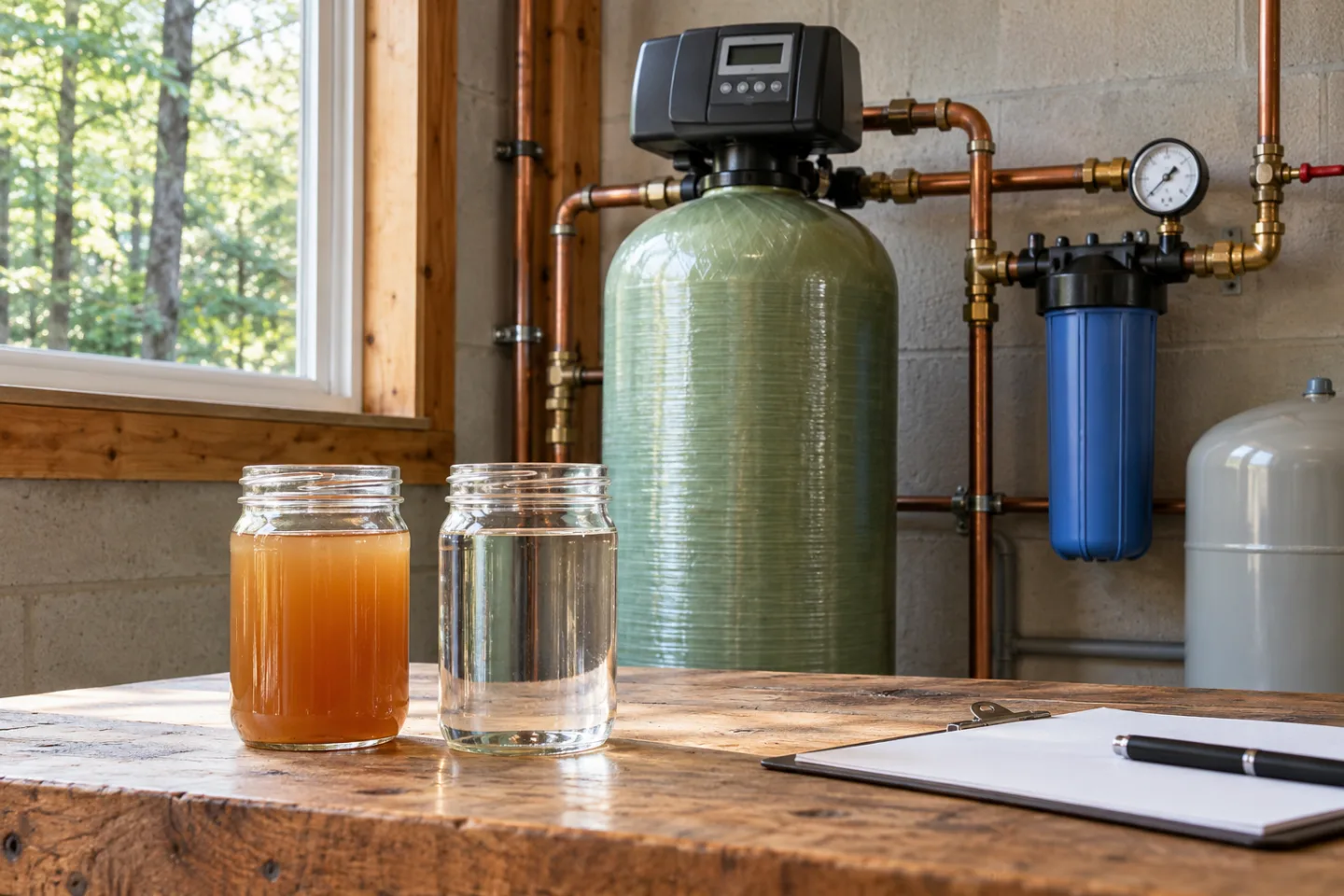
Our recommendation
The Crystal Quest tank is better than cartridges when laboratory turbidity and sediment loading would exhaust large cartridges too often, and the well can support automatic backwash. Cartridge filtration remains simpler for light or intermittent sediment, especially where there is no suitable drain.
| If this sounds like you | Best next move | What decides it |
|---|---|---|
| Heavy recurring sediment load | Crystal Quest candidate | Backwashing can release captured solids without frequent housing changes. |
| Light or seasonal sediment | Large cartridge system | Lower complexity may outweigh replacement labor. |
| No adequate backwash flow or drain | Cartridge route | The tank cannot operate correctly without both. |
| Unknown cloudiness | Test first | Turbidity has multiple causes. |
In this guide
- Crystal Quest Turbidity Filter: our verdict
- How the self-cleaning tank differs
- Measure the problem
- 1.5 versus 2.0 cubic feet
- Compare five-year work, not just price
- What the installation needs
- Who should choose the tank?
- Who should stay with cartridges?
- Should you choose Crystal Quest Turbidity Filter?
- Frequently asked questions
- Sources & editorial notes
Crystal Quest Turbidity Filter: our verdict
Crystal Quest’s turbidity system is a sensible step up when 20-inch cartridges clog quickly, water pressure drops and replacements become a repeated chore. Its mineral tank holds sediment throughout the bed, then flushes that sediment to a drain during an automatic cleaning cycle. Crystal Quest describes removal generally in the 5–20 micron range.
It is more equipment than a mild problem needs. Measure turbidity and identify where the sediment comes from before comparing products. We have not installed or tested this system.
How the self-cleaning tank differs
A cartridge stores sediment until you replace it. The Crystal Quest tank captures suspended material throughout its treatment bed, then flushes that material to a drain. You may change cartridges less often, but the tank uses water and still needs a working drain and control valve.
The wider package still includes sediment and carbon cartridges. Ask which part is expected to catch most of the sediment and how often each cartridge may need replacement.
Measure the problem
Ask a laboratory or qualified professional for turbidity, sediment characterization and other well parameters. Cloudiness can involve clay, silt, iron, biological material or air; not every cause is solved by a mineral tank.
Investigate changes after storms or well work and correct well-construction or drainage problems where applicable rather than using treatment to hide them.
1.5 versus 2.0 cubic feet
Crystal Quest offers both sizes. Confirm normal household flow, pressure loss and the water flow needed when the selected tank cleans itself. Match the size to the fixtures your household may use at the same time.
The larger tank can hold more sediment and support higher flow, but it also needs the well pump and drain to handle its cleaning cycle. Do not choose from bathroom count alone.
Compare five-year work, not just price
For cartridges, estimate the real replacement interval, cartridge price, shipping, pressure loss and labor. For the tank, include installation, backwash water, electricity, valve service, pre/post cartridges and eventual media replacement.
A backwashing tank wins when avoided cartridge changes and stable flow offset the higher installed cost. Keep actual dates and pressure readings to check the assumption.
What the installation needs
Confirm floor space, a bypass valve, power, a suitable drain, freeze protection and a safe place for wastewater. Have the well pump and pressure tank checked to make sure they can supply the tank’s cleaning cycle.
Crystal Quest offers fiberglass and stainless tanks. Its warning about humidity and condensation may make fiberglass the more practical choice in a damp equipment room.
Who should choose the tank?
Choose it for measured, recurring turbidity or sediment that clogs cartridges too quickly, when the home can supply the required flow and drain water safely. A professional should start it up and check the settings.
Request turbidity measurements before and after installation and put the acceptable treated-water result in the quote.
Who should stay with cartridges?
Stay with cartridges when loading is light, service is easy, pressure remains stable and a drain is impractical. A staged spin-down or large sediment housing may be the more transparent solution for coarse material.
Do not choose a smaller micron rating blindly; finer cartridges can create faster pressure loss. Match the filter to particle size and load.
Should you choose Crystal Quest Turbidity Filter?
Use maintenance frequency as evidence. If cartridges fail early under a confirmed sediment load, price the Crystal Quest tank. If cartridges last predictably, keep the simpler system.
The best comparison uses measured turbidity, peak flow, backwash capacity and a five-year ownership model—not “low maintenance” language.
Water terms used in this guide
- Backwash
- A cleaning cycle that sends water backward through a treatment tank and then to a drain.
Frequently asked questions
Is the Crystal Quest Turbidity Filter worth considering?
The Crystal Quest tank is better than cartridges when laboratory turbidity and sediment loading would exhaust large cartridges too often, and the well can support automatic backwash. Cartridge filtration remains simpler for light or intermittent sediment, especially where there is no suitable drain.
Who is the Crystal Quest Turbidity Filter best for?
Heavy recurring sediment load. Crystal Quest candidate. Backwashing can release captured solids without frequent housing changes.
What should I check before buying the Crystal Quest Turbidity Filter?
Measure turbidity and current cartridge life, then compare five-year labor and backwash requirements.
Put this guide to work
Compare two quotes on the same scope
Use the matching tool, save the result to My Home Water Plan and return when a quote, test result or service date changes.
Open the tool →Open My Water Plan →Get the editable pack →How we checked this guide
We prepared this review using current official product and data-sheet descriptions. We did not install or test treated water.
- Crystal Quest: Turbidity Whole House Water Filter
- CDC: About home water treatment systems
Product details can change. Confirm the exact model and current terms before ordering. How we write and update guides.