 tap
tap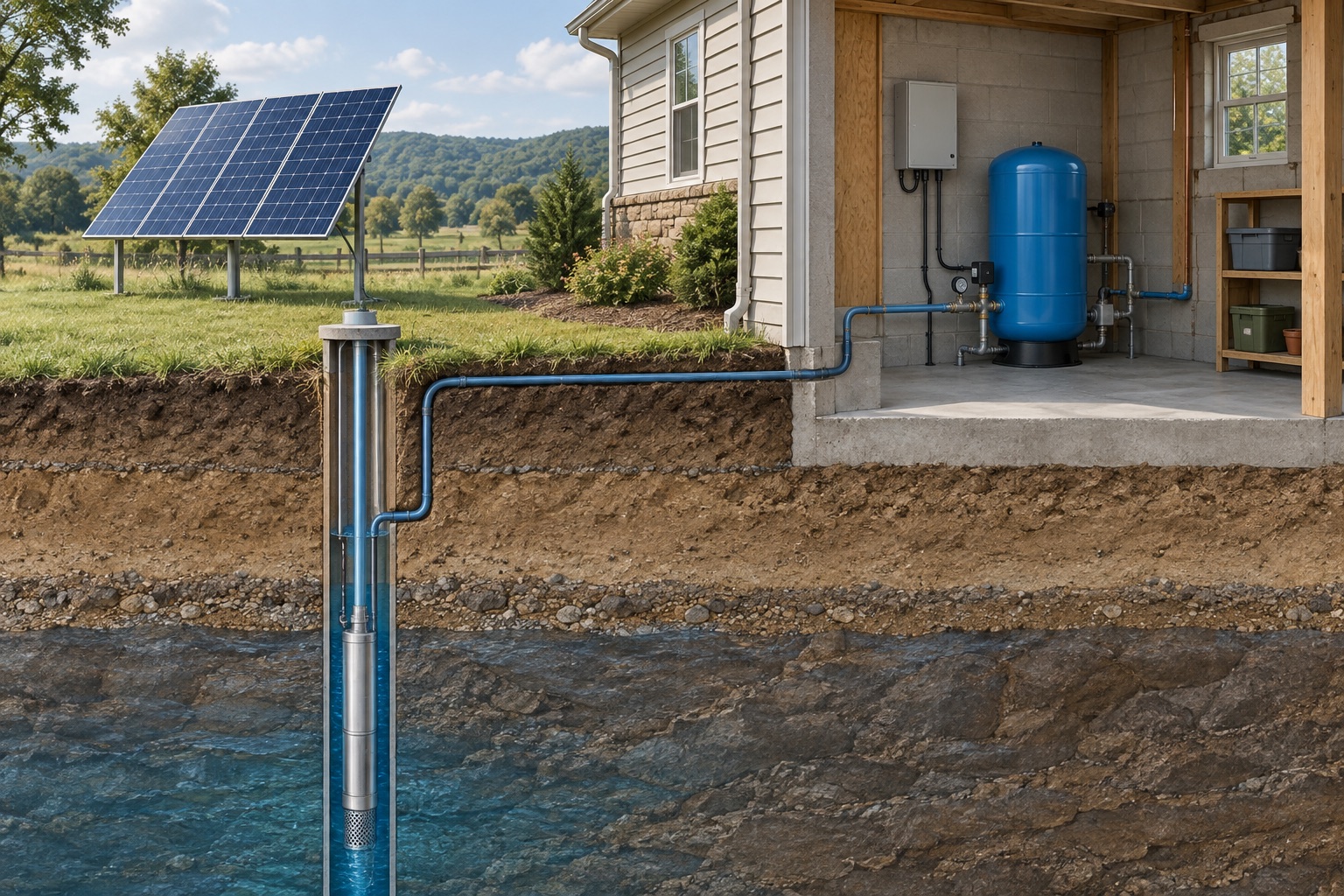
Our recommendation
Size a solar well-pump system from daily water demand, sustainable well yield, pumping water level, total dynamic head, required flow, storage strategy and site-specific solar conditions. Well depth alone does not select a pump. Do not buy a kit until its pump curve shows the required flow at your calculated head and the supplier confirms the array, controller, wire and storage design.
| If this sounds like you | Best next move | What decides it |
|---|---|---|
| You have well and drawdown records | Build a pump-curve shortlist | Use pumping level and total dynamic head. |
| You know only drilled depth | Gather more measurements | Drilled depth is not the pumping head. |
| The well has low sustainable yield | Plan storage and controls | A larger pump does not create more groundwater. |
In this guide
- Start with the water job
- Collect the well record
- Calculate total dynamic head
- Read the pump curve
- Size storage before oversizing the pump
- Match the solar array and controller
- Plan dry-run and overflow protection
- The quote checklist
- Who should consider solar pumping?
- Who should pause?
- Solar Well Pump Sizing: the bottom line
- Sources & editorial notes
Start with the water job
List daily gallons by household, livestock, irrigation or other uses, then identify the highest seasonal day. Separate daily volume from peak flow. A system can move enough gallons over a sunny day yet still fail a short high-flow demand without appropriate storage and pressure equipment.
Decide whether the solar pump fills a nonpressurized storage tank, feeds a pressure system directly, or works with batteries or grid backup. Those are different system architectures.
Collect the well record
Ask for total drilled depth, casing diameter, static water level, pumping water level during a documented flow test, sustainable yield and pump setting depth. The pumping level—not just static level—matters when the pump is operating.
If the well is low yielding, increasing pump horsepower may make the problem worse. Penn State explains that intermediate storage can allow a low but steady well yield to accumulate water for household peaks.
Calculate total dynamic head
The supplier should include vertical lift from the pumping water level to the discharge point, desired outlet pressure converted to feet of head, and friction losses through pipe, fittings, filters and valves. Elevation to a storage tank or livestock trough also matters.
Do not use a single generic online depth number as the final design. Ask the supplier to show each input and the resulting total dynamic head so the pump curve can be checked independently.
Read the pump curve
A pump curve shows flow at different head. Locate the required head and confirm the pump can deliver the planned flow there, with an appropriate operating range. A headline maximum flow is usually measured at a lower head and should not be used by itself.
Ask for the exact current model curve, voltage, controller and maximum input limits. Confirm whether the supplier’s proposed operating point changes during seasonal water-level drawdown.
Size storage before oversizing the pump
A storage tank can separate slow solar pumping from short household demand. It can also help a low-yield well when controls prevent pumping below a safe level. The downstream pressure pump and pressure tank then serve the house.
Storage adds sanitation, overflow, freeze, foundation, level-control and secondary-pump requirements. Have the complete system designed, not just the submersible pump.
Match the solar array and controller
Use the supplier’s current design method for location, season, shading, pump duty and controller. Confirm module wattage, string voltage, mounting, disconnects, surge protection, grounding, wire gauge and distance.
A system sized for average annual sun may disappoint during the season when water is needed most. Ask for the design-day assumption and expected daily gallons in the weakest relevant solar month.
Plan dry-run and overflow protection
The design should address a falling well level, empty storage, full storage, sensor failure and controller faults. Ask what stops the pump, how it restarts and which alarms remain visible.
Do not bypass low-water protection to chase more flow. Protecting the pump and well is part of system value.
The quote checklist
Require the same fields from each supplier so kits can be compared on output at your site rather than panel count.
- Daily and peak water demand
- Static and pumping water level
- Sustainable well yield and pump setting
- Total dynamic head calculation
- Exact pump curve and operating point
- Solar array, controller and wire specification
- Storage and pressure-system design
- Dry-run, overflow, freeze and surge protection
- Installation, commissioning and measured-output test
- Warranty, spare parts and remote support
Who should consider solar pumping?
Solar pumping can suit remote wells, stock watering, irrigation storage and properties where grid extension is costly. It is strongest when demand can be shifted into a storage tank during available sun.
For a primary residence, compare resilience, service access and backup arrangements with grid power plus generator or battery.
Who should pause?
Pause when the well has no current yield data, when the supplier will not provide a pump curve, or when the proposal promises output from drilled depth alone. Also pause when household pressure and storage have not been included.
A product review of one pump is premature without the exact model and curve. Tap & Terrain will not rank Flowatt or another solar kit until those documents can be matched to a real use case.
Solar Well Pump Sizing: the bottom line
A solar well-pump purchase is an engineering match among water, head, storage and sunlight. A complete, transparent worksheet is more valuable than a bigger panel bundle or maximum-flow claim.
Put this guide to work
Keep your equipment and service dates together
Use the free tool, then download a record you can keep. No email required.
Open the tool →Get the editable pack →Sources & editorial notes
Independent sizing framework based on well-system and public-health guidance. It is not a pump selection or installation design.
- Penn State Extension: low-yield wells and intermediate storage
- EPA: protect and test private wells
- EPA manual: individual water supplies and pumping systems
Product details can change. Confirm the exact model and current terms before ordering. How we write and update guides.