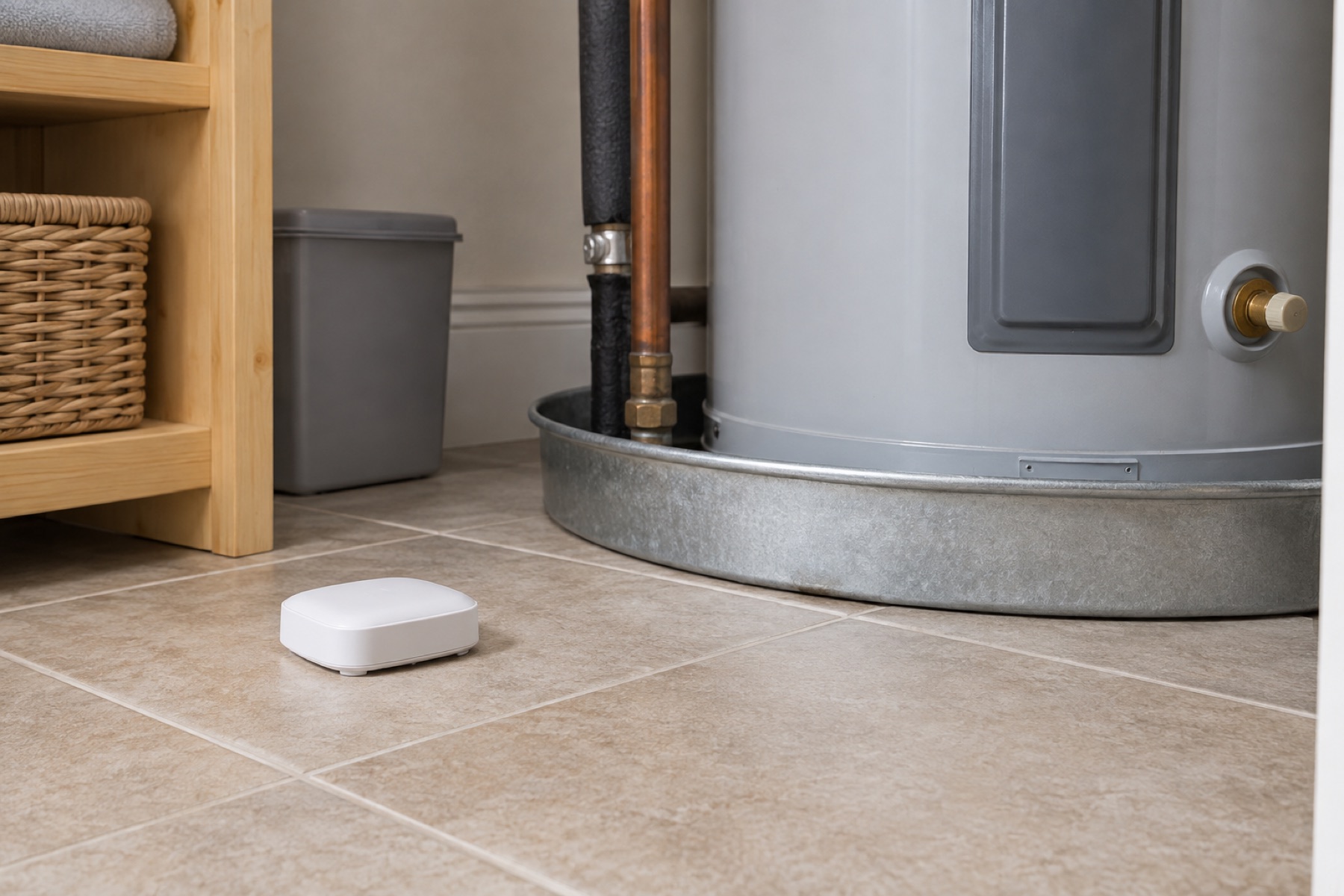
The short answer
Use point leak sensors for named places where escaping water is likely to reach a probe. Consider a smart whole-home monitor when you want flow-based insight across the supply and accept main-line or meter-side requirements. Many homes benefit from both, because each covers blind spots the other keeps.
| Your situation | A sensible next step | Keep in mind |
|---|---|---|
| Known appliance and fixture risks | Start with point sensors | Coverage ends where water cannot reach a probe. |
| Hidden or whole-home usage concern | Assess a smart water monitor | Confirm installation and what patterns it can identify. |
| Often-empty home with slow response | Assess monitor plus shutoff and point sensors | Plan outages and a local responder. |
In this guide
These products observe different signals
A point sensor reacts when water touches its probes or sensing cable. A whole-home monitor observes flow or pressure patterns at a central part of the water supply. One is location-specific; the other infers activity from the system it monitors.
That difference explains the blind spots. Water can leak without reaching a floor probe. A small or unusual flow can be difficult for an algorithm to classify, and some water sources may sit outside the monitored line. Do not ask one product category to guarantee every leak.
Choose point sensors for visible risk locations
Sensors are the lower-friction start for water heaters, washing machines, sinks, toilets, sump areas and other named locations. They can be placed without cutting the main line, although exact placement and accessories still matter.
They work best when you map likely water paths, use enough sensors and have an alarm path people will notice. A sensor behind a finished wall cannot detect hidden moisture unless water eventually reaches it.
Choose a monitor for system-wide patterns
A smart monitor can help identify unusual whole-home water use and, in some models, control an automatic shutoff valve. It may provide usage information that individual floor sensors cannot. The purchase often costs more and may require professional plumbing, power and reliable connectivity.
Confirm which supply branches are included, which fixtures or irrigation may confuse learning, and whether the model only alerts or can close water. “Whole home” applies to the monitored plumbing, not rain, groundwater, roof leaks or every detached line.
Build a room-by-room coverage plan
List every concern and mark whether a point sensor, flow monitor, automatic valve or building repair addresses it. This prevents buying overlapping gadgets while leaving the main risk uncovered.
For each alert, name the responder and the action they are authorized to take. Keep emergency contacts and safe shutoff instructions from a professional. The device is one layer in that plan.
| Risk | Useful first layer | Remaining gap |
|---|---|---|
| Water-heater pan | Point probe or cable sensor | Hidden supply leak before water reaches pan |
| Washing-machine hose | Point sensor nearby | Leak path may miss the probe |
| Pipe leak in wall | Whole-home pattern monitoring | Small/slow flow may be hard to classify |
| Rain entering basement | Building/drainage assessment | Domestic-water devices do not stop rain |
| Home vacant for weeks | Remote alerts plus response/shutoff plan | Power, internet and human-response failures |
Compare ownership and false-alarm consequences
Point sensors require batteries, location checks and occasional supported testing. A monitor can require installation, learning time, network support, valve exercise and a plan for unexpected closure. Price the full system and the household effort.
Ask what information the app stores and who can access it. Review notification sharing before adding caretakers. For an automatic valve, identify water-dependent equipment and what happens if water closes while nobody is present.
Our recommended sequence
Start with inexpensive point sensors at the highest-consequence visible locations while documenting their blind spots. Add whole-home monitoring when hidden flow, usage insight or automatic action solves a real remaining problem and the property supports it.
For an often-empty or high-value property, have an installer assess a layered design rather than choosing one category from a headline. The best protection is understandable, maintainable and paired with someone who can respond.
Put this guide to work
Make a leak-protection purchasing brief
Use the free tool, then download a record you can keep. No email required.
Open the tool →Get the editable pack →Sources & editorial notes
This category comparison is based on product architecture and documented limitations, not controlled leak simulations.
- Moen: Smart Water Security product information
- Phyn: Smart water product information
- YoLink: Water leak sensor information
Product details can change. Confirm the exact model and current terms before ordering. How we write and update guides.